After DarkSoloWest

Five days · Death Valley National Park

Five days under Death Valley's dark skies — winter 2026–27

Salt flats, sand dunes, sailing stones, and a desert waterfall — five days in a Gold-Tier Dark Sky Park, timed to the new moon and built for one person traveling alone.

National Parks & Wild Places

5 days / 4 nights New moon · Nov–Mar Solo pace, sky-first Estimate: $1,000–$1,900
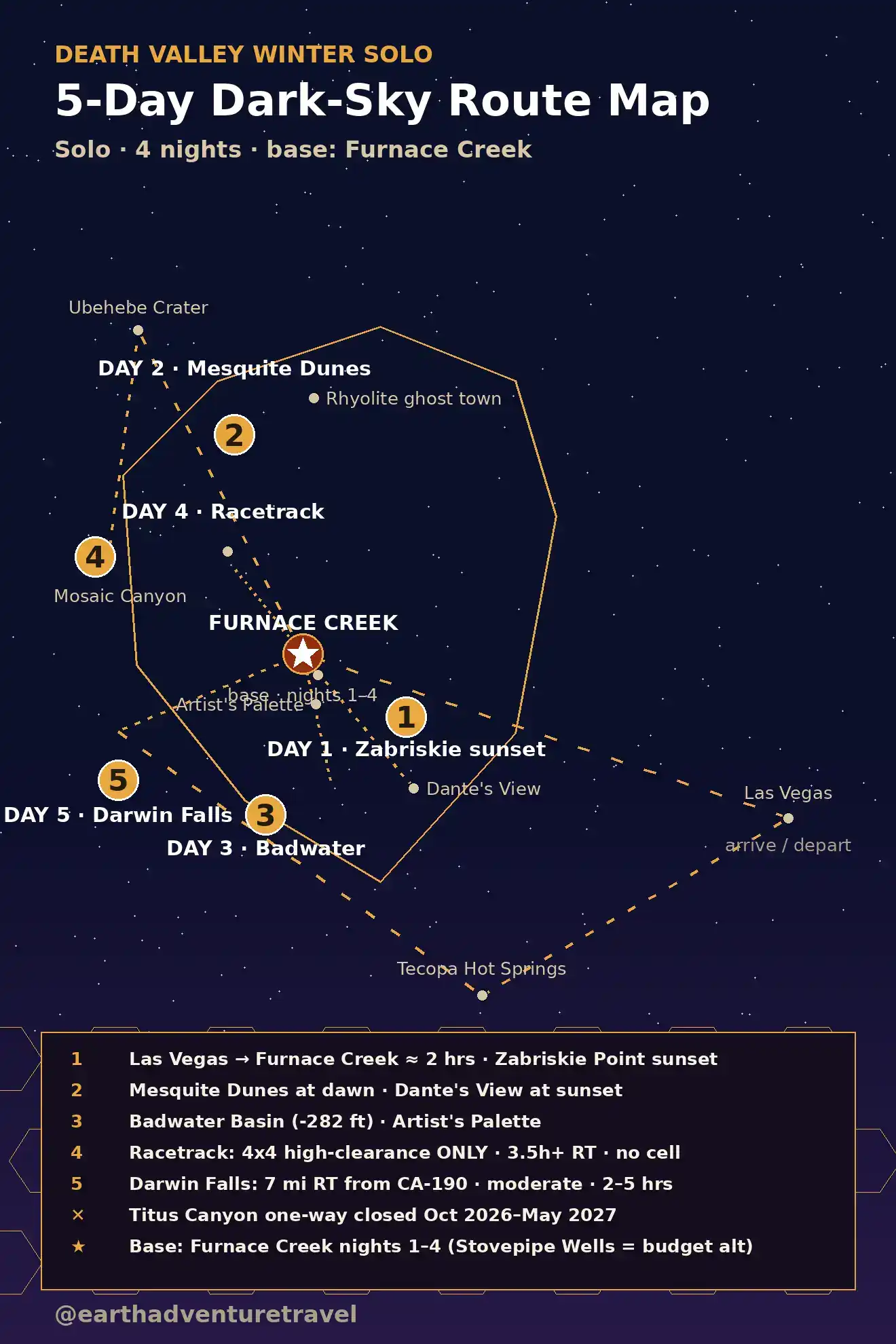
Cover graphic for a five-day Death Valley winter dark-sky solo itinerary
Original itinerary artwork · 1 of 10
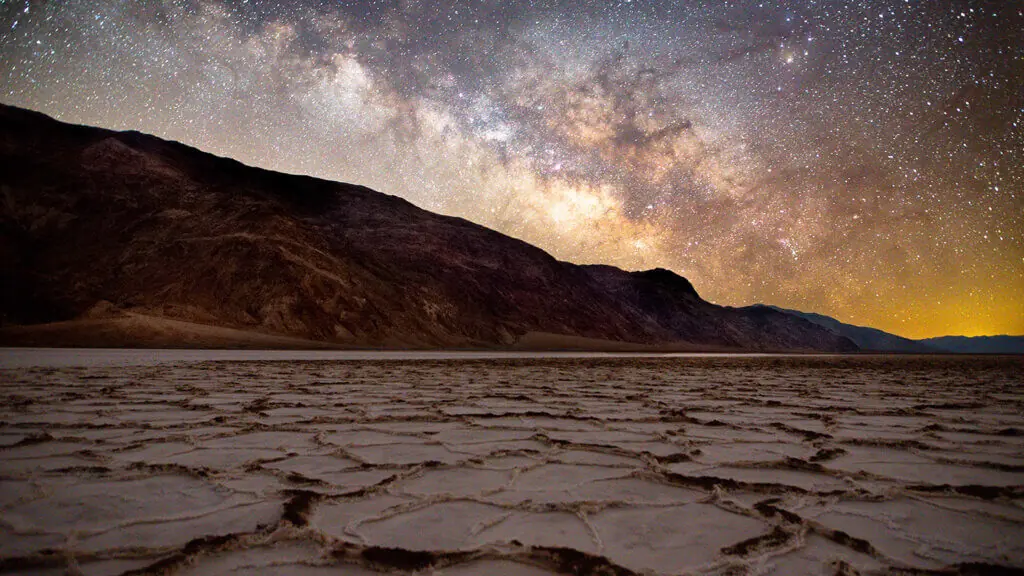
Milky Way arching over the salt polygons of Badwater Basin at night
Milky Way over Badwater Basin's salt polygons · Death Valley National ParkPhoto: NPS / Patrick Taylor (public domain) — credit in Official trip checks.

The trip in 60 seconds

Rough budget · solo traveler

The range below is a planning estimate, not a quote. Lodging is the biggest variable — book 2–3 months ahead for winter. The park fee is the official 2026 price.

$1,000–$1,900
4 nights · lodging, park fee, food, gas · flights and rental car excluded
Lodging
$620–$1,200 · 4 nights, Stovepipe Wells (~$155/nt) to The Ranch (~$210/nt)
Park pass
$30 · vehicle, 7 days, card only
Food
$250–$450 · ranch dining, general store, Tecopa burgers
Gas
$120–$200 · long desert drives
Buffer
red headlamp, souvenirs, a 4x4 rental day for the Racetrack
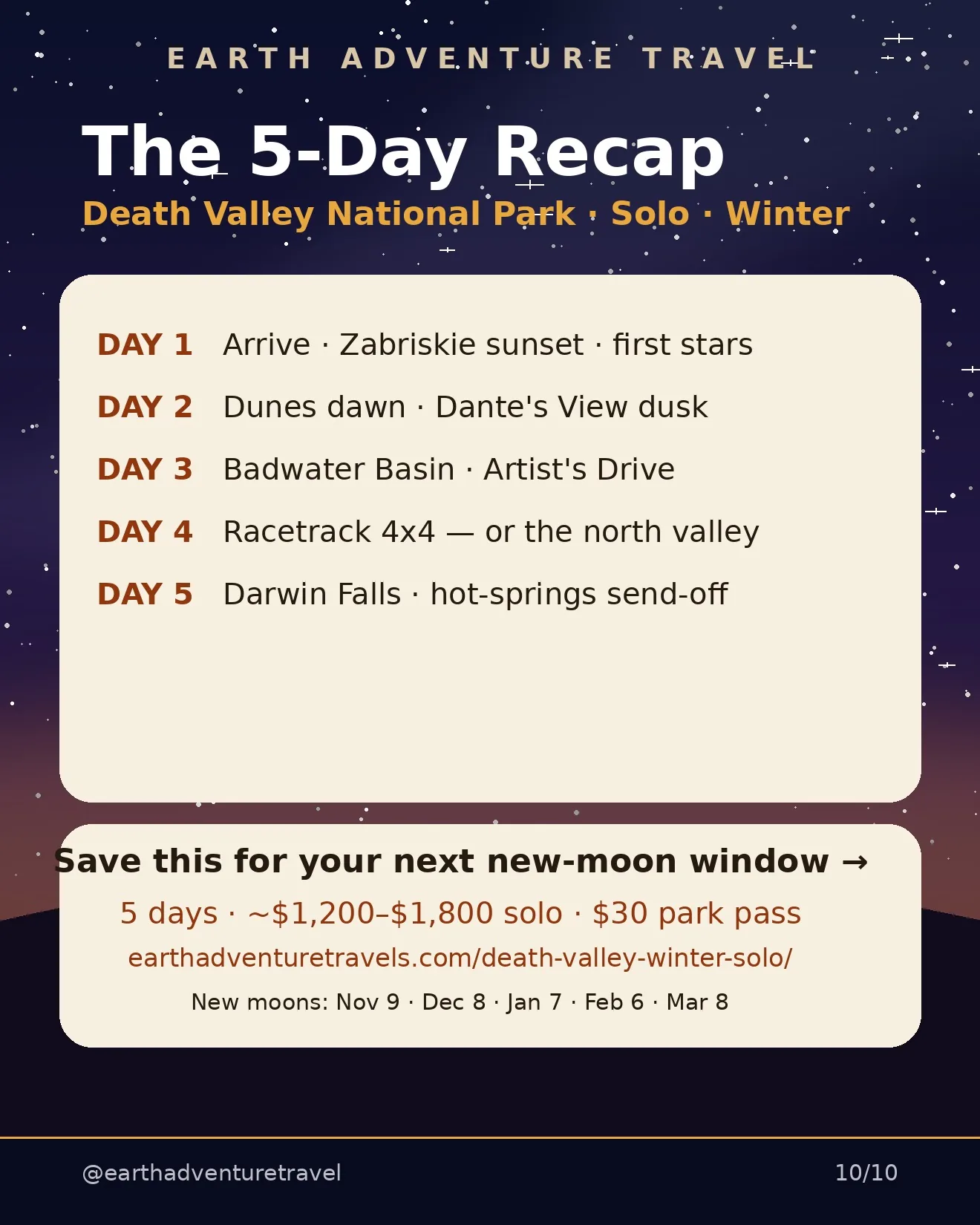
Five-day recap graphic for the Death Valley winter dark-sky solo route
Saveable route recap · five days under Death Valley's dark skies

Day-by-day summary

The idea

A calendar written in moonlight.

Death Valley has been an International Dark Sky Park since 2013 — Gold Tier, Bortle 1–2, some of the darkest skies you can reach by car. In winter the park trades its furnace for 65–73°F days and long, cold, crystalline nights. This trip is built around that single fact, and around the moon: every night's plan assumes a new-moon sky, because a full moon washes out the very thing you came for.

Traveling solo here isn't a compromise; it's the point. No one talks through the meteors. You set your own hours — sleep until ten after a 2 a.m. sky session, linger at Dante's View as long as the light holds, eat dinner when you're hungry. The silence does the rest.

There's no cell service in most of the park, so this trip demands more planning than most: download offline maps in Las Vegas, tell someone your daily plan, and carry twice the water you think you need. Book the Ranch 2–3 months out for winter — it's the social and logistical heart of the park, and solo travelers pay the base rate with no single-supplement penalty.

2026 guide

Last verified: October 2026

5desert days
1solo traveler
−282ft · lowest point in North America
1–2Bortle · Gold-Tier skies

The route

Five days, one base, zero wasted light.

Build each day around the boldface activity. Everything else is optional. Days are short in winter — that's the point: you're here for what happens after dark.

“In Death Valley, you don't plan around the weather — you plan around the moon.”

The people behind the plans

Who is Earth Adventure Travel?

We build routes for real life — wrangling kids, spanning generations, or heading out solo — and check every detail against official sources so the plan holds up when you get there.

Learn About Us

Before you go

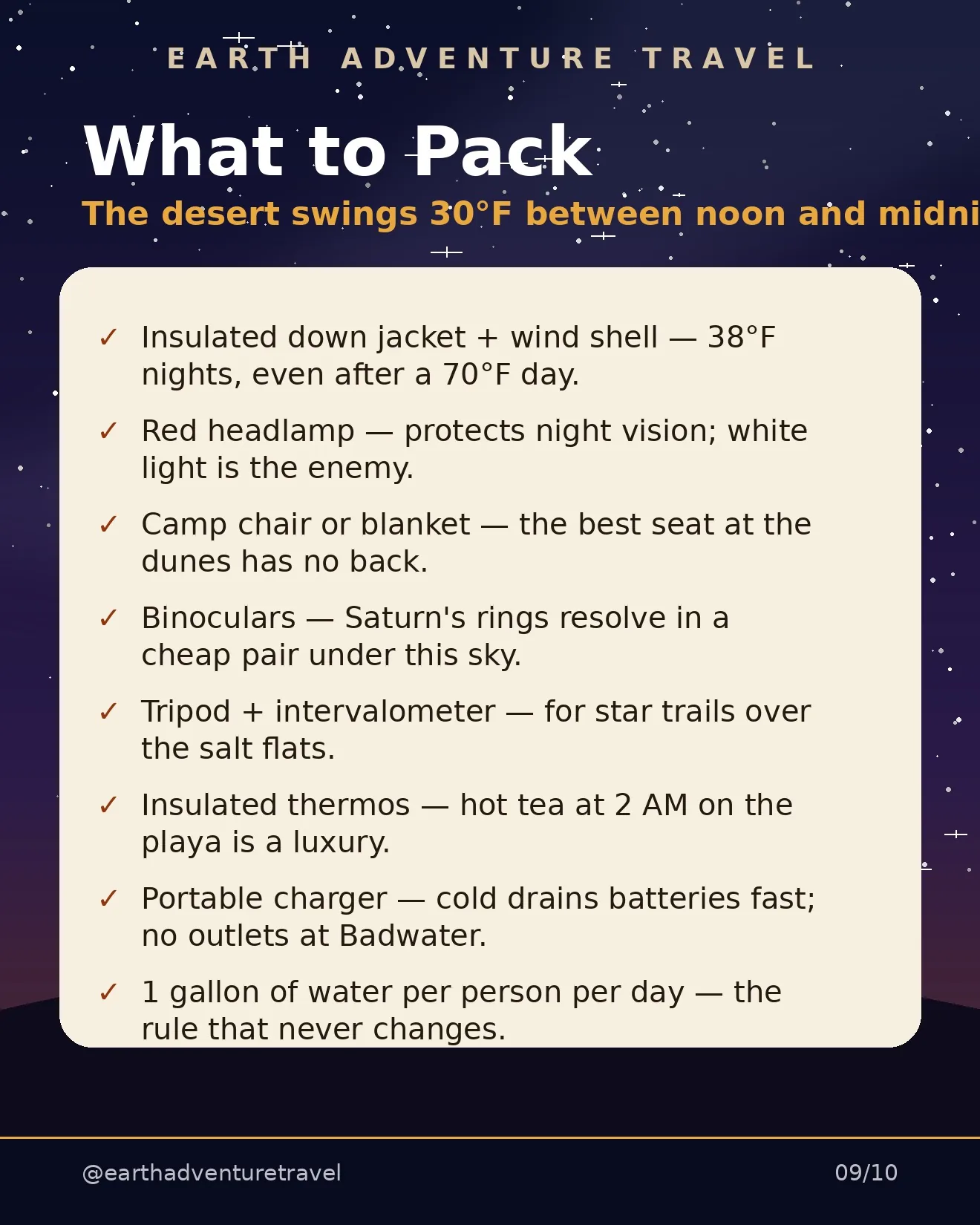
Pack for 40°F swings. Download maps before you go.

What earns space

  • Red headlamp — white light, even from a phone, resets night vision 20 minutes
  • Down jacket + warm hat + gloves — Dante's View runs 25–30°F colder than the valley floor, and you stand still for hours
  • A gallon of water per day — there is no water on the trails or at most overlooks
  • Downloaded offline maps — cell service is nearly nonexistent inside the park
  • Camp chair or blanket — for long sky sessions at signed overlooks
  • Binoculars (10×50 ideal) — Andromeda, the Pleiades, and star clusters reward them
  • Mini tripod — a $15 one turns your phone into a night-sky camera
  • Swimsuit + quick-dry towel — for the Ranch pools and Tecopa Hot Springs
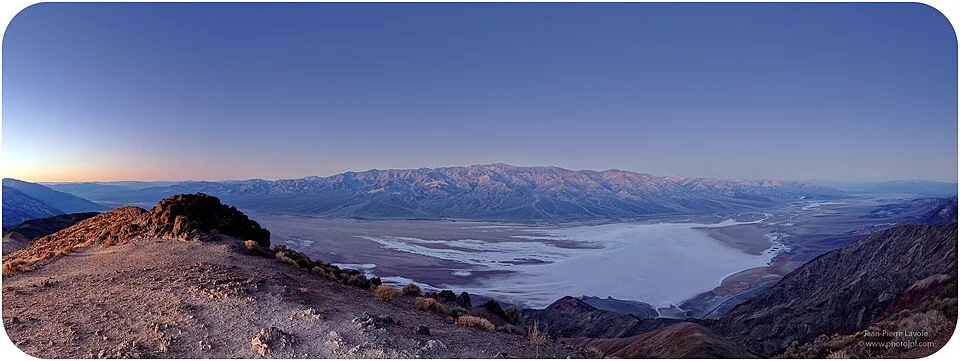
Dante's View panorama over Death Valley, 5,475 feet above the valley floor
Dante's View sits 5,475 feet above Badwater — about 30°F colder. That's why the down jacket earns space.
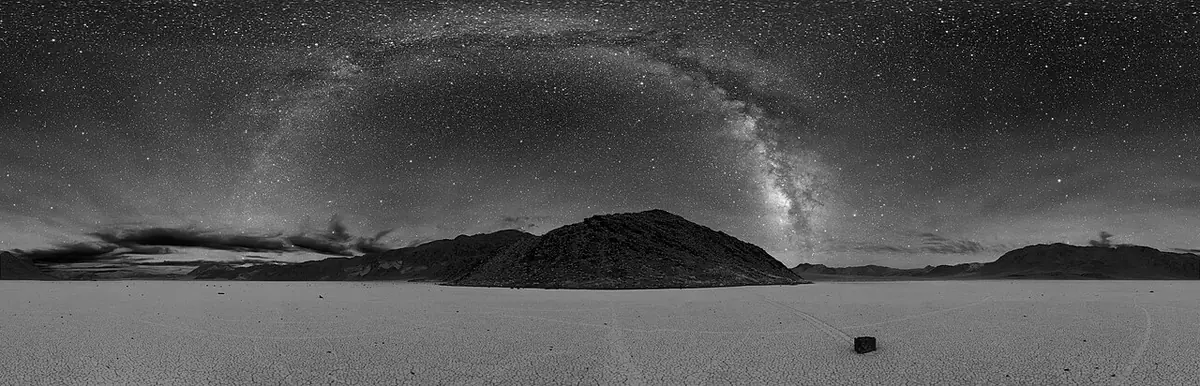
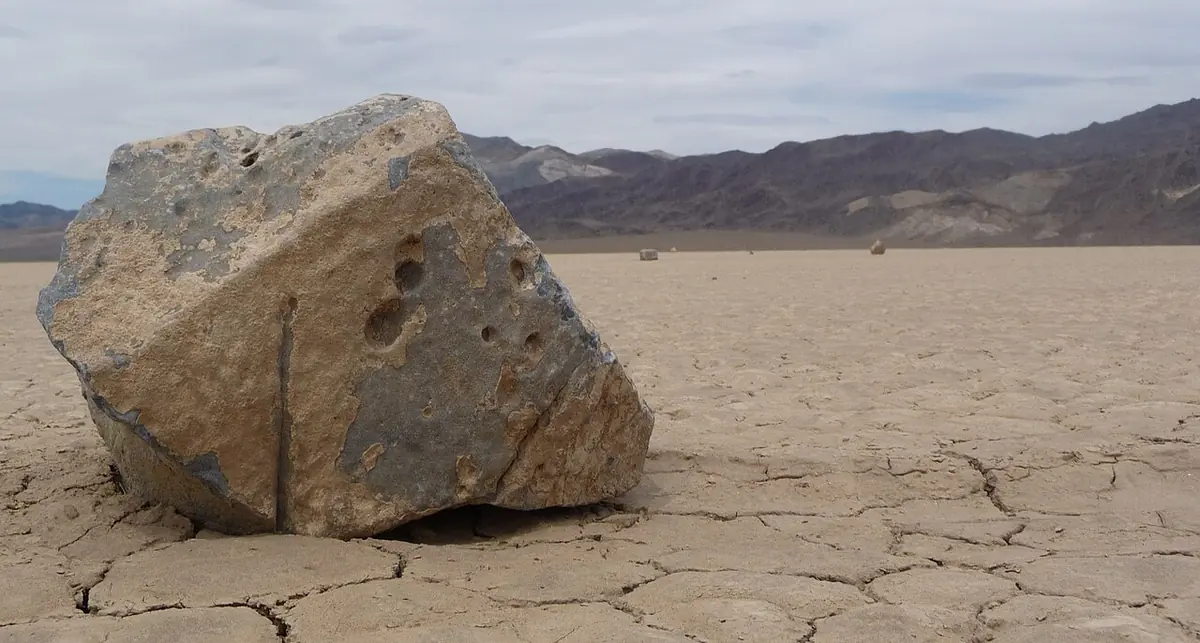
A sailing stone resting on the cracked mud of the Racetrack Playa
A sailing stone on the Racetrack Playa — winter ice and wind moved it here, and no one has ever watched one go.Photo credit in Official trip checks.

Quick answers

Planning notes

Is Death Valley safe for a solo traveler?

Yes — with desert-specific preparation: tell someone your daily plan, download offline maps in Las Vegas, carry a gallon of water per day, and keep the tank full. Tell the Ranch front desk where you're headed each day. The desert itself — dehydration, getting lost — is the real risk, and it's manageable with planning.

I'm nervous about stargazing alone at night. What's the safest way to do it solo?

Park at signed overlooks — Zabriskie Point, Dante's View, Badwater — not dark pullouts, and tell the front desk your plan. Keep your car nearby. For the group option, join a ranger night-sky program: as the park service puts it, ranger programs are a great way to learn about the night sky in a group setting.

Where should a solo traveler stay — The Ranch, The Inn, or Stovepipe Wells?

The Ranch at Death Valley (~$210/night) wins for solo travelers: it's the park's social heart with restaurants, pools, a store, and rangers nearby — and there's no single-supplement penalty. The Inn (~$395/night) is the 1927 landmark for a splurge night. Stovepipe Wells (~$155–250/night) is the budget alternative, 25 minutes west. Book 2–3 months ahead for winter.

Do I need a high-clearance 4x4, or will a regular rental car work?

A regular rental car handles 90% of this itinerary — every paved viewpoint, the dunes, Badwater, Dante's View. Only the Racetrack demands a high-clearance 4x4 with good tires: 27 miles of rough dirt, 3.5+ hours round trip, no cell service. Rent a 4x4 in Las Vegas for Day 4, or take the sedan-friendly Option B: Ubehebe Crater, Mosaic Canyon, Rhyolite.

What are the new moon dates for winter 2026–27?

November 9, 2026; December 8, 2026; January 7, 2027; February 6, 2027; and March 8, 2027. Book the week containing the new moon. Bonus: February 6 lands on the Dark Sky Festival (Feb 5–7, 2027). Pair December with the Geminids (peak Dec 13–14) or January with the Quadrantids (peak Jan 3–4).

What will I actually see in a winter night sky?

Honest answer: the Milky Way core sleeps November through March. What you get instead: Orion at its best, Andromeda as a naked-eye smudge, the Pleiades, and the zodiacal light after dusk. Winter air is the steadiest and clearest of the year — many astrophotographers prefer it.

How cold does it get in Death Valley in winter?

Days run 65–73°F (December–February) — genuinely pleasant hiking weather. Nights drop to 38–46°F at Furnace Creek, and Dante's View at 5,475 feet runs about 25–30°F colder than the valley floor. Pack a real down jacket, warm hat, and gloves for night-sky sessions; you'll stand still for hours, which feels far colder than the thermometer says.

Is there cell service, gas, or food inside the park?

Almost no cell service anywhere in the park — download offline maps first. Gas at Furnace Creek and Stovepipe Wells (pricey; fill up in Pahrump). Food: the Ranch has restaurants and a general store, Stovepipe Wells has a saloon, Panamint Springs a small restaurant. Carry snacks and water on every drive.

Can I photograph the night sky with just my phone?

Yes. Use night mode, turn off the flash, prop the phone on something stable — a rock, your camp chair, a $15 mini tripod — and give it 10–30 seconds. You'll catch constellations and meteor streaks. A camera at 20 seconds, f/2.8, ISO 3200 does better, but the phone keeps you looking up.

What if it's cloudy on my new-moon nights?

Winter is Death Valley's clearest season, but clouds happen. Backup stack: ranger programs often run under cloud, the Borax Museum fills a cloudy afternoon, and Tecopa Hot Springs is better in cool overcast weather. The new-moon calendar gives you five windows — shifting by a month is easier here than in most parks.

The route continues

See the places behind the plans.

Follow Earth Adventure Travel for field notes, cinematic reels, and the next itinerary worth saving.

Follow @earthadventuretravel

Plan with confidence

Official trip checks

NPS · Death Valley National Park ↗Park homepage — alerts, conditions, and trip planning
NPS · Entrance fees ↗$30 per vehicle, 7 days — card only, no staffed entrance stations
NPS · Alerts & conditions ↗Road closures: Titus Canyon one-way closed Oct 2026–May 2027; Darwin Falls Road destroyed 2023
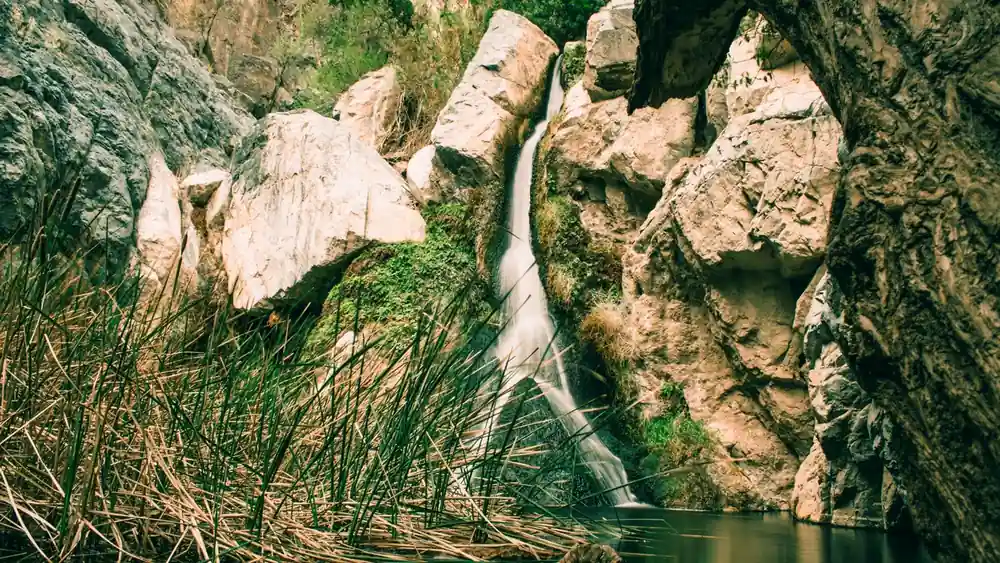
NPS · Darwin Falls ↗7 miles round trip, moderate, 2–5 hours — park on the CA-190 shoulder
NPS · The Racetrack ↗High-clearance 4x4 with good tires required; no cell service
NPS · Dark Sky Festival ↗February 5–7, 2027 — lands on the February 6 new moon
NPS · Weather ↗Winter daytime temperatures and elevation effects
Recreation.gov ↗Pay the entrance fee online before you arrive
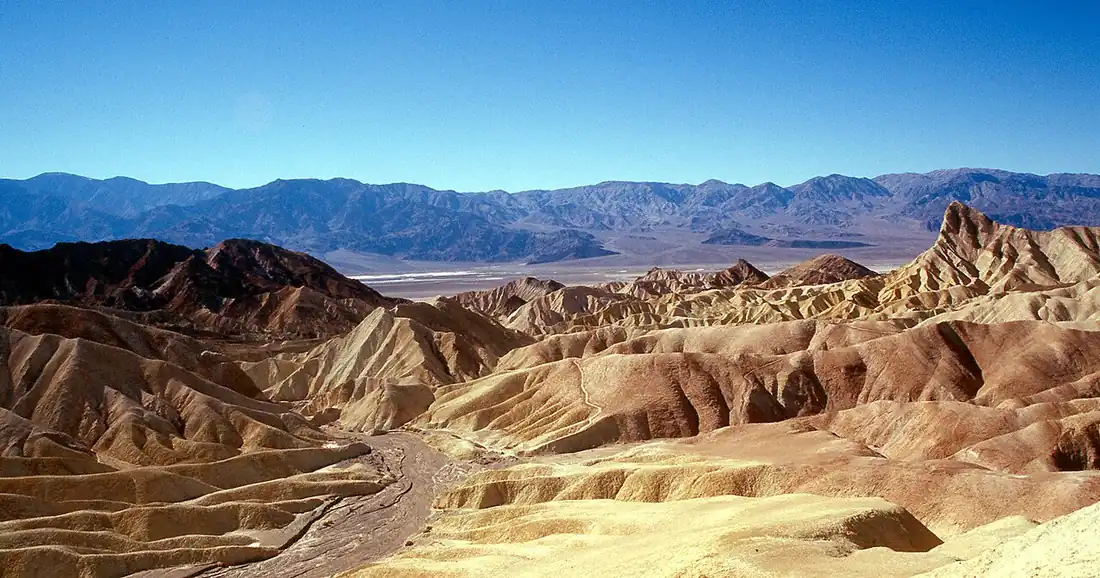
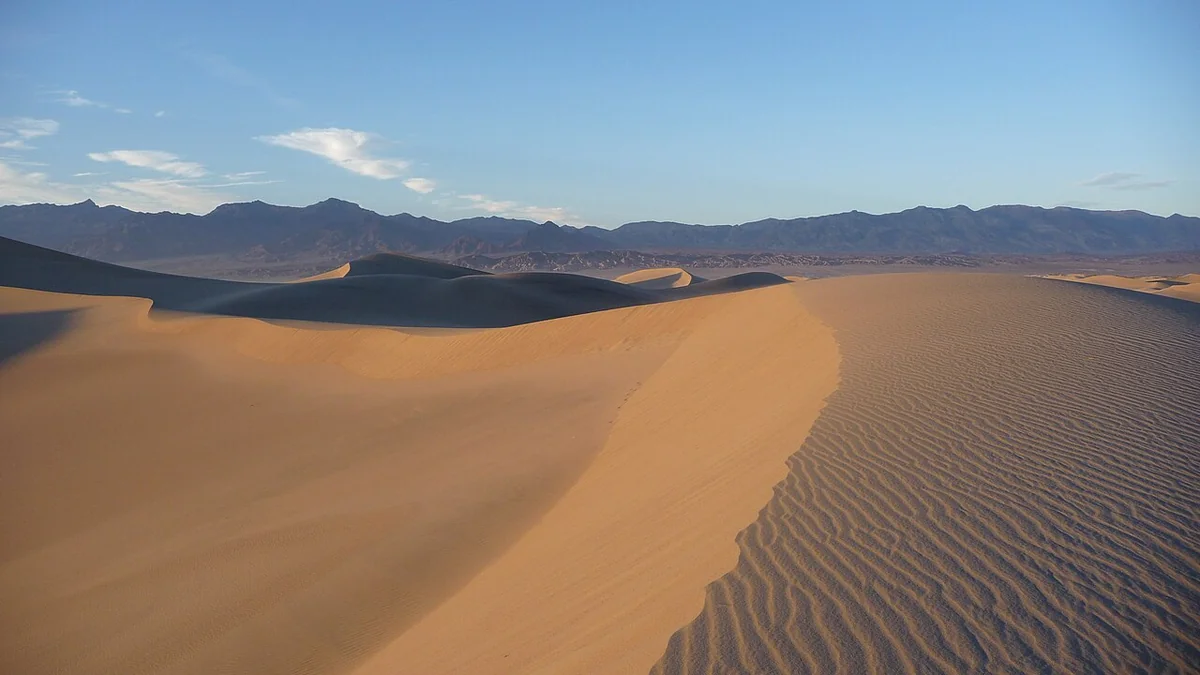
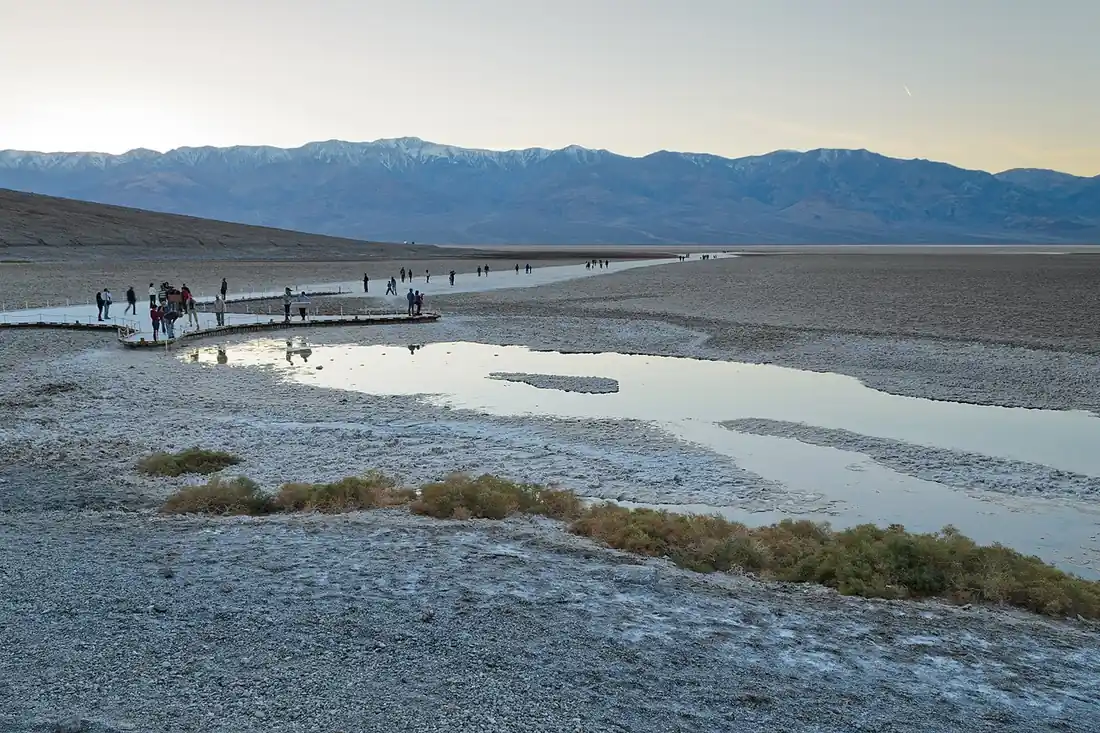
Photography (freely licensed, cropped/resized for web): Milky Way over Badwater Basin © NPS / Patrick Taylor (public domain); Zabriskie Point, Mesquite Flat Sand Dunes, Badwater Basin (December 2013), and Dante's View via Wikimedia Commons (CC BY-SA); Racetrack Playa night panorama © NPS / Dan Duriscoe (public domain); sailing stone closeup © Daniel Mayer (CC BY-SA 3.0); Darwin Falls © NPS / Jason Gray (public domain).
Details checked October 5, 2026. Conditions and prices can change — verify road closures on the NPS conditions page before you go.

The trip index

Choose the landscape. Then choose the pace.

Every itinerary gives you a realistic route, daily rhythm, planning notes, and the details that make a solo trip work.

Use the filters above to see matching itineraries.

No exact match—yet.

Clear a filter to see the closest routes already in the library.