InternationalSoloCities & Urban

Five days · Seoul, solo-tested pacing

5 Days Solo in Seoul: K-Culture, Food & Palaces

Last verified: October 2026How we verify

One traveler, five days, zero rental cars — palace mornings, neon nights, and the easiest solo dining culture on earth.

InternationalCities & Urban WeekendsFood & Drink Trails

5 days / 4 nightsBest Apr–May & Oct–NovSoloEstimate: $750–$1,600
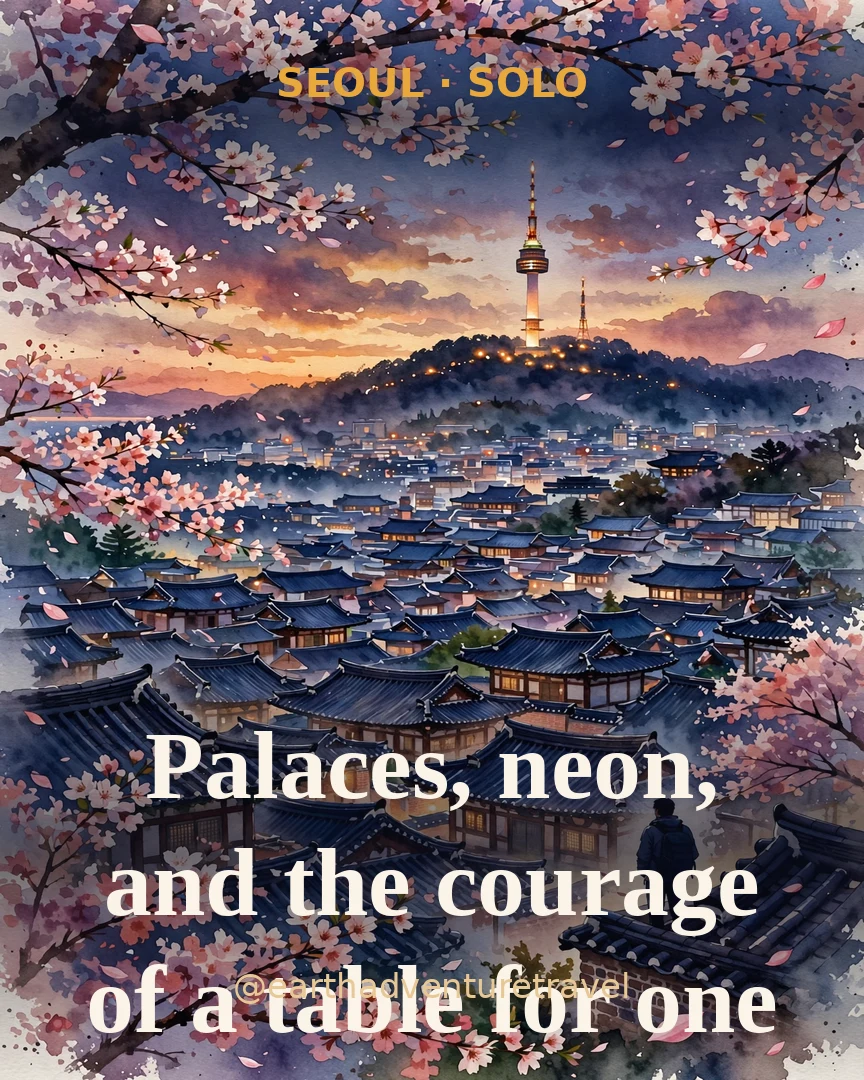
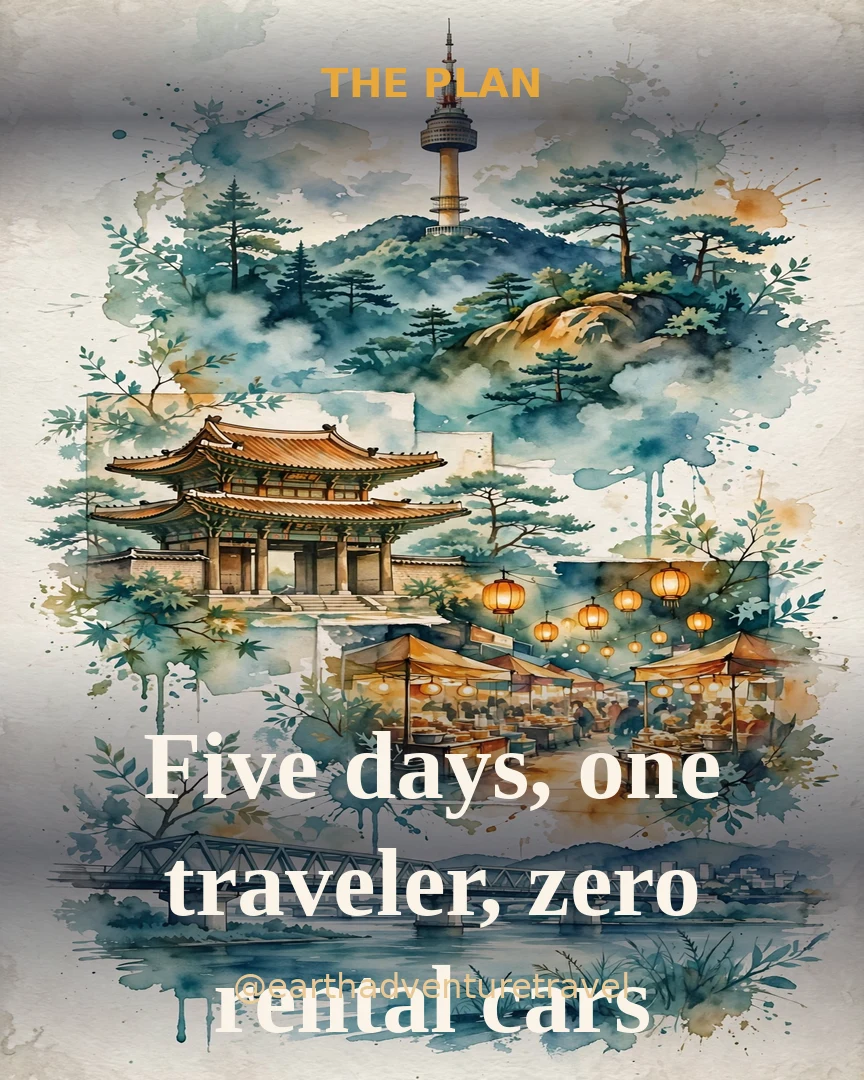
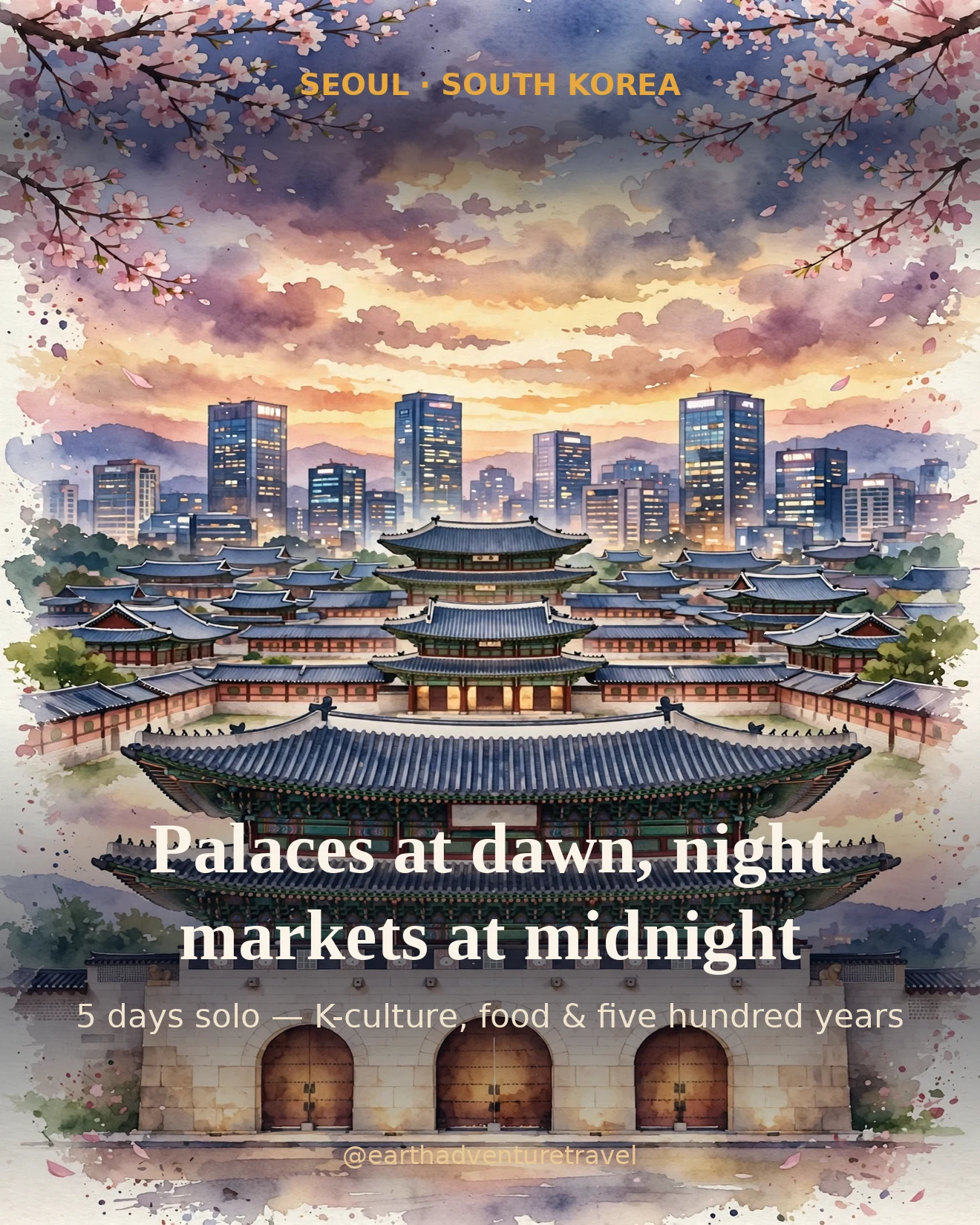
Seoul solo travel guide cover: Gyeongbokgung Palace with modern Seoul towers and cherry blossoms — a 5-day solo itinerary
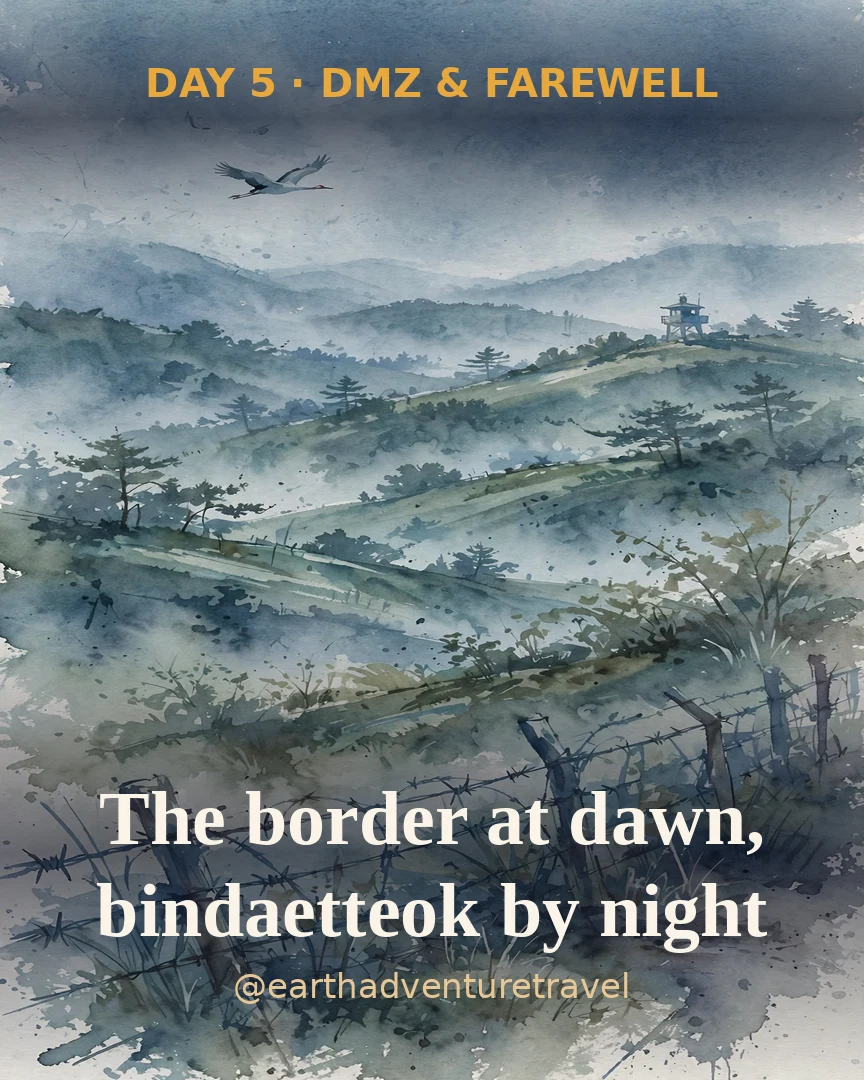
Original itinerary artwork
On this page
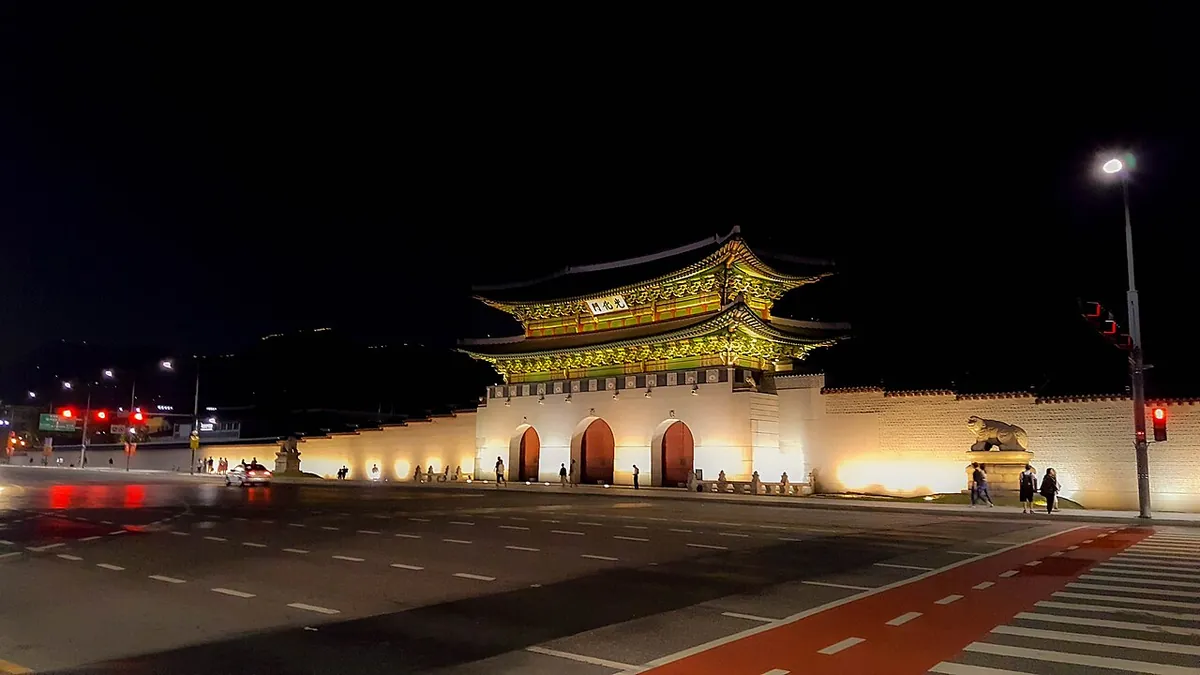
Gwanghwamun Gate of Gyeongbokgung Palace lit at night, Seoul
Gwanghwamun Gate at night — Seoul's front door, five centuries old. Photo: Smin630 / Wikimedia Commons (CC BY-SA 4.0)

The 60-second version

At a glance

Who it's for
Solo travelers — first-timers to Korea, including solo women; Seoul is one of the world's safest big cities for traveling alone, and eating alone is completely normal here
Route
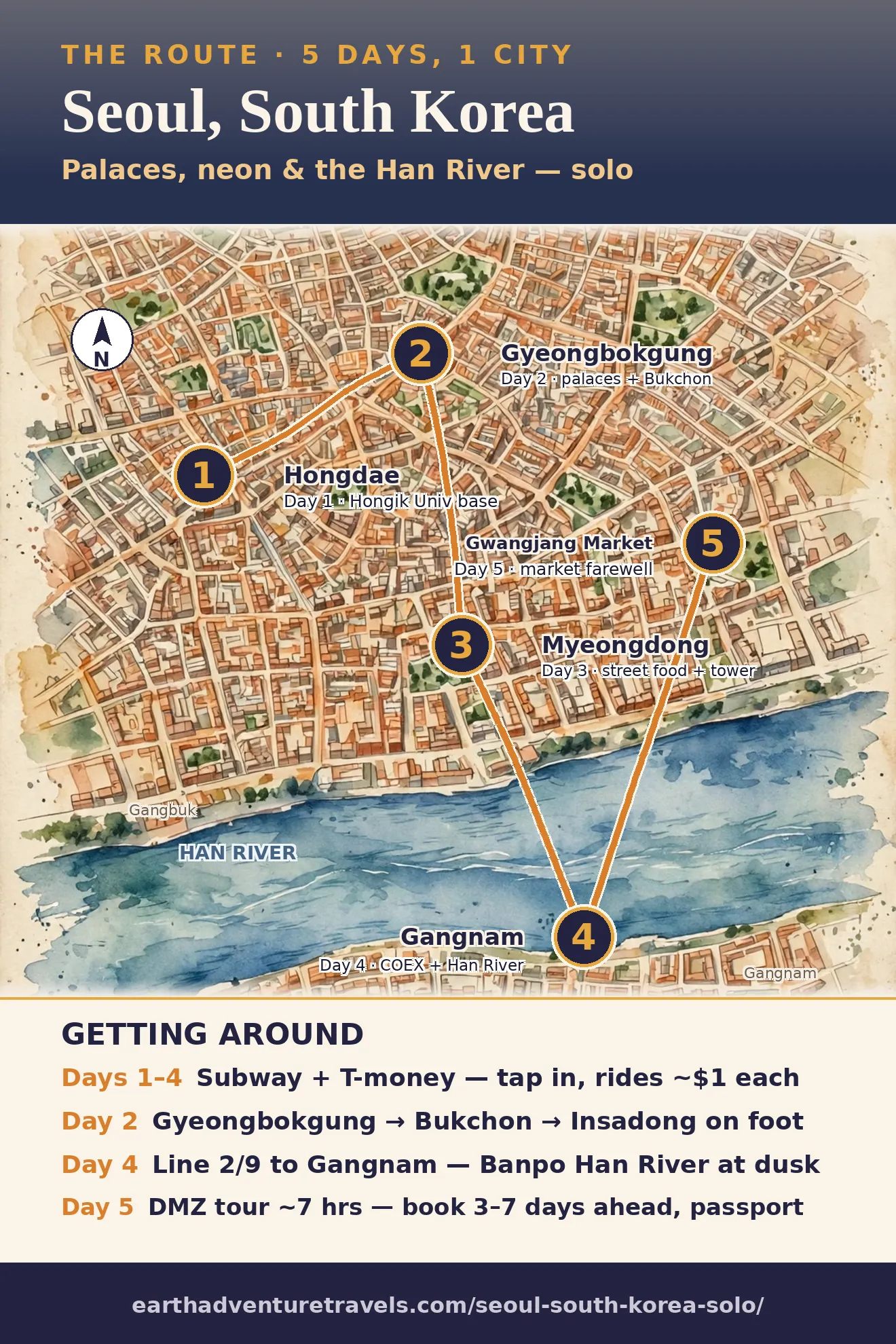
Hongdae (2 nights) · Jongno palaces · Myeongdong/Namsan · Gangnam/Han River · DMZ day trip + Gwangjang Market farewell
Best timing
April–May for cherry blossoms and October–November for fall color: mild walking weather, clear skies, and the palaces at their most photogenic
Pace
Easy-moderate — 12,000–18,000 steps a day, one full-day DMZ tour, one slow café afternoon built in; everything by subway
Sleep
Two bases: Hongdae for nights 1–2, then central Seoul (Myeongdong/Insadong) for nights 3–4 — or one Hongdae base the whole way
Good to know
Gyeongbokgung is closed Tuesdays (₩3,000, free in hanbok); the DMZ tour must be booked 3–7 days ahead with your passport; get a T-money card on arrival

Rough budget · solo

$750 – $1,600

5 days / 4 nights · lodging, food, subway, attractions · international flights excluded · ₩1,400 ≈ $1 (October 7, 2026)

The route

The five-day route

Five days, one city, zero rental cars. The subway does everything: nine lines, English signage, and rides for about a dollar. Each day below opens into the full plan — where to go, what it costs, where to eat alone without a second thought, and where to sleep that night.

Seoul solo route map: Hongdae (day 1), Gyeongbokgung (day 2), Myeongdong (day 3), Gangnam (day 4), Gwangjang Market (day 5), divided by the Han River
Save the route.
Day 1 itinerary card: arrive in Seoul, Hongdae evening
Share the day.

Touch down at Incheon International Airport (ICN), about 50 km west of the city. The move for a Hongdae base is the AREX all-stop train: roughly 53 minutes to Hongik University Station for ₩4,750 (about $3.40). The express train skips Hongdae and ends at Seoul Station, so take the all-stop — it is cheaper and drops you at your neighborhood. If you land with heavy bags after a long haul, the limousine bus 6002 runs to Hongdae in about 70 minutes for roughly $12. Buy a T-money card (₩4,000, about $3) at any airport CU, GS25, or 7-Eleven and load ₩20,000–30,000 in cash — top-ups are cash-first, and this card is your subway, bus, and convenience-store wallet for five days.

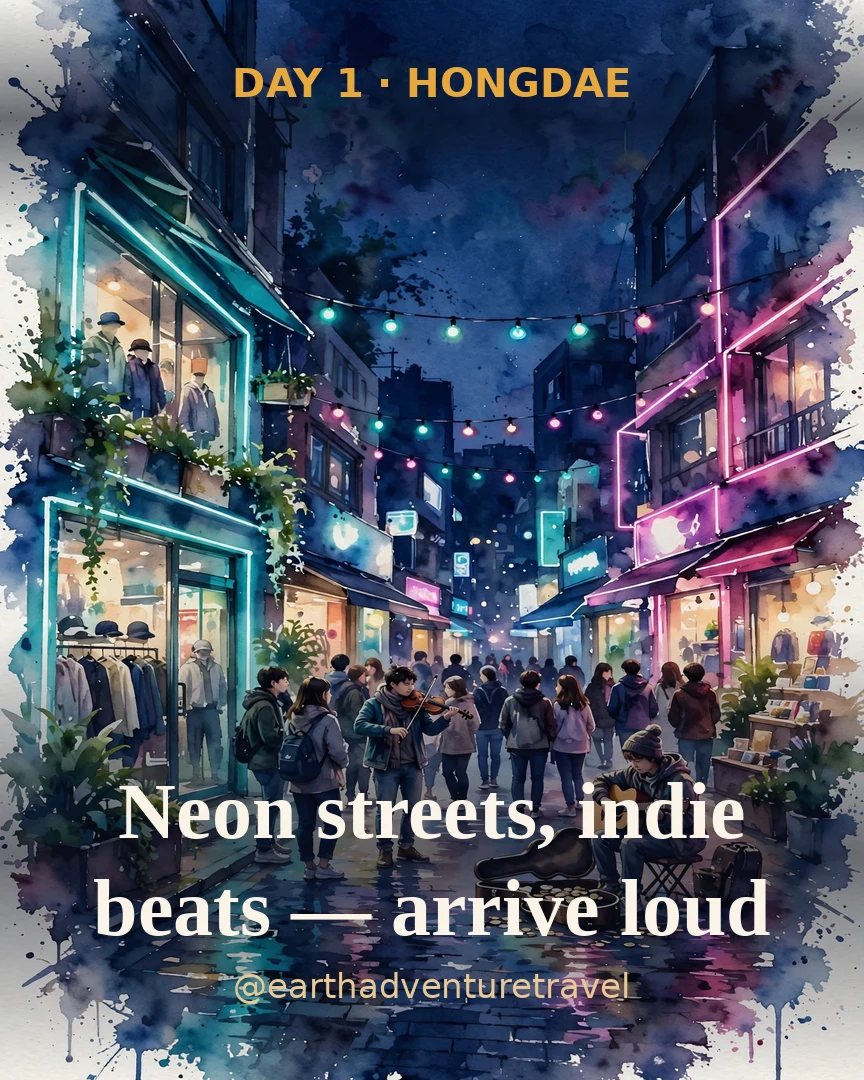
Base yourself in Hongdae — the youth district around Hongik University, exits 8 and 9 of Hongik Univ. Station. Drop bags and walk the Hongdae shopping street as it wakes up: indie boutiques, buskers with full PA setups by 6 p.m., and the famous photo booths (인생네컷) on every block — ₩4,000–6,000 for a strip of solo portraits that make the perfect trip souvenir. Dinner is your first solo-dining lesson: walk into any kimbap shop or sundubu (soft tofu stew) counter — single seats, fast, under $10. Then find a coin noraebang (coin karaoke): private booths from ₩1,000 a song, no audience, no shame. This is the single best solo activity in Seoul.

End the night the Korean way: cup ramyeon at a convenience store. Buy the cup noodles and a triangle gimbap at CU, use the hot-water dispenser by the door, and eat at the plastic tables outside — Koreans do this at all hours, and at midnight the tables fill with students and night-shift workers. It is safe, it is normal, and it costs under $4. Restrooms: Hongik Univ. Station and every convenience store-adjacent café. Bad-weather pivot: the Hongdae Free Market weekends are outdoors, but the underground Hongdae shopping arcades and the Trickeye Museum are covered.

The plan

  • Land at ICN; AREX all-stop to Hongik Univ. Station (~53 min, ~$3.40); T-money at the airport CU.
  • Check in; Hongdae shopping street — buskers, photo booths, indie boutiques.
  • Counter dinner under $10; coin noraebang; midnight cup ramyeon at the CU.

Where to stay

  • L7 Hongdae — design hotel right on the main drag; rooftop with skyline views, mid-range.
  • Holiday Inn Express Seoul Hongdae — built over the subway/AREX station; the zero-stress pick.
  • Zzzip Guesthouse in Hongdae — budget, social, and built for solos meeting solos.
Day 1 → Day 2: Palaces tomorrow — Line 2 from Hongik Univ. to Euljiro 3-ga, transfer to Line 3 for Gyeongbokgung (about 35 minutes door to door).

Beat the jet lag with the AREX, not a taxi. The all-stop train is faster than a taxi in daytime traffic and a third of the price — and the walk from Hongik Univ. Station into Hongdae is your first real look at the city.

Solo tip

Hongdae is Seoul's most solo-normal neighborhood — nobody looks twice at a table for one. The coin noraebang booths are made for exactly this: private, cheap, and the fastest cure for arrival-day loneliness.
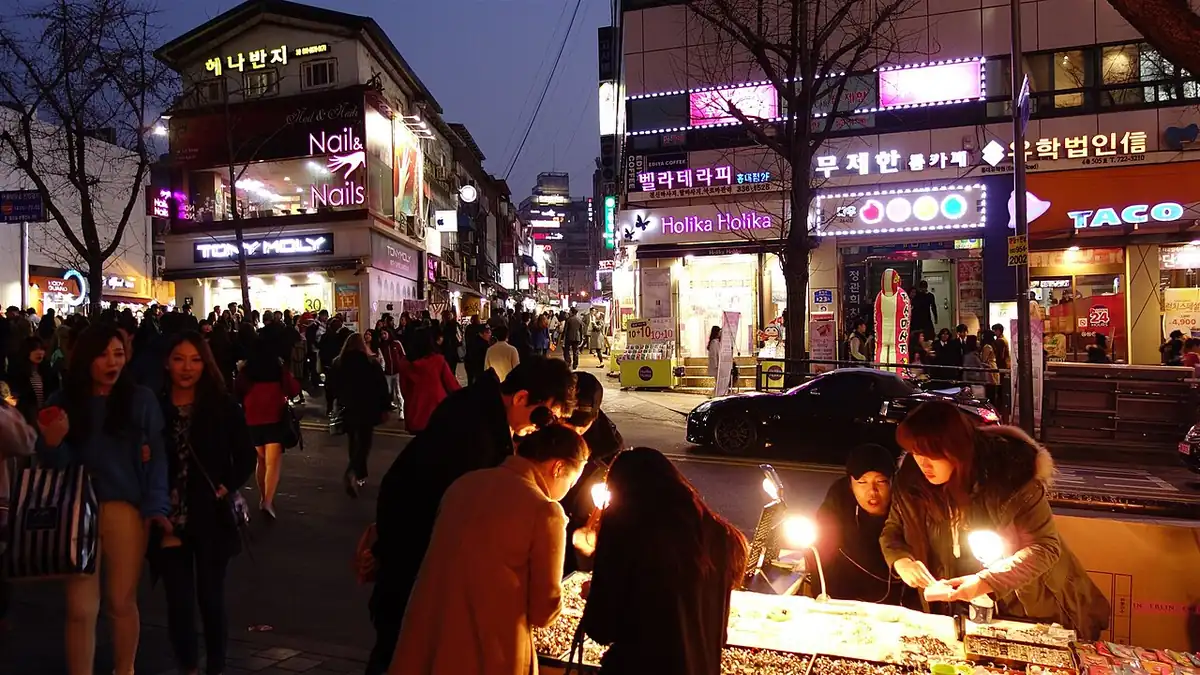
Hongdae's party district glowing at night, Seoul
Hongdae after dark — buskers, neon, and nobody minding their own business but you. Photo: Ken Eckert / Wikimedia Commons (CC BY-SA 4.0)
Day 2 itinerary card: Gyeongbokgung Palace and Bukchon Hanok Village
Share the day.

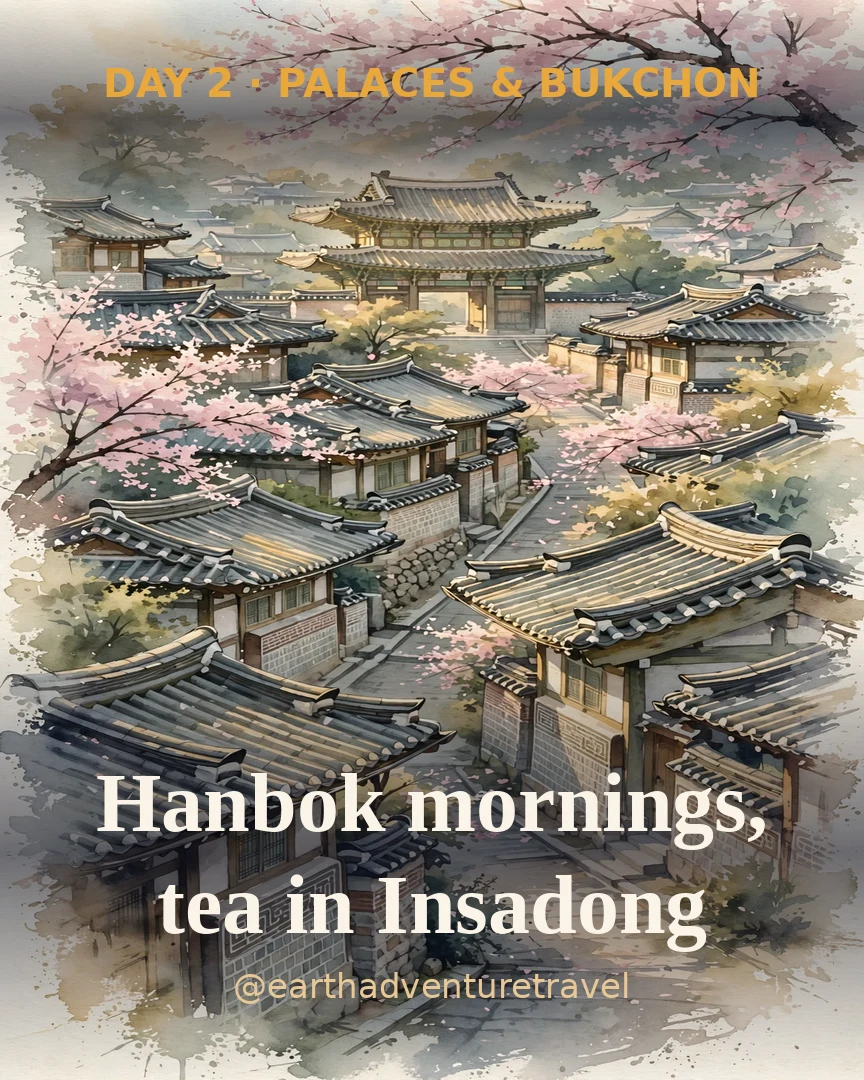
Start at Gyeongbokgung Palace, the 1395 Joseon-dynasty grand palace — Subway Line 3, Gyeongbokgung Station, Exit 5, two minutes to the gate. Hours are 9:00 a.m.–6:00 p.m. in March–May and September–October (6:30 p.m. in summer, 5:00 p.m. in winter), and it is closed every Tuesday. Admission is ₩3,000 (about $2) — or free if you wear a hanbok, which is why the rental shops cluster around Exit 4: a full hanbok rental runs ₩15,000–25,000 ($11–18) for four hours, and the palace in hanbok is the definitive Seoul photo. Time your arrival for the Changing of the Royal Guard at Gwanghwamun Gate — 10:00 a.m. and 2:00 p.m. daily except Tuesdays; arrive ten minutes early for the front row. Budget two to three hours for the grounds: Geunjeongjeon (the throne hall), Gyeonghoeru (the banquet pavilion on the pond), and the National Folk Museum inside the grounds, which is free with palace admission.

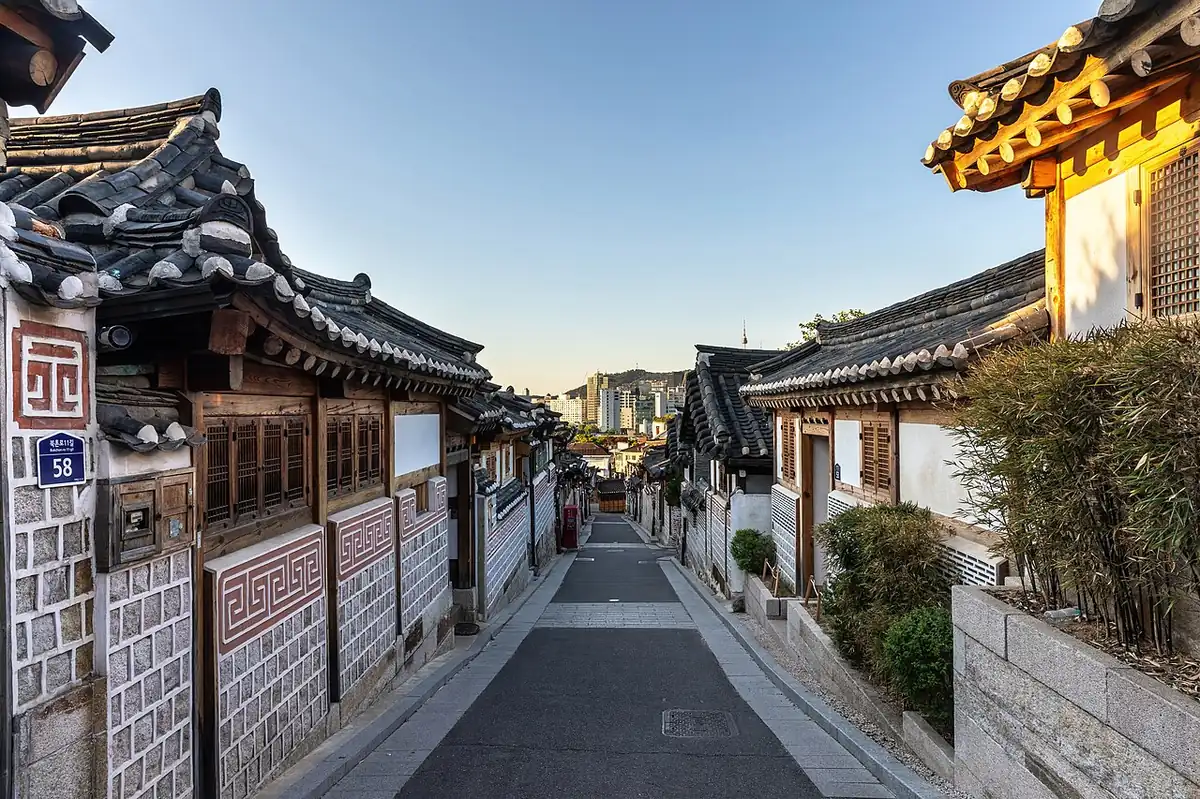
From the palace's east side it is a 15-minute walk to Bukchon Hanok Village — the hillside lanes of traditional wooden houses between Gyeongbokgung and Changdeokgung. This is a living residential neighborhood, so observe the posted visiting hours (10:00 a.m.–5:00 p.m.) and keep voices down on the slopes. The famous viewpoint is Bukchon-ro 11-gil: hanok rooftops cascading downhill with the modern city behind. The climb is steep — this is where broken-in shoes earn their keep. Allow 60–90 minutes of wandering, then walk downhill into Insadong for the afternoon: Ssamziegil's spiral craft mall, and tea at Dawon, the traditional teahouse in the Kyungin Museum garden — jujube or ginger tea in a hanok courtyard, about $8.

Dinner in Insadong or nearby Ikseon-dong, the hanok alley district gone café-wild: solo-friendly bibimbap and kalguksu (knife-cut noodle) shops with counter seating everywhere, $8–14. Restrooms: the palace has facilities near the main halls; Bukchon's public restroom sits at the top of Bukchon-ro. Bad-weather pivot: the National Palace Museum (inside the palace grounds, covered) and Insadong's indoor arcades.

The plan

  • Hanbok rental near Gyeongbokgung Station Exit 4; enter the palace by 9:30 a.m.
  • Guard ceremony at 10:00 a.m.; Geunjeongjeon, Gyeonghoeru, Folk Museum — 2–3 hours.
  • Walk to Bukchon Hanok Village (10 a.m.–5 p.m. visiting hours); Insadong tea; Ikseon-dong dinner.

Where to stay

  • Keep the Hongdae base — 35 minutes by subway; no need to move.
  • Nine Tree by Parnas Seoul Insadong — modern, calm, two minutes from the teahouses.
  • Orakai Insadong Suites — apartment-style with kitchen and laundry; the longer-stay pick.
Day 2 → Day 3: Myeongdong tomorrow — Line 3 to Chungmuro, transfer to Line 4, one stop to Myeongdong (about 30 minutes from Hongdae).

The hanbok is the hack. Free palace entry, the best photos of the trip, and rental shops handle everything including hair styling — book nothing ahead, just walk into any shop near Exit 4 before 10 a.m.

Solo tip

Solo travelers get the best hanbok photos — no waiting on a group. Ask a rental-shop staffer to snap your palace shots; they do it all day and know the angles.

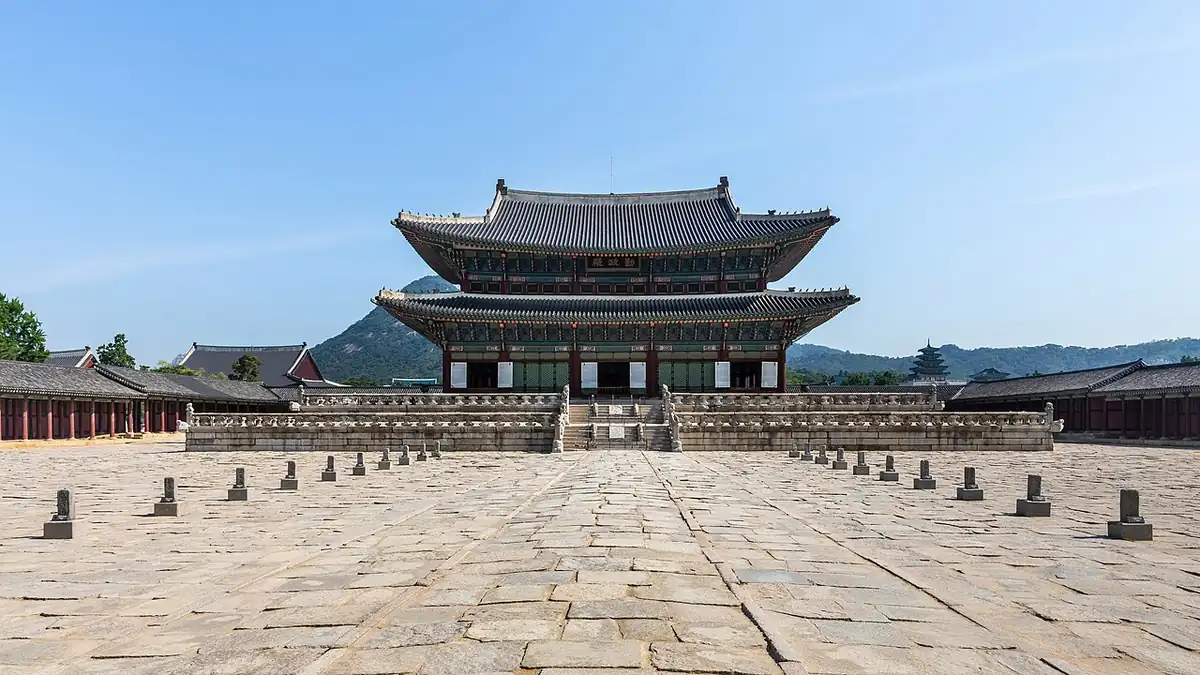
Geunjeongjeon, the throne hall of Gyeongbokgung Palace, Seoul
Geunjeongjeon throne hall — arrive at opening and the courtyard is yours. Photo: Basile Morin / Wikimedia Commons (CC BY-SA 4.0)
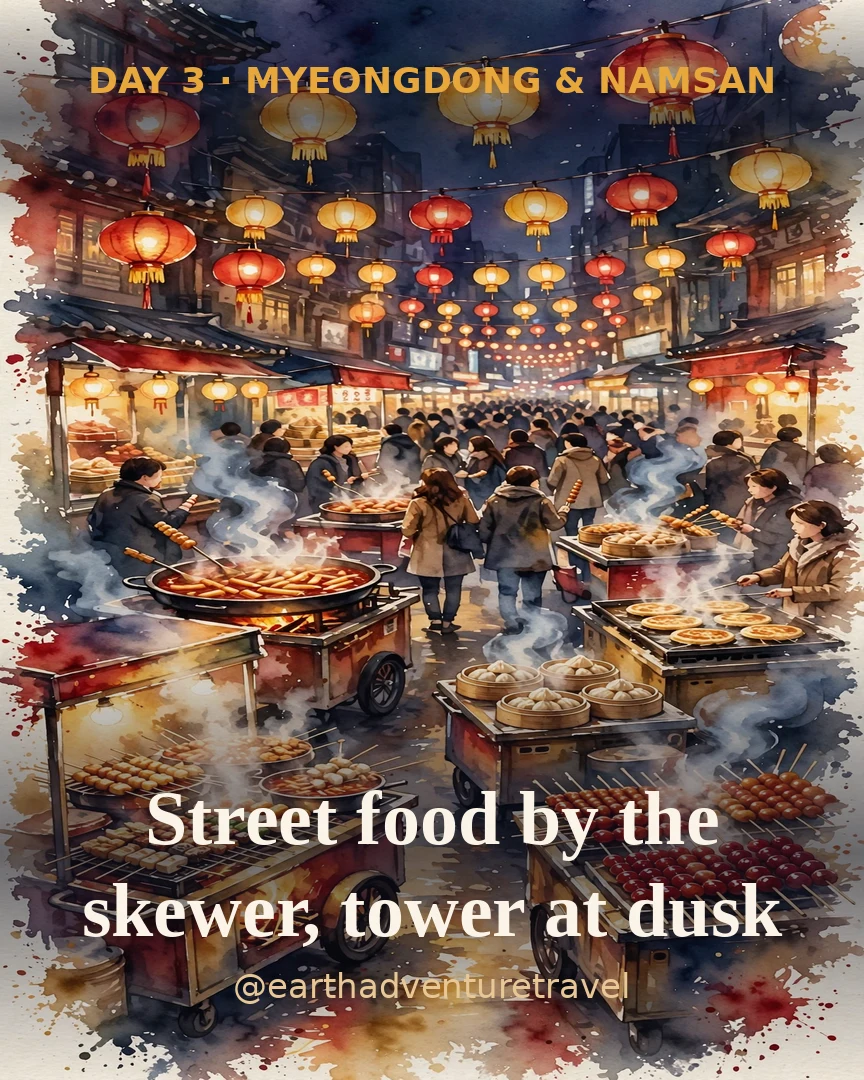
Day 3 itinerary card: Myeongdong street food at night
Share the day.

This is the eating day. Myeongdong — Subway Line 4, Myeongdong Station — is Seoul's great pedestrian shopping street, and from late morning the street-food stalls fire up: tteokbokki (spicy rice cakes), hotteok (sweet stuffed pancakes), tornado potatoes, odeng (fish-cake skewers in hot broth, ₩1,000–2,000), grilled lobster tails and strawberry mochi for the camera. Nothing costs more than about $5 a skewer, everything is eaten standing up, and every stall is a table for one — this is the single easiest solo lunch on earth. For a sit-down anchor, Myeongdong Kyoja (operating since 1966, on the Michelin Guide): kalguksu knife-cut noodles and mandu, about $9 — expect a line at lunch; it moves fast.

Afternoon, walk or ride up Namsan. The cable car leaves from near Myeongdong Station Exit 3 (follow the signs uphill about 10 minutes) and climbs to N Seoul Tower in a few minutes — check nseoultower.co.kr for current cable car and observatory pricing before you go. The observatory deck looks over the entire basin: palace roofs to the north, the Han River to the south. Alternatively hike up via the Namsan park trails (about 40 minutes, free, well-lit) or take the Namsan shuttle bus 02/03/05 from the station. Time it for sunset: the city lights come on while you watch, and the "Locks of Love" fences are the classic photo stop. Restrooms at the cable car base and the tower plaza.

Descend for dinner back in the Myeongdong lanes or nearby Namdaemun Market (Korea's oldest traditional market, 10 minutes on foot): kalguksu alley and galchi jorim (braised cutlassfish) stalls, most under $12. If you want the Korean BBQ experience tonight, this is the night: the 2-portion minimum applies (two orders of samgyeopsal, ₩15,000–19,000 each — 300–400g of pork, an easy solo meal), and solo-friendly spots like Gogit Bar in Seongsu or the BBQ counters in Myeongdong's side streets welcome tables for one. Bad-weather pivot: the Lotte Department Store food hall and the underground Myeongdong shopping arcades.

The plan

  • Stall-crawl Myeongdong from late morning; Myeongdong Kyoja for kalguksu.
  • Cable car or hike up Namsan for sunset at N Seoul Tower.
  • Namdaemun Market dinner — or your solo Korean BBQ night (2-portion rule).

Where to stay

  • Hotel28 Myeongdong — quiet rooms and a rooftop garden just off the main drag.
  • Nine Tree by Parnas Seoul Myeongdong II — sharp value, deep in the action.
  • Keep the Hongdae base — 30 minutes by subway; one base the whole trip is fine.
Day 3 → Day 4: Gangnam tomorrow — Line 4 to Dongjak, transfer to Line 9 for Sinnonhyeon, or Line 2 across the river (about 40 minutes from Myeongdong).

Eat with the stalls' rhythm: stalls peak 2–8 p.m. Go at 3 p.m. for zero lines, graze a skewer every 20 minutes, and save your appetite — Myeongdong rewards the grazer, not the planner.

Solo tip

Myeongdong is the one neighborhood where eating alone needs zero strategy — the food is designed to be eaten standing up, one skewer at a time, by everyone.

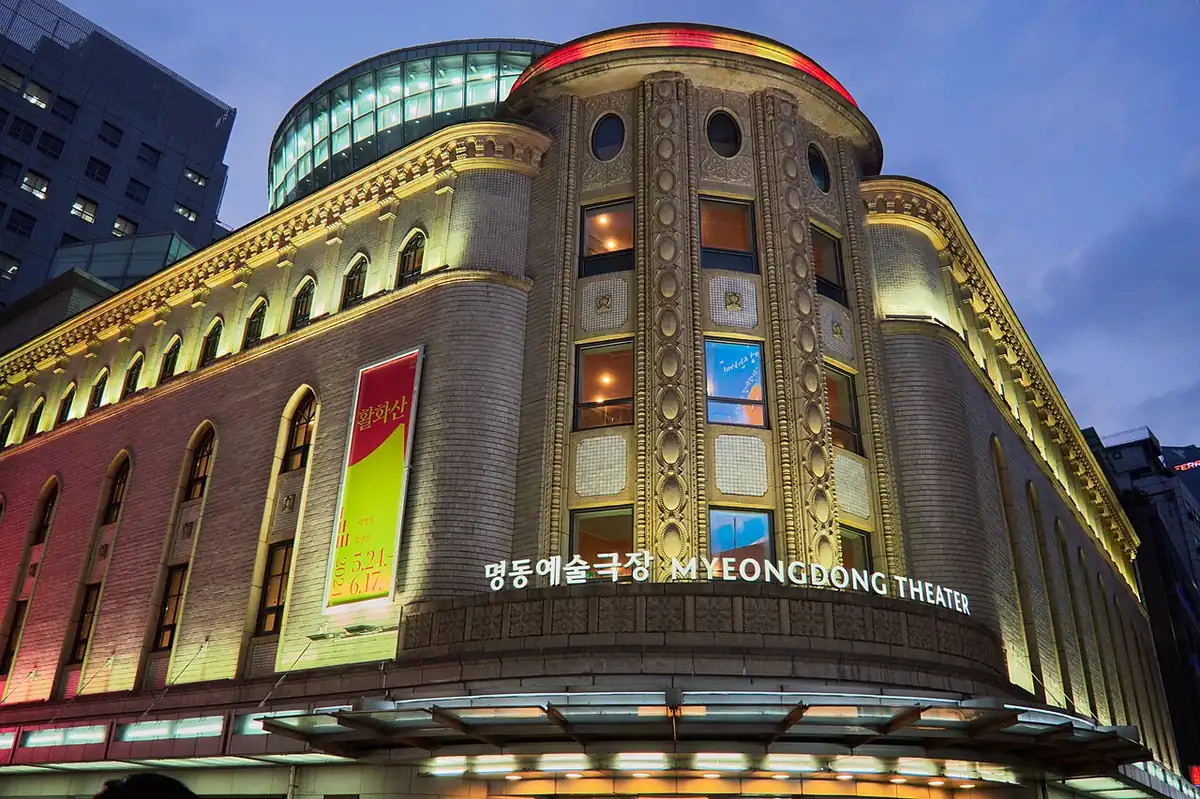
Myeongdong's shopping street in Seoul
Myeongdong by day — the stalls fire up by late morning. Photo: lumoplank / Wikimedia Commons (CC0)

In Seoul, the table for one is not the lonely table — it is the front-row seat.

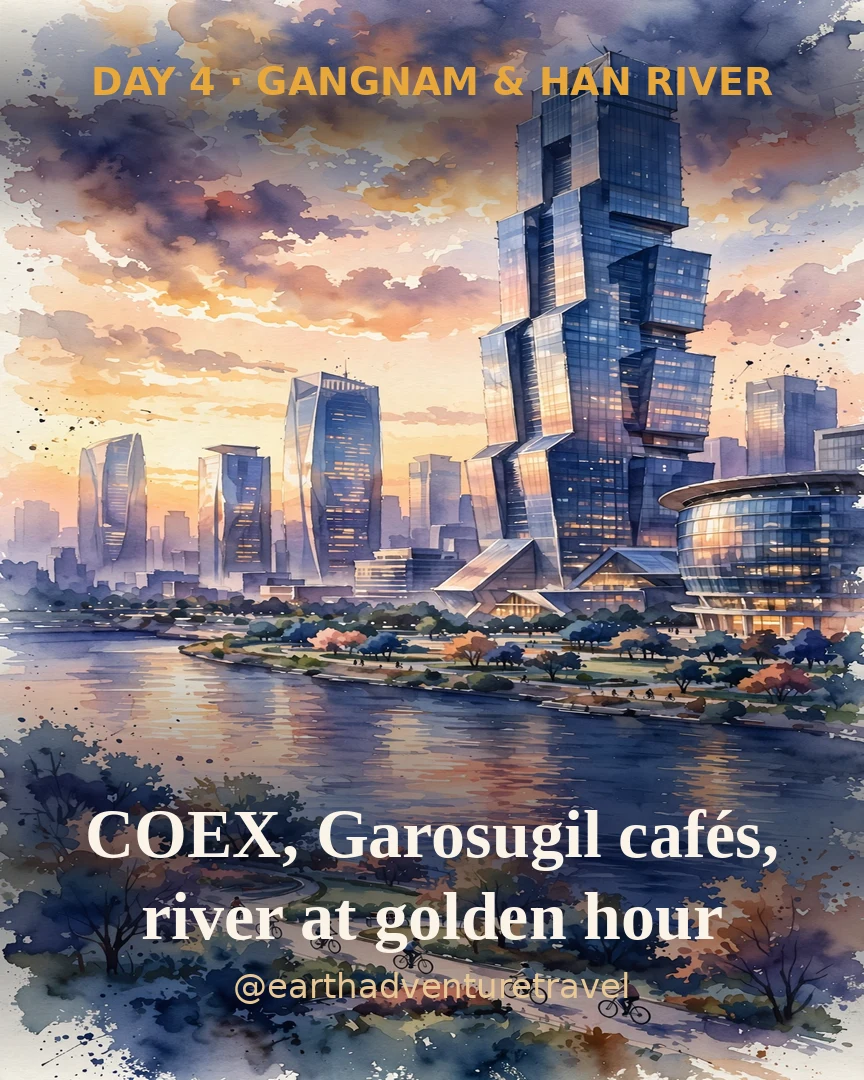
Day 4 itinerary card: Gangnam towers and the Han River
Share the day.

Cross the river to the Seoul of the song. Start at COEX — Subway Line 2, Samseong Station, directly connected underground. The Starfield Library is free and genuinely stunning: two stories of bookshelves in the mall atrium, and the morning light through the glass is the photo. From COEX it is a 10-minute walk to Bongeunsa Temple, a 1,200-year-old Buddhist temple set improbably against the Gangnam towers — free entry, and the contrast of chanting monks and glass skyscrapers is pure Seoul. The temple runs a templestay program if you want the full overnight version; the two-hour daytime program is bookable ahead.

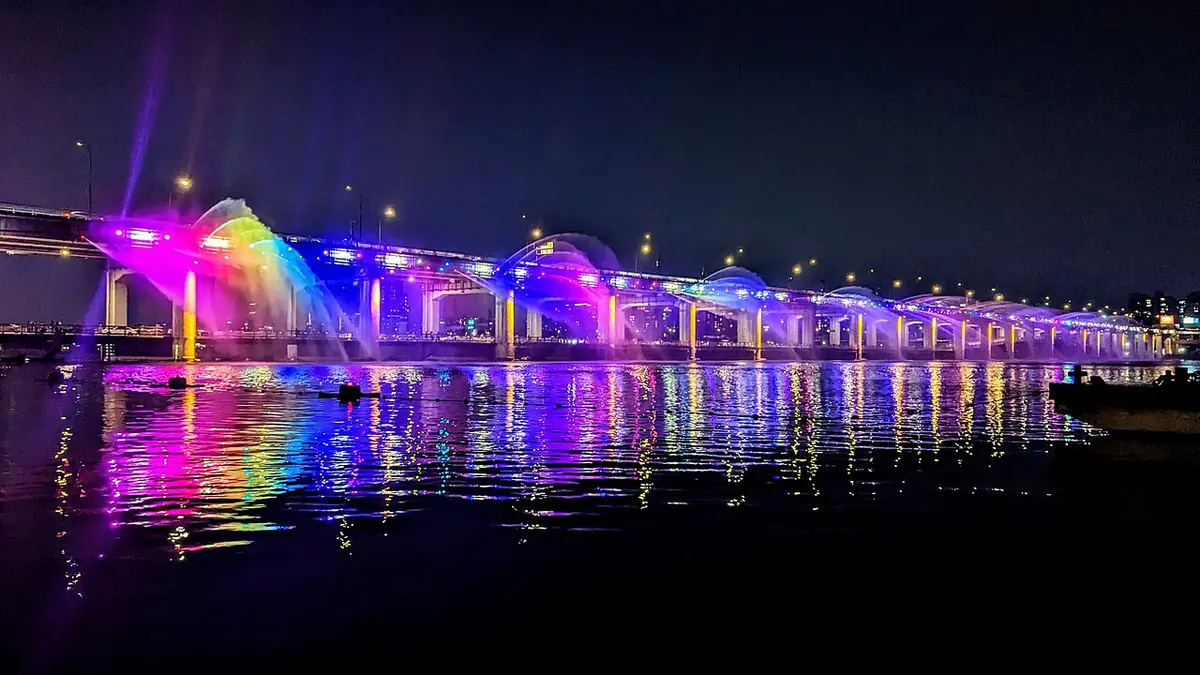
Afternoon: Garosugil in Sinsa-dong — the tree-lined café street. This is Seoul's café capital: multi-floor designer cafés, and the bingsoo (shaved ice dessert) shops that define a Korean summer afternoon. Line 3, Sinsa Station, Exit 8. Graze, people-watch, recharge your phone. Then head for the river: Banpo Hangang Park — Line 3/7/9 Express Bus Terminal Station, then a 15-minute walk to the riverfront. This is the evening's main event. The Banpo Bridge Moonlight Rainbow Fountain — the world's longest bridge fountain — runs evening shows April through October (several shows nightly; check the park schedule for 2026 times). Claim a spot on the riverbank steps by 7 p.m.

Dinner is chimaek by the Han: order fried chicken and beer delivered to the park — every riverside convenience store has delivery-app flyers, or use the park's delivery zones and have it brought to your mat. A whole chicken plus beer runs about $20–25, and eating it cross-legged on the riverbank with the fountain show is the most Seoul evening there is. Solo diners do this constantly — the park is full of one-person mats. Restrooms at Banpo park pavilions. Bad-weather pivot: COEX Aquarium or the SMTOWN Museum.

The plan

  • COEX Starfield Library (free) → Bongeunsa Temple (free) in the morning.
  • Garosugil café afternoon — bingsoo, people-watching, phone recharge.
  • Banpo Hangang Park by 7 p.m.; Rainbow Fountain show; chimaek delivery on the riverbank.

Where to stay

  • GLAD Gangnam COEX Center — design hotel wired into the COEX complex.
  • Hotel Newv (Yeoksam) — sharp budget pick south of the river.
  • Keep the Hongdae or Myeongdong base — Line 2/9 makes Gangnam a 30–40 minute ride.
Day 4 → Day 5: DMZ day — most tours pick up at Hongik Univ. Station, Myeongdong, or City Hall; confirm your meeting point the night before.

The fountain shows are seasonal. The Rainbow Fountain runs April–October only. In winter, swap this evening for the Dongdaemun Design Plaza's lit LED rose garden — equally spectacular, and open year-round.

Solo tip

Banpo at dusk is the park's social hour — families, couples, and plenty of solo mats. Bring a convenience-store mat (₩2,000) and you belong instantly.

Banpo Bridge Moonlight Rainbow Fountain at night, Seoul
The Moonlight Rainbow Fountain — the world's longest bridge fountain, April to October. Photo: Wvdp / Wikimedia Commons (CC0)
Day 5 itinerary card: DMZ hills and Gwangjang Market
Share the day.

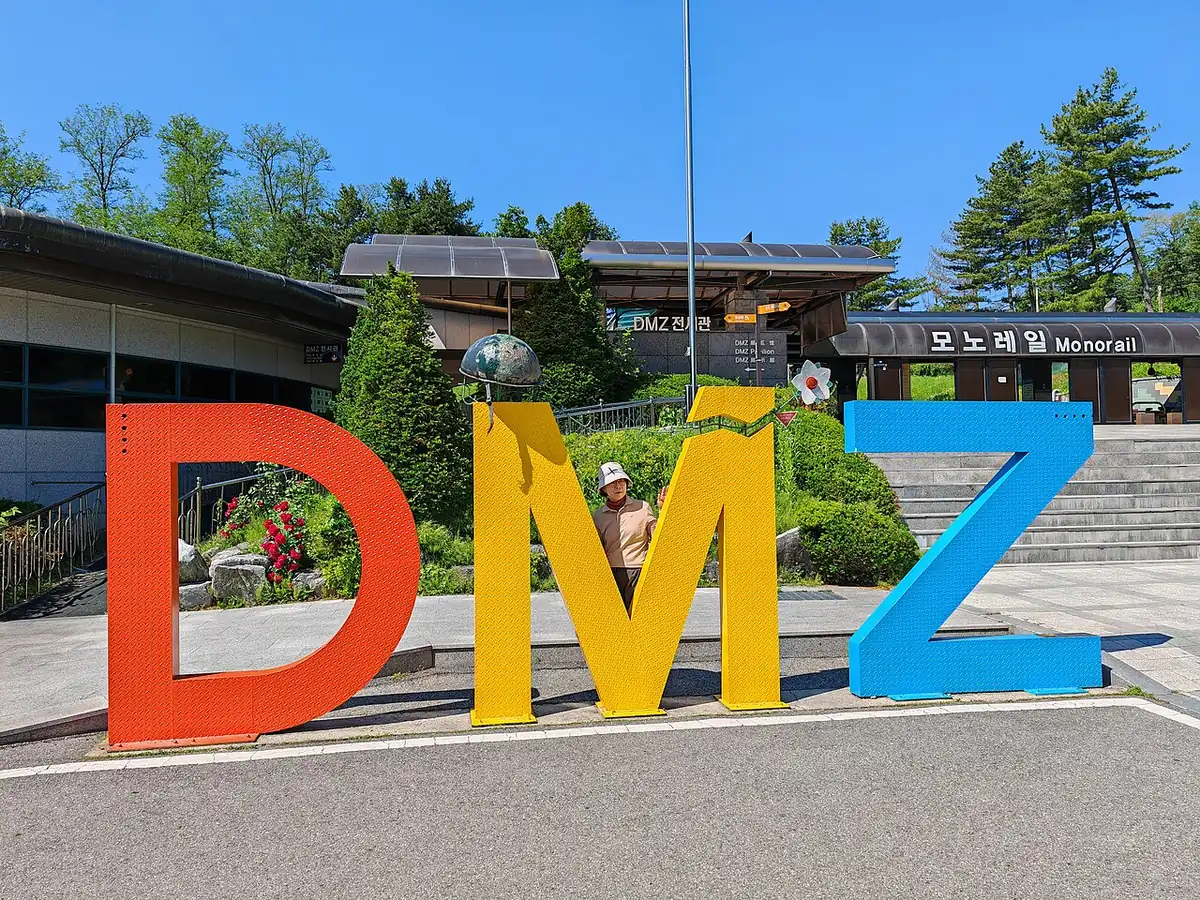
The heaviest, most worthwhile day. Book a half-day DMZ tour 3–7 days ahead on Trazy, Klook, or GetYourGuide — about $40–55 (₩55,000–75,000), and the no-shopping-stop tours are worth the premium. You must carry your passport — the army checks it, no exceptions, no refunds without it. Tours depart around 7:00–7:30 a.m. from Hongik Univ. Station, Myeongdong, or City Hall and run 7–9 hours. The standard route: Imjingak Park, the 3rd Infiltration Tunnel (you walk a steep section of the tunnel North Korea dug toward Seoul — hard hat provided, the low ceiling is real), and the Dora Observatory, where telescopes look into North Korea on clear days. The JSA at Panmunjom has been closed to tourists since July 2023 — any listing still advertising it means a museum, not the blue huts.

Tours typically drop you back around 2:30–3:30 p.m. Rest, then head to the farewell dinner: Gwangjang Market — Subway Line 1, Jongno 5-ga Station — Korea's oldest continuously operating market and its greatest food hall. The move is bindaetteok (mung-bean pancake, about $5) at one of the famous stalls, mayak gimbap (mini seaweed rice rolls), and kalguksu in the market's noodle alley. The market food stalls wind down around 9–10 p.m., so go for an early dinner, not a late one. Every stall is counter seating; solo diners are the market's natural clientele.

Close the night at the Dongdaemun Design Plaza (DDP) — Line 2/4/5, Dongdaemun History & Culture Park Station — Zaha Hadid's aluminum spaceship, lit up after dark with the LED rose garden. It is free to wander, open late, and the perfect exhale after the DMZ's weight. Then the AREX back to Incheon if you're flying tonight, or one last Hongdae nightcap. Bad-weather note: DMZ tours run in most weather but sites can close for military reasons — bookings include free cancellation or rebooking.

The plan

  • DMZ tour: meet 7:00–7:30 a.m. with passport; 3rd Tunnel + Dora Observatory; back by ~3 p.m.
  • Rest, then Gwangjang Market early dinner — bindaetteok, mayak gimbap, kalguksu alley.
  • Dongdaemun Design Plaza after dark; AREX to ICN or one last Hongdae night.

Where to stay

  • No hotel tonight if you fly — AREX to ICN takes under an hour from Hongik Univ.
  • If the flight is tomorrow: Hotel the Designers Seoul Station — budget, right on the AREX line.
  • Last-night splurge: Four Seasons Seoul (Gwanghwamun) — the grande dame, five minutes from Gwangjang.
Day 5 → home: ICN tax-free past security is genuinely good — the last place to spend leftover won on K-beauty and snacks.

Book the DMZ for a weekday. Weekend tours sell out first and the tunnel queues double — a Tuesday or Wednesday tour is calmer, and Gyeongbokgung is closed Tuesdays anyway, so the days never collide.

Solo tip

DMZ tours are full of solo travelers — the shared bus and the tunnel walk make conversation easy. Sit near the front and you'll have company by Imjingak.

The Third Tunnel of Aggression in the DMZ, Korea
The 3rd Infiltration Tunnel — the DMZ's most sobering walk. Photo: Dwxn / Wikimedia Commons (CC BY-SA 4.0)

The idea

THE IDEA

The direct answer: Seoul is the rare megacity that is genuinely easier alone. The subway runs in four languages and costs about a dollar a ride. Eating alone is not tolerated here — it is designed for: counter seats, street stalls, kimbap shops, and convenience-store tables at midnight. The palaces cost $2, the guard ceremony is free, and the heaviest experience of the trip — the DMZ — is a book-ahead bus tour full of other solos. Five days, two bases, zero rental cars, every price below verified for 2026 and converted at ₩1,400 ≈ $1.

The route works because Seoul's neighborhoods each do one thing perfectly. Hongdae is the arrival shock — neon, buskers, coin noraebang. Jongno is the history — Gyeongbokgung, Bukchon, Insadong in one walking day. Myeongdong and Namsan are the eating and the view. Gangnam and the Han River are the modern city at golden hour. And the DMZ is the day that puts everything else in perspective. The T-money card ties it together: one tap for every subway, bus, and convenience store in the city.

Seoul seen from N Seoul Tower
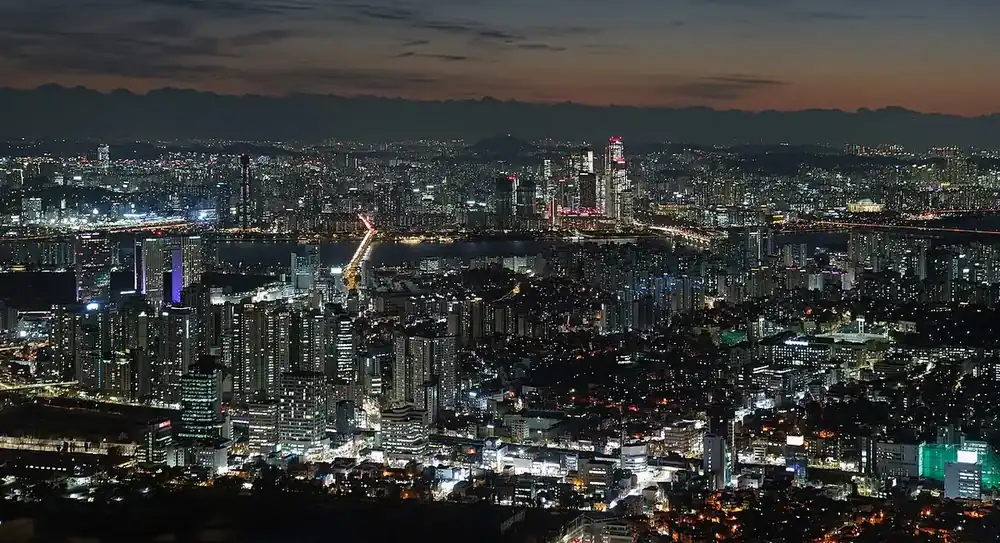
The view from N Seoul Tower — palace roofs north, the Han River south. Photo: kallerna / Wikimedia Commons (CC BY-SA 4.0)

Two ground rules make it work. Book the DMZ first. It is the only thing on this route that sells out — 3–7 days ahead, passport in hand, weekday if you can. And let the solo math work for you. The 2-portion KBBQ rule sounds like a barrier until you realize 300g of samgyeopsal is one hungry traveler's dinner; the noraebang booths are private by design; and the Banpo riverbank at dusk is full of one-person mats. Traveling alone in Seoul is not the compromise version of the trip. It is the trip.

Saveable recap graphic for the five-day Seoul solo route
Saveable route recap · five days solo in Seoul
5days, 2 bases, 0 rental cars
Apr–Maycherry blossoms · Oct–Nov fall color
~$1subway rides with T-money
$750–1.6Ksolo budget, 5 days

The people behind the plans

Who is Earth Adventure Travel?

We build routes for real life — heading out solo, wrangling kids, or spanning generations — and check every detail against official sources so the plan holds up when you get there.

Learn About Us

Plan & pack

What the money goes to

  • Lodging — $280–600: guesthouse dorms $30–55/night (4 nights), private rooms $60–110, mid-range hotels $110–180/night.
  • Food — $200–350: street-stall grazing $10–20/day, counter meals $8–14, one KBBQ night $25–35, market dinners $10–15.
  • Transit — $35–60: T-money card $3 + subway rides ~$1 each, AREX airport runs ~$3.40, cable car and buses.
  • Attractions — $80–150: palaces ~$2–3 each, hanbok rental $11–18, N Seoul Tower observatory, DMZ tour $40–55.
Booking deadlines, compared — miss these and you pay full price or queue
WhatBook aheadWhere2026 price
DMZ half-day tour3–7 daysTrazy / Klook / GetYourGuide$40–55 · passport required
Hanbok rentalWalk-up before 10 a.m.shops near Gyeongbokgung Stn Exit 4$11–18 / 4 hrs · palace entry free
N Seoul Tower observatoryWalk-up or onlinenseoultower.co.krCheck 2026 pricing
T-money cardOn arrivalCU / GS25 / 7-Eleven~$3 + cash top-up
Bongeunsa templestayA few daystemple siteDay program — book ahead
Gyeongbokgung guard ceremonyNo booking — arrive 10 min earlyGwanghwamun GateFree · 10 a.m. & 2 p.m., not Tue

Pack for the trip

  • Broken-in walking shoes with grip — 12,000–18,000 steps a day; Bukchon's slopes and palace courtyards are stone, and rain makes them slick.
  • Small crossbody bag — Myeongdong and the subway are crowded; front-carry beats a backpack in the crush.
  • Light layers + packable rain shell — April and October swing 15 degrees between morning palaces and midnight street food; monsoon leftovers can surprise spring.
  • Portable charger — Naver Maps, Papago, and T-money-adjacent apps drain phones by mid-afternoon.
  • Cash in small bills — T-money top-ups are cash-first; market stalls and street food run on won, not cards.
  • One nicer outfit — Garosugil cafés and Gangnam dinner spots reward the traveler who didn't dress for the trail.
  • Padlock for hostel lockers — Hongdae's guesthouses provide lockers; bring your own lock.
  • Picnic mat (or buy one there) — a ₩2,000 mat from any convenience store is your seat at Banpo Hangang Park.
  • Sunscreen + hat — the palace courtyards, Bukchon slopes, and the N Seoul Tower plaza have zero shade.
  • Copies of bookings offline — DMZ tour confirmation and passport details live in your email; screenshot everything.
Steep hanok lane in Bukchon at sunrise, Seoul
Broken-in shoes with grip. Bukchon-ro's slopes at sunrise — the hanok lanes climb hard, and the stone turns slick in rain. Photo: Basile Morin / Wikimedia Commons (CC BY-SA 4.0)
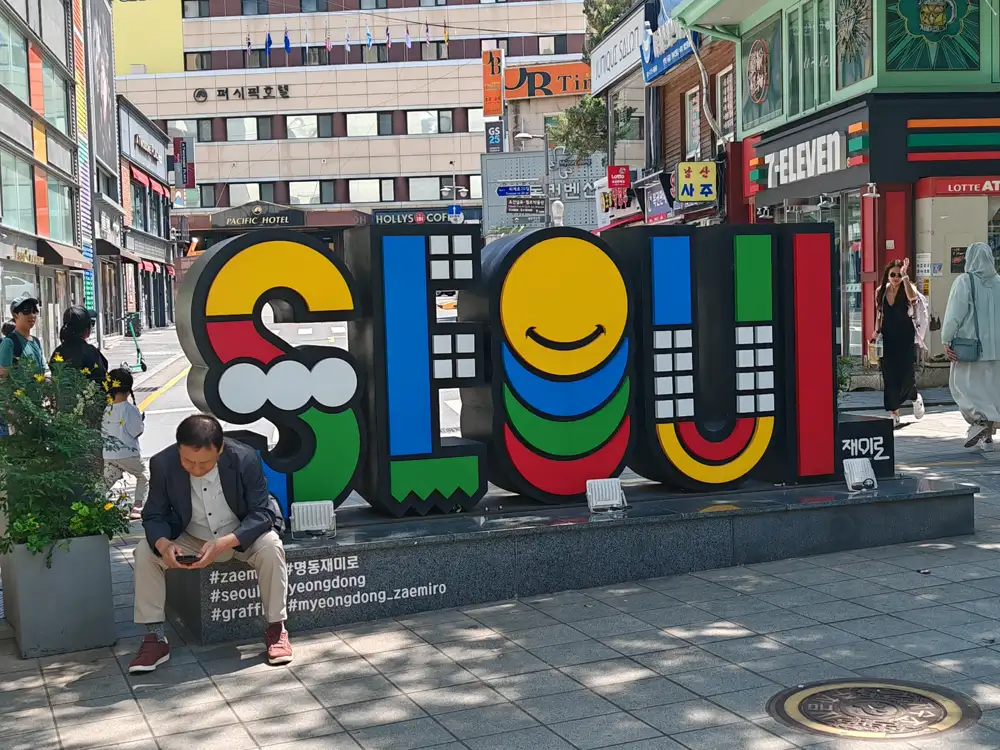
The Seoul sign on Myeongdong street
Crossbody, front pockets. Myeongdong's main drag — ride the crowd with your valuables zipped and in front. Photo: Dwxn / Wikimedia Commons (CC BY-SA 4.0)
Seoul street after rain
Packable rain shell. Seoul after April showers — spring and fall both surprise. A shell that stuffs into a daypack earns its grams. Photo: Republic of Korea / Wikimedia Commons (CC BY-SA 2.0)

Eat like a local

Seoul rewards the hungry soloist more than any city on earth. Breakfast at a kimbap shop — triangle gimbap and instant coffee, $3. Lunch is the stall or the counter: kalguksu, sundubu, bibimbap, $8–12. Dinner: one long KBBQ night (order the 2 portions, grill it yourself, wrap it in lettuce), one market night at Gwangjang, one chimaek night on the Han. Counter seats are the norm, not the consolation prize — sit at the counter and the cook talks to you. And the convenience store is a restaurant: cup ramyeon, triangle gimbap, and a beer at the outdoor tables, under $6, at any hour.

Day trips & swaps

Got a sixth day? Suwon Hwaseong Fortress is the palace-town swap — UNESCO walls you can walk end to end, 30 minutes by subway. Incheon Chinatown + Wolmido pairs with the airport corridor. Seoul Forest + Seongsu-dong ("the Brooklyn of Seoul") is the café-and-boutique day — and home to solo-friendly KBBQ counters like Gogit Bar. Rainy palace day? Trade Bukchon's slopes for the National Museum of Korea in Yongsan — free, enormous, and a full afternoon.

Planning notes

Is Seoul safe for solo travelers — including solo women?

Yes — Seoul is one of the safest major cities in the world for traveling alone. Pickpocketing, endemic in tourist zones of Paris or Barcelona, is rare here; bag-snatching is extremely uncommon. The official Seoul tourism guidance calls the city generally safe for solo travelers including women, with the usual advice to avoid poorly lit areas late at night.

Emergency numbers: 112 (police), 119 (fire/ambulance), 1330 (tourism assistance), 1339 (medical help for international visitors). The 24-hour convenience stores everywhere double as lit, staffed refuges.

Is it easy to eat alone in Seoul?

Easier than almost anywhere on earth. Solo dining is mainstream: counter seats at kimbap and noodle shops, street stalls eaten standing up, and convenience-store tables at midnight. Nobody stares at a table for one.

The one exception is Korean BBQ, where most restaurants require a 2-portion minimum (about $11–14 per portion of samgyeopsal). Order both portions — 300–400g is one hungry traveler's dinner — or pick a solo-friendly spot like Gogit Bar in Seongsu. Tipping is 0% everywhere.

How much does 5 days in Seoul cost for a solo traveler?

Roughly $750–$1,600 for 5 days and 4 nights, excluding international flights. Guesthouse dorms run $30–55/night, mid-range hotels $110–180; food $40–70/day; subway rides about $1 each; attractions $80–150 for the week including the DMZ tour.

Converted at ₩1,400 ≈ $1 (October 7, 2026). The palaces are the bargain of the trip — Gyeongbokgung is about $2, and the guard ceremony is free.

What is a T-money card and how do I use it?

It is the single most useful purchase of your trip. The card costs about ₩4,000 ($3) at any CU, GS25, or 7-Eleven — including at Incheon Airport — and you tap it on every subway and bus. Rides run about $1, and tapping gives you free bus-subway transfers within 30 minutes.

Top up with cash at convenience stores or station kiosks. Since March 2026 you can add T-money to Apple Wallet, but reloading it still requires a Korean-issued card — most visitors just top up with cash.

Do I need to speak Korean in Seoul?

Not for this route. Subway signage and announcements run in Korean, English, Chinese, and Japanese; hotels, museums, and tour operators speak English; younger staff switch effortlessly.

Two apps close every gap: Naver Maps for navigation (Google Maps is weak in Korea) and Papago for translation. Learn the courtesies — kamsahamnida (thank you), annyeonghaseyo (hello) — and menus in tourist zones run in English.

Where should a solo traveler stay in Seoul?

Hongdae for energy, Myeongdong for first-timer convenience, Insadong for culture. Hongdae is the solo-social pick — guesthouses, nightlife, and the AREX airport train at Hongik Univ. Station. Myeongdong puts the palaces, markets, and N Seoul Tower within short subway rides.

Insadong is quieter and walkable to Gyeongbokgung and Bukchon. Wherever you land, stay near a major subway station — the subway is the whole transit plan.

Is the DMZ tour worth it — and how do I book?

Yes — it is the single most memorable day trip from Seoul. Book a half-day tour 3–7 days ahead on Trazy, Klook, or GetYourGuide ($40–55); tours cover the 3rd Infiltration Tunnel, Dora Observatory, and Imjingak Park over 7–9 hours.

You must carry your passport — no exceptions. The JSA at Panmunjom has been closed to tourists since July 2023, so ignore listings still advertising the blue huts.

When is the best time to visit Seoul?

April–May for cherry blossoms, October–November for fall color. Both windows bring mild walking weather, clear skies, and the palaces at their most photogenic — this itinerary is built for them.

July–August brings monsoon rain and heat; December–February is dry but bitterly cold. The Banpo Rainbow Fountain runs April–October only.

How do I get from Incheon Airport to the city?

The AREX all-stop train. It reaches Hongik Univ. Station (Hongdae) in about 53 minutes for ₩4,750 (~$3.40) — cheaper and often faster than a taxi in traffic. The express train skips Hongdae for Seoul Station.

With heavy bags, the limousine buses (e.g. 6002 to Hongdae) run about 70 minutes for ~$12. Buy your T-money card at the airport convenience store before you board.

What is the convenience-store culture about?

CU, GS25, and 7-Eleven are a way of life, not a fallback. They are open 24 hours and sell cup ramyeon (with a hot-water dispenser by the door), triangle gimbap, fried chicken, beer, and soju — eaten at the plastic tables outside at all hours.

Drinking in public is legal in Korea, and the storefront tables are where students and night-shift workers actually eat. A full midnight meal runs under $6.

Can I drink the tap water in Seoul?

Yes — Seoul's tap water is treated and drinkable. Most locals still drink filtered or bottled water out of habit, and every convenience store sells large bottles cheaply.

Bring a refillable bottle anyway: the palace courtyards and Bukchon's slopes have fountains and long, shadeless stretches between drinks.

What if it rains during the trip?

Every day has a strong indoor pivot. Palace day: the National Palace Museum and National Folk Museum, both on the Gyeongbokgung grounds. Myeongdong day: the Lotte Department Store food hall and underground arcades.

Gangnam day: COEX Aquarium. DMZ tours run in most weather but can be curtailed for military reasons — bookings include free cancellation or rebooking.

Before you lock the trip

References

Research behind this guide

The reporting and research that shaped this itinerary.

Korean BBQ Dining Etiquette (2026): 2-Person Meat Rule, Ssam & Grilling Hacks ↗koreamadeeasy.com — verified the 2-portion minimum rule, ₩15,000–19,000 portion pricing, free unlimited banchan, and the 0% tipping culture, Oct 2026
Gyeongbokgung Palace Guide: Hours, Tickets & Best Time ↗koreavisiting.com — confirmed 9 a.m.–6 p.m. shoulder-season hours, Tuesday closures, ₩3,000 admission, free hanbok entry, and the 10 a.m./2 p.m. guard ceremony, Oct 2026
Where to Book a Seoul DMZ Tour: Klook, KKday or Viator? ↗gentlyyonder.com — confirmed $40–55 half-day pricing, the 3–7 day booking window, mandatory passport rules, and the JSA closure since July 2023, Oct 2026
One Card Pays for Almost Everything You Do in Seoul ↗franvia.com — verified the ₩4,000 card price, cash-first top-ups, the 30-minute transfer discount, and the March 2026 Apple Wallet addition, Oct 2026
Where to Stay in Seoul: 6 Best Areas and Hotels ↗destinationlesstravel.com — cross-checked the Hongdae vs Myeongdong vs Insadong trade-offs and specific property picks for the where-to-stay sections, Oct 2026
64 Things to Do in Seoul Alone (2026) ↗airial.travel — sourced solo-specific activities (coin noraebang, Seongsu's solo KBBQ counters, Han River bike rentals) from traveler reports, Oct 2026
Is It Safe to Walk Alone at Night in Seoul? An Honest Guide ↗medium.com — grounded the safety FAQ: low pickpocket rates vs European cities, 24-hour convenience stores as refuges, and the 112/119/1330 emergency numbers, Oct 2026

Trip Types

National Parks & Wild PlacesCoastal Drives & Beach TownsCities & Urban WeekendsHistoric & Cultural RoutesMountain TownsFood & Drink TrailsInternationalView all 112 trips →

The trip index

Choose the landscape. Then choose the pace.

Every itinerary gives you a realistic route, daily rhythm, planning notes, and the details that make a solo trip work.

Use the filters above to see the routes that match.

No exact match—yet.

Clear a filter to see the closest routes already in the library.