InternationalSoloCities & Urban

Six days · Lisbon & Porto, solo-tested pacing

Lisbon + Porto in 6 Days: Alfama to the Douro for Solo Travelers

Portugal's two great cities, one rail line, and a valley of terraced vines — timed for the shoulder season, priced in dollars, and paced for one.

InternationalCities & Urban Weekends

6 days / 5 nightsBest May–Jun & Sep–OctSoloEstimate: $600–$1,500
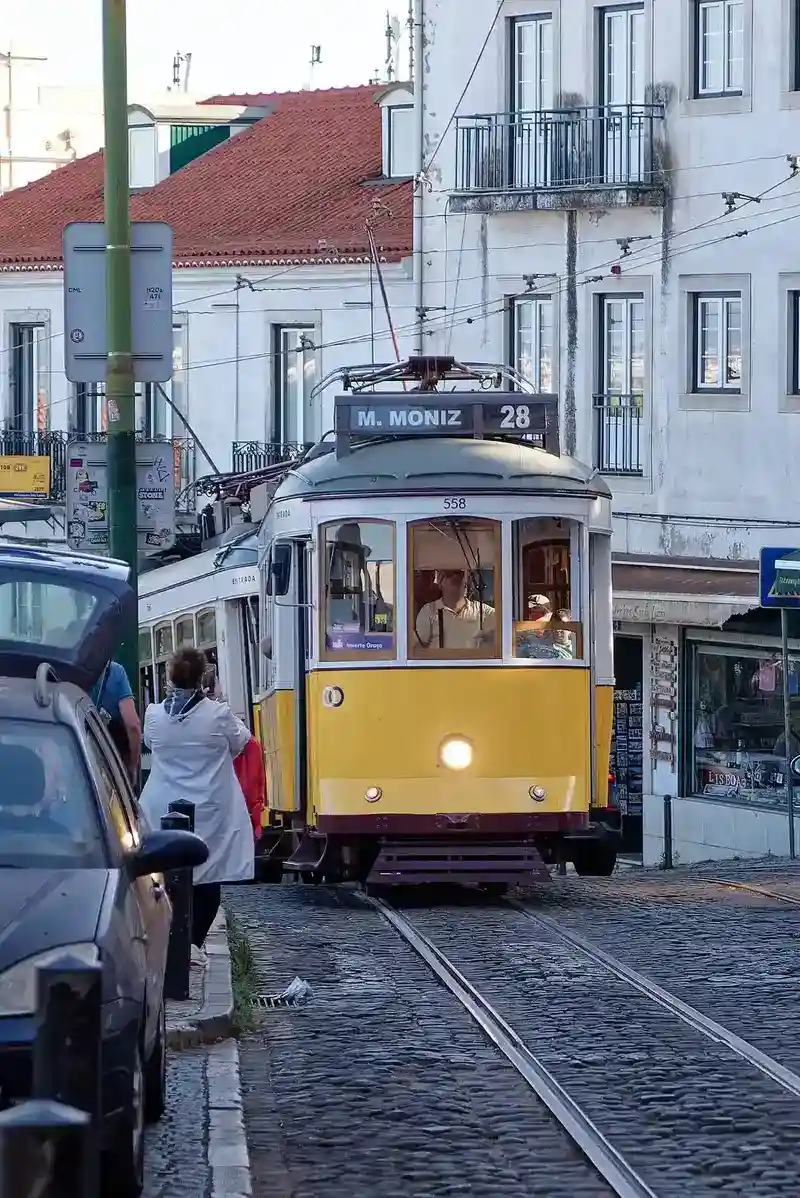
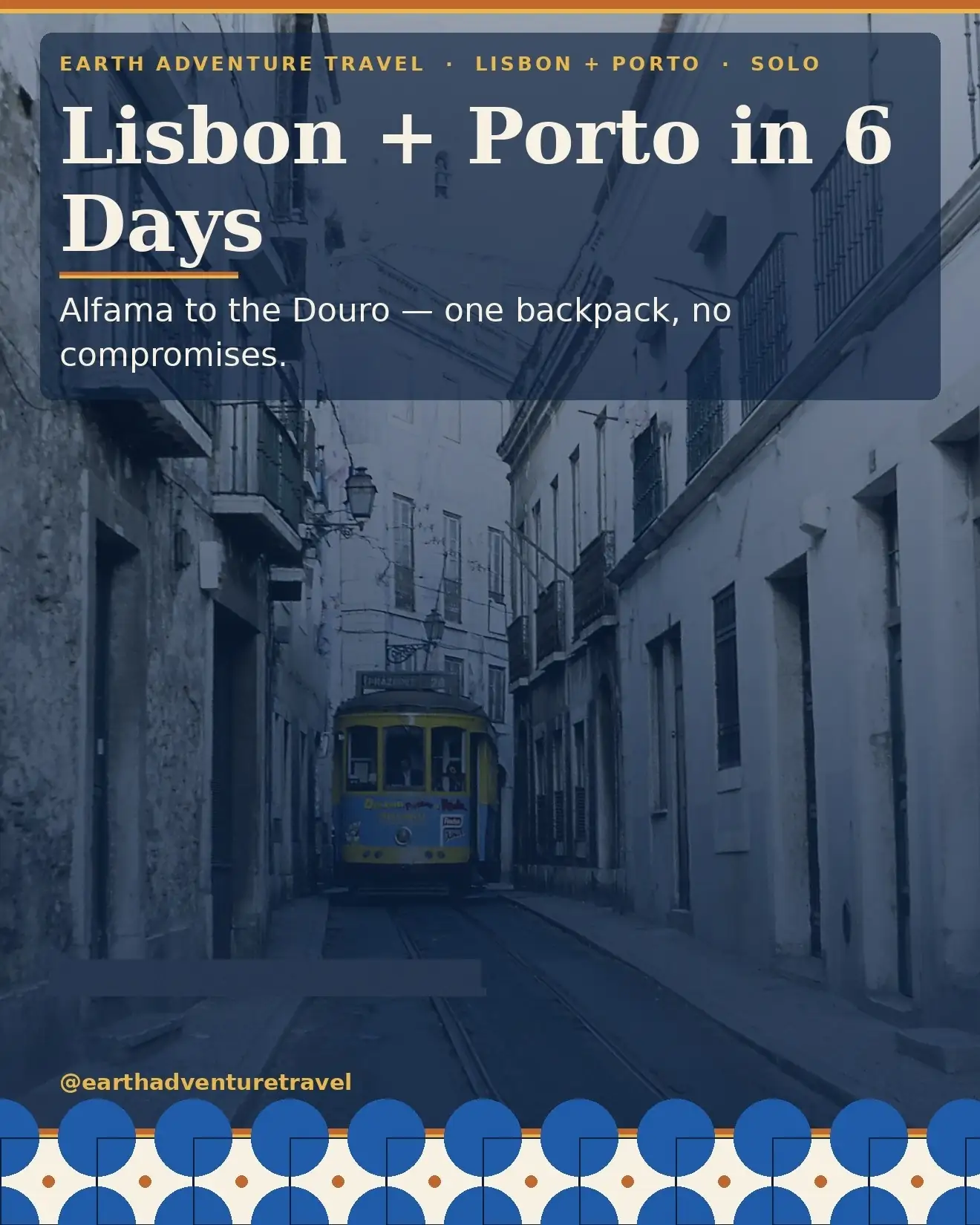
Lisbon + Porto solo travel guide cover: tram 28 in Alfama — a 6-day solo itinerary
Original itinerary artwork
On this page
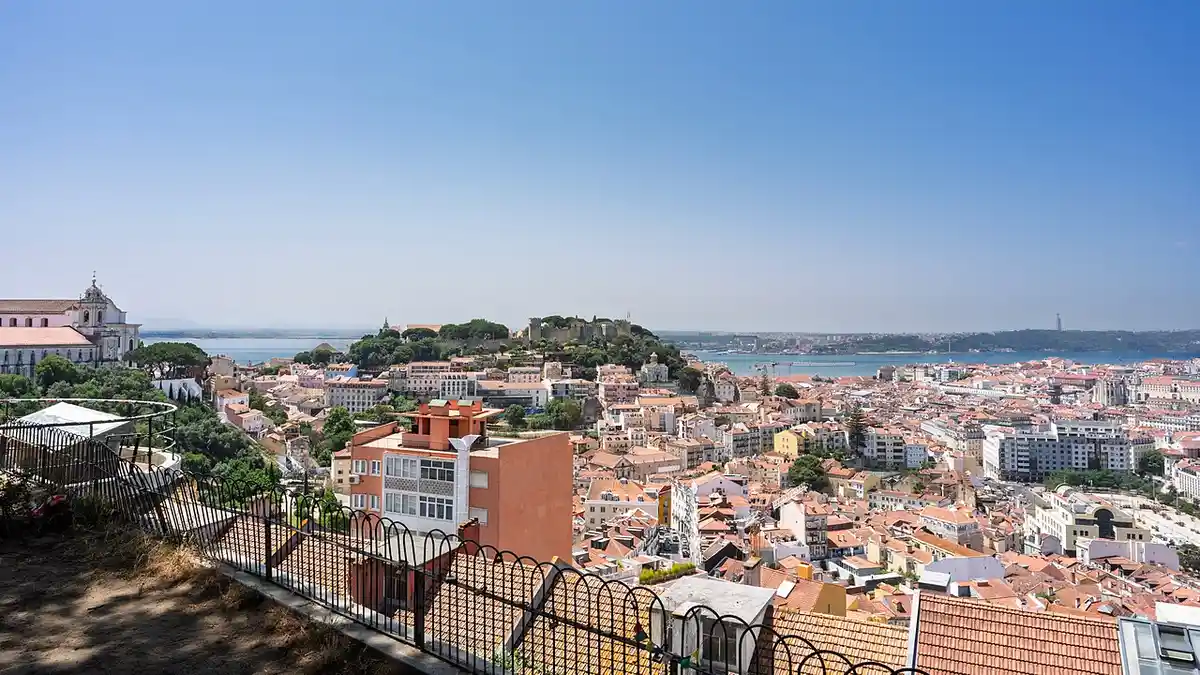
Lisbon from the Miradouro da Senhora do Monte — Alfama rooftops and the Tagus at dusk
Lisbon from the Miradouro da Senhora do Monte — Alfama and the Tagus at dusk. Photo: Dale Cruse / Wikimedia Commons (CC BY 4.0)

The 60-second version

At a glance

Who it's for
Solo travelers — first-timers to Portugal, including solo women; Portugal ranks among the world's safest countries for traveling alone
Route
Lisbon (3 nights) · Porto (3 nights) · Sintra + Douro Valley day trips
Best timing
May–June and September–early October: warm, dry walking weather, full Douro cruise and quinta schedules, and thinner crowds than the August peak
Pace
Easy-moderate — 12,000–18,000 steps a day on hills and calçada cobblestones, one rail travel day, one slow morning built in
Sleep
Lisbon 3 nights → Porto 3 nights; two bases, one intercity train, no packing roulette
Good to know
Book Pena Palace 3–5 days ahead (timed entry is mandatory); the Lisbon–Porto Alfa Pendular runs ~$24–38; ETIAS is not yet live

Rough budget · solo

$600 – $1,500

6 days / 5 nights · lodging, food, trains, attractions · international flights excluded · €1 ≈ $1.12 (October 5, 2026)

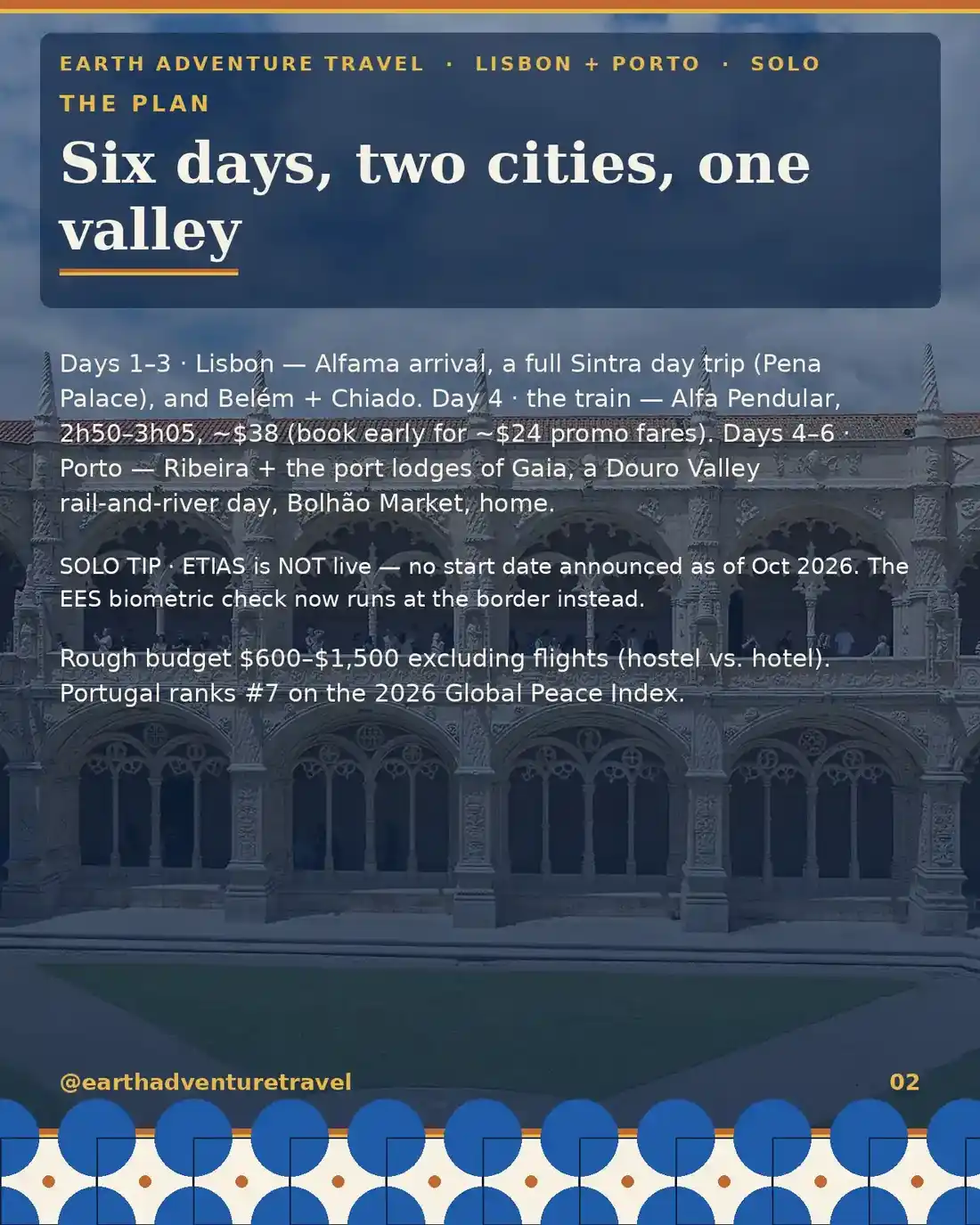
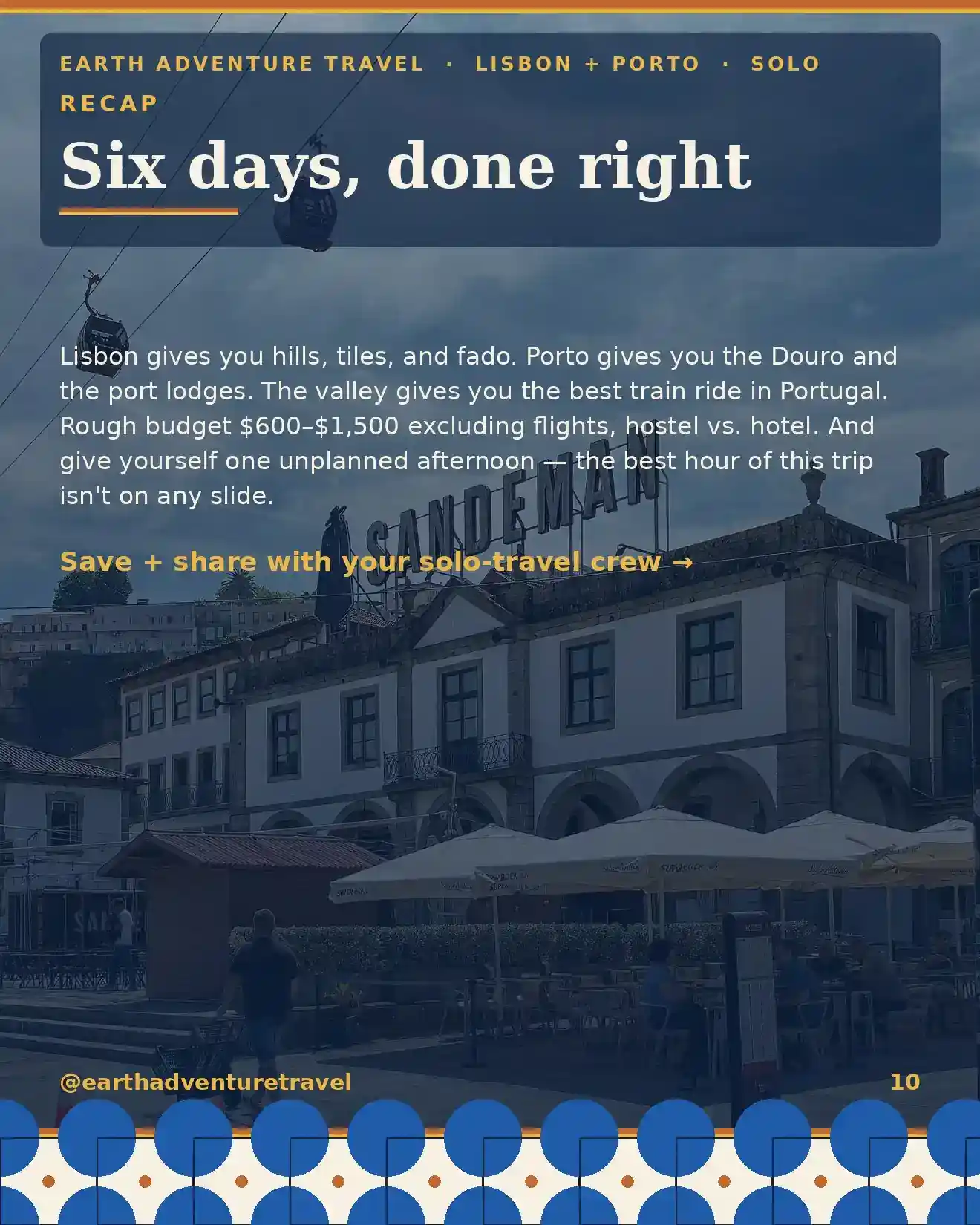
Lisbon + Porto trip recap graphic: 6 days, Alfama to the Douro
Share the plan.

The idea

The direct answer: this is Portugal's greatest-hits route — Lisbon's Alfama and Belém, a Sintra day trip, then the Alfa Pendular north to Porto's Ribeira and the Douro Valley — done in six days with two hotel bases and zero rental car. Every train fare, palace ticket, and tram price below is verified for 2026 and converted to USD at €1 ≈ $1.12. The pacing assumes one traveler: early starts when the crowds are thin, hostel social scenes and group dinners when you want company, and quiet miradouros when you don't.

The route works because Portugal's trains do the heavy lifting. The Rossio–Sintra line puts the fairy-tale palaces 40 minutes from your Lisbon door; the Alfa Pendular covers Lisbon–Porto in under three hours for ~$24–38; and the Douro regional train from São Bento to Pinhão is a sightseeing cruise on rails. No car, no parking hunts in Alfama's lanes, no wrong turns on the N222 — the rails are the itinerary.

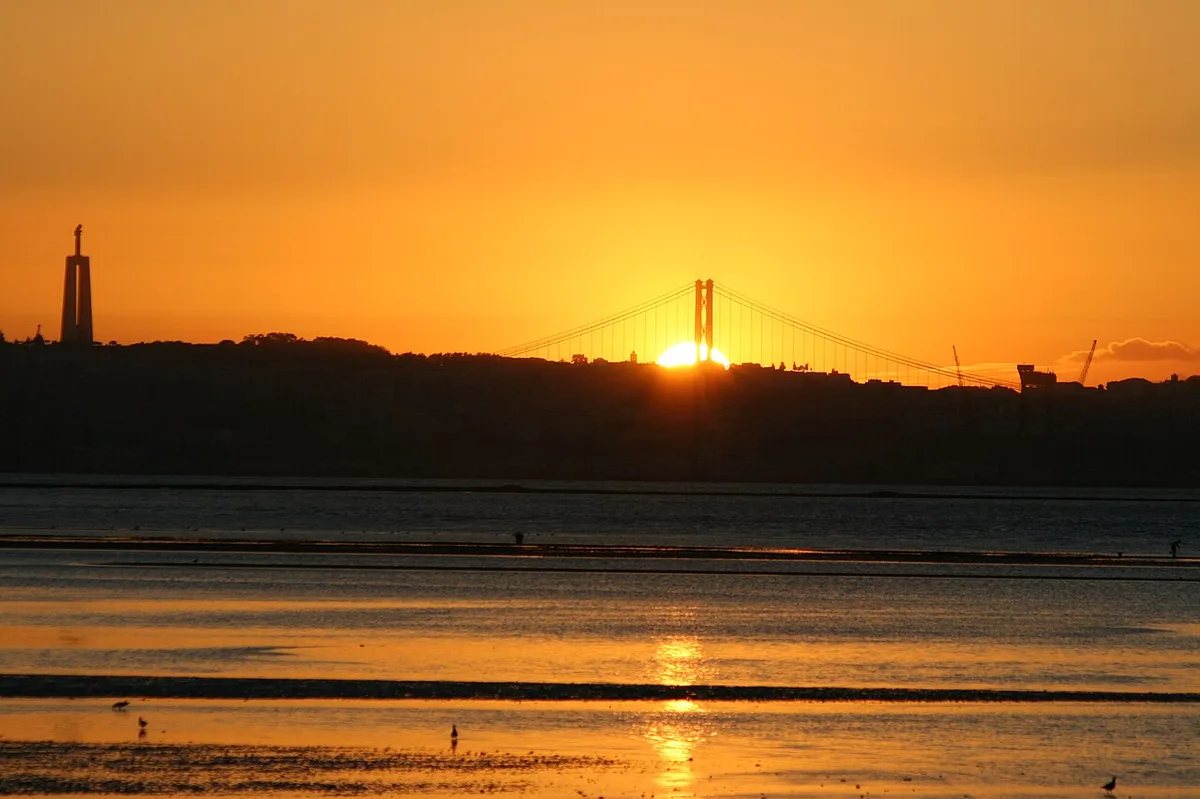
Sunset over the Tagus with the 25 de Abril Bridge, Lisbon
Sunset over the Tagus — the 25 de Abril Bridge from the Lisbon waterfront. Photo: Ricardo Liberato / Wikimedia Commons (CC BY-SA 2.0)

Two ground rules make it work. Book the two timed entries first. Pena Palace requires a timed slot booked 3–5 days ahead, and the Alfa Pendular's cheapest promo fares go ~2 weeks out — miss those windows and you pay full price or queue. And let the solo math work for you. Portugal's hostels run proper social programs (Yes Lisbon's group dinner, PILOT's bar nights), the Douro tour lunches are communal, and a table for one at a tasca counter is the fastest way to get talking to the cook.

6days, 2 bases, 0 rental cars
May–Octshoulder season, full schedules
#12solo-female safety rank, 2026 (Tier 1)
$600–1.5Ksolo budget, 6 days

The six-day route

Day 1 itinerary card: arrive in Lisbon, Alfama evening
Share the day.

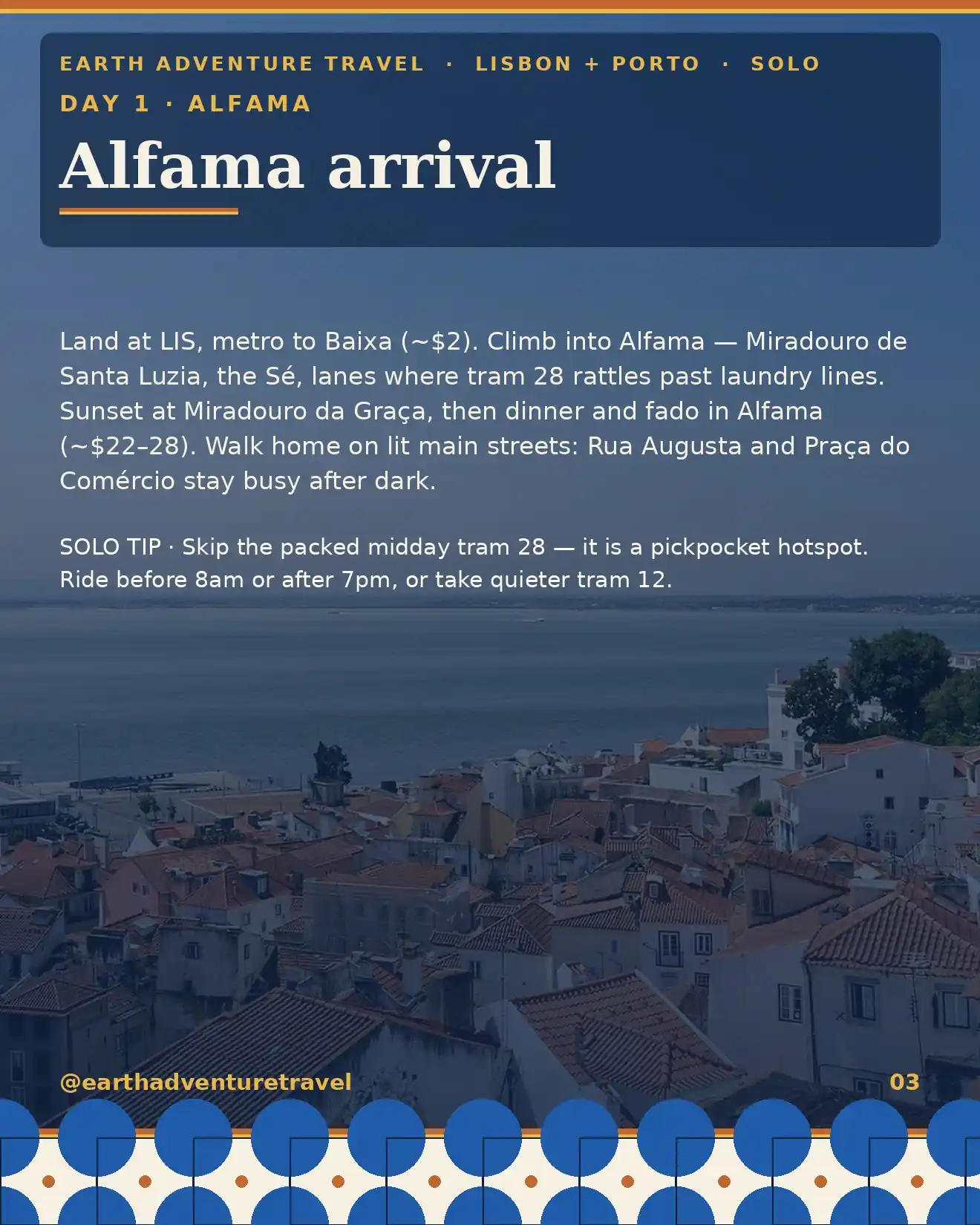
Touch down at Humberto Delgado Airport (LIS), 7 km northeast of downtown. The cheapest ride in is the Metro Red Line from the Aeroporto station: about 20 minutes for $2.13, plus a one-time $0.56 Navegante card from the machines. The old Aerobus shuttle is permanently discontinued. With heavy bags or a late landing, a taxi or Uber/Bolt runs $11–22.

Base yourself in Alfama — the Moorish maze under the castle — and pack light for its lanes. Drop bags, then climb to the Castelo de São Jorge for afternoon light over the Tagus; the ramparts are the city's best orientation lesson. Check castelodesaojorge.pt for 2026 hours and prices. Walk down past the Sé Cathedral to the Miradouro da Senhora do Monte for sunset — free, and the locals' pick.

Alfama after dark is fado territory: book Clube de Fado a day ahead, or start at the Museu do Fado for context. Dinner at Senhor Peixe — grilled fish, vinho verde, reserve ahead. Use the castle's restrooms mid-afternoon. Bad-weather pivot: the Museu do Fado or the Money Museum.

The plan

  • Land at LIS; Metro Red Line to the center ($2.13 + $0.56 card).
  • Check in in Alfama; climb to the castle for afternoon light.
  • Sunset at Senhora do Monte; fado + dinner in Alfama.

Where to stay

  • Memmo Alfama — design hotel, rooftop terrace and plunge pool over the Tagus.
  • Santiago de Alfama — restored 15th-century mansion under the castle.
  • Yes Lisbon Hostel (Baixa) — group dinner and pub crawl; the solo social pick.
Day 1 → Day 2: Sintra tomorrow — trains leave from Rossio station.

If the flight was brutal, skip the castle and sleep. Alfama's lanes will still be there tomorrow.

Solo tip

Alfama's lanes are safe but poorly lit — stick to the lit main lanes on night one, and share your live location with someone back home.
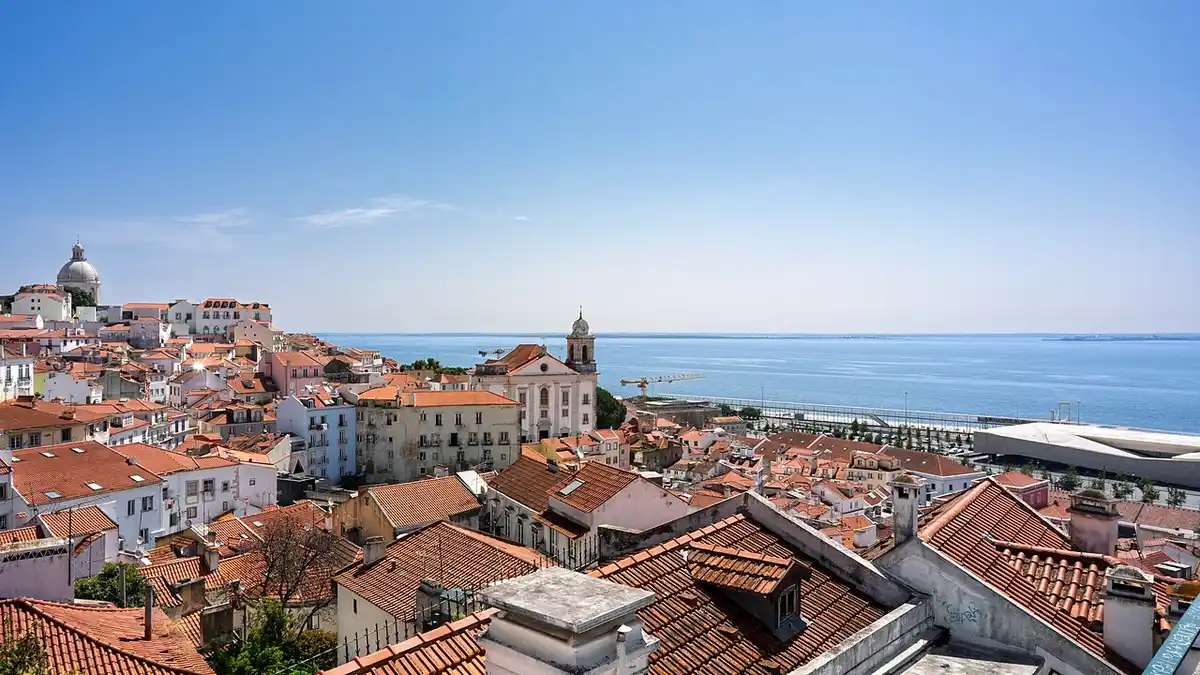
Alfama rooftops and the Tagus River, Lisbon
Alfama rooftops and the Tagus — the Day 1 evening view. Photo: Dale Cruse / Wikimedia Commons (CC BY 4.0)
Day 2 itinerary card: Sintra day trip, Pena Palace
Share the day.

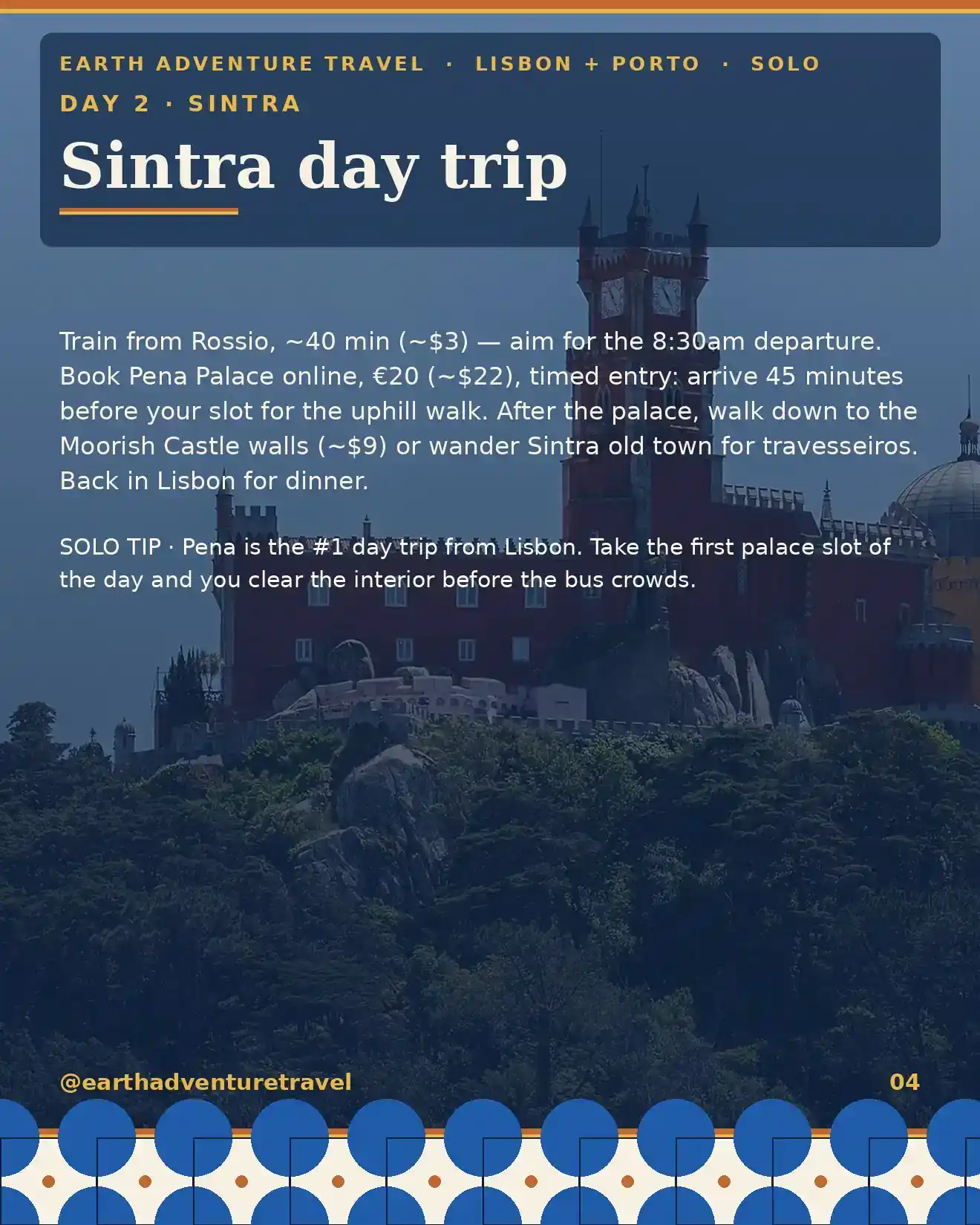
Rossio station → Sintra runs about 40 minutes for ~$3 each way — take an early train. Pena Palace requires a timed entry booked 3–5 days ahead at parquesdesintra.pt: palace + park $22, park-only $11; palace 9:30–18:30, park 9:00–19:00. Book the earliest slot, enter the park gates at 9:00, and walk the 20–30 minute uphill garden path, or ride the park shuttle.

Pena's facades are the postcard; the terraces are the experience — walk the full rampart loop for the Sintra hills to the Atlantic. Then the Moorish Castle walls (separate ticket; check the official site for 2026 prices) or Quinta da Regaleira — the Initiation Well. Lunch at Tascantiga (petiscos; queues by 1 p.m.).

Back in Lisbon by late afternoon. Sunset at the Miradouro da Graça, then dinner. Restrooms at the park entrance and palace; almost none on the trails. Bad-weather pivot: the indoor Palácio Nacional de Sintra, or Lisbon's Calouste Gulbenkian Museum.

The plan

  • Early train Rossio → Sintra (~40 min, ~$3 each way); park gates at 9:00.
  • Pena earliest slot ($22 palace+park, booked 3–5 days ahead); terraces + gardens.
  • Moorish Castle or Quinta da Regaleira; Tascantiga lunch; evening in Lisbon.

Where to stay

  • Same Alfama base as Day 1 — no need to move for a day trip.
  • The Independente (Príncipe Real/Bairro Alto) — quieter, design-led.
  • Lisbon Destination Hostel (Rossio) — inside the station building.
Day 2 → Day 3: Belém tomorrow — tram 15 from Praça da Figueira or Cais do Sodré.

The Pena first-slot strategy is the whole game: earliest entry + 9:00 park gates means the terraces with dozens of people, not hundreds.

Solo tip

Solo travelers get Pena's best photos — no waiting for the group on the terrace. Keep valuables zipped on the crowded park shuttle.

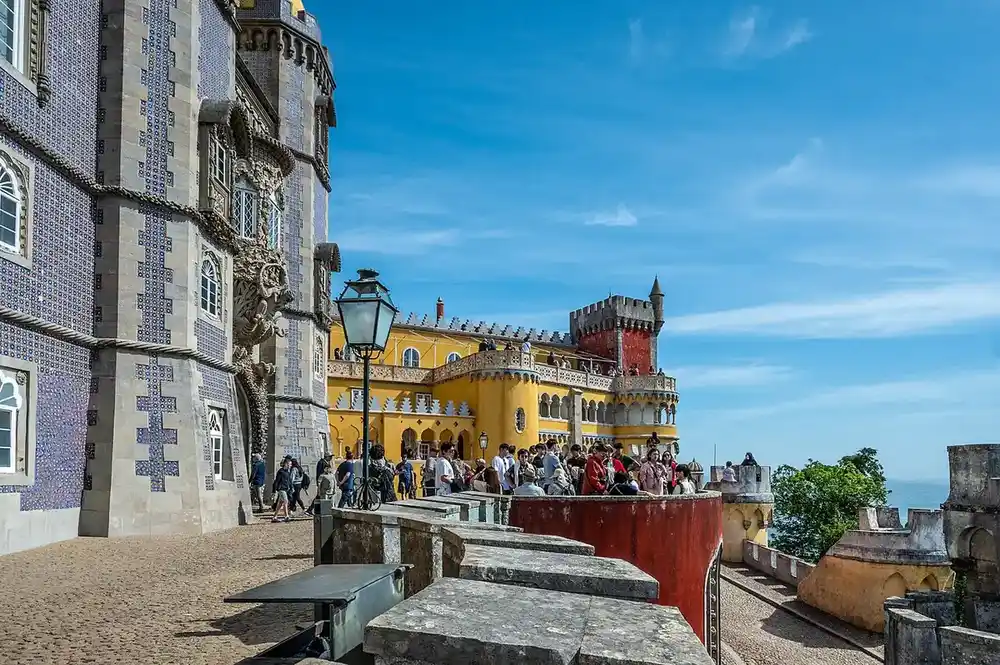
Pena Palace's yellow and red facades with the azulejo tower, Sintra
Pena Palace — yellow facades, red towers, and the azulejo cloister tower. Photo: Michael Gaylard / Wikimedia Commons (CC BY 4.0)
Day 3 itinerary card: Belém and Chiado
Share the day.

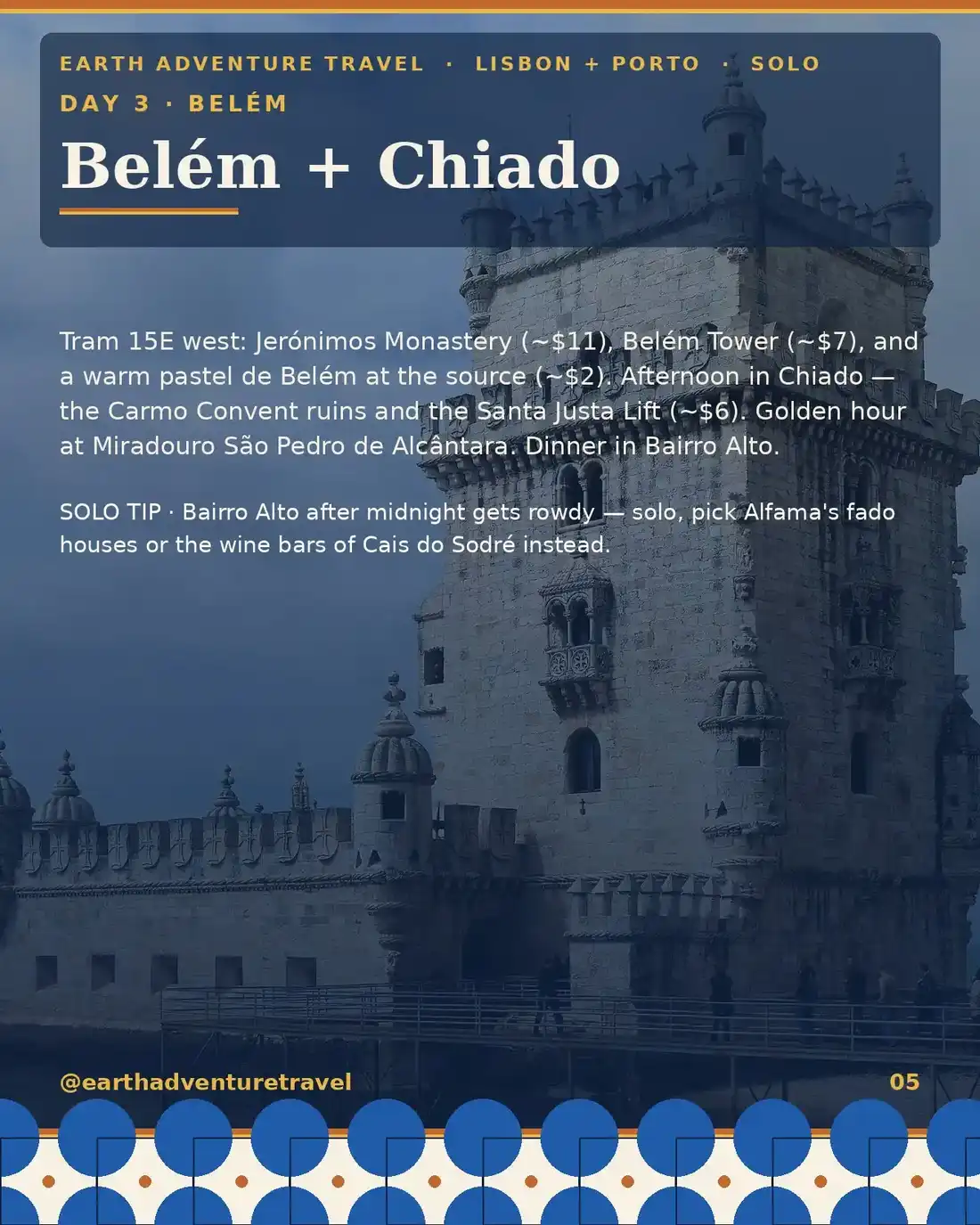
Tram 15 from Praça da Figueira or Cais do Sodré reaches Belém in about 20 minutes ($1.93 zapping vs. $3.70 onboard). Start at the Jerónimos Monastery — arrive at opening; the cloister line builds by 11 a.m. Walk the flat riverside path to the Belém Tower and the Padrão dos Descobrimentos. Then Pastéis de Belém — the 1837 bakery's warm custard tarts, a couple of euros each.

Afternoon in Chiado: skip the Elevador de Santa Justa queue for the free view from the Carmo Convent terrace — the roofless arches are the better photo. Wander Rua Garrett, then rest ahead of tonight. Restrooms: the monastery has facilities; MAAT's café is the riverfront backup.

Evening belongs to Bairro Alto: dinner first (book Taberna da Rua das Flores ahead — 20 seats, always full), then the bar streets. A table for one at a tasca counter is an invitation, not an awkwardness. Bad-weather pivot: MAAT.

The plan

  • Tram 15 to Belém (~20 min); Jerónimos at opening, Belém Tower, Padrão dos Descobrimentos.
  • Pastéis de Belém; afternoon in Chiado — Carmo Convent, Rua Garrett.
  • Evening: dinner + Bairro Alto bar streets.

Where to stay

  • Same Lisbon base — Belém is 20 minutes by tram; no move needed.
  • AlmaLusa Alfama — heritage bones, boutique calm, on the tram line.
  • The Ivens (Chiado) — design hotel in the evening's neighborhood.
Day 3 → Day 4: Alfa Pendular to Porto tomorrow — Santa Apolónia or Oriente; arrive 20 minutes early.

Tram math: zapping at $1.93 vs. $3.70 onboard — the Navegante card pays for itself by the second ride.

Solo tip

Bairro Alto after dark: stay on the main bar streets, keep your drink in sight, and Uber/Bolt back to Alfama rather than walking the unlit lanes alone.

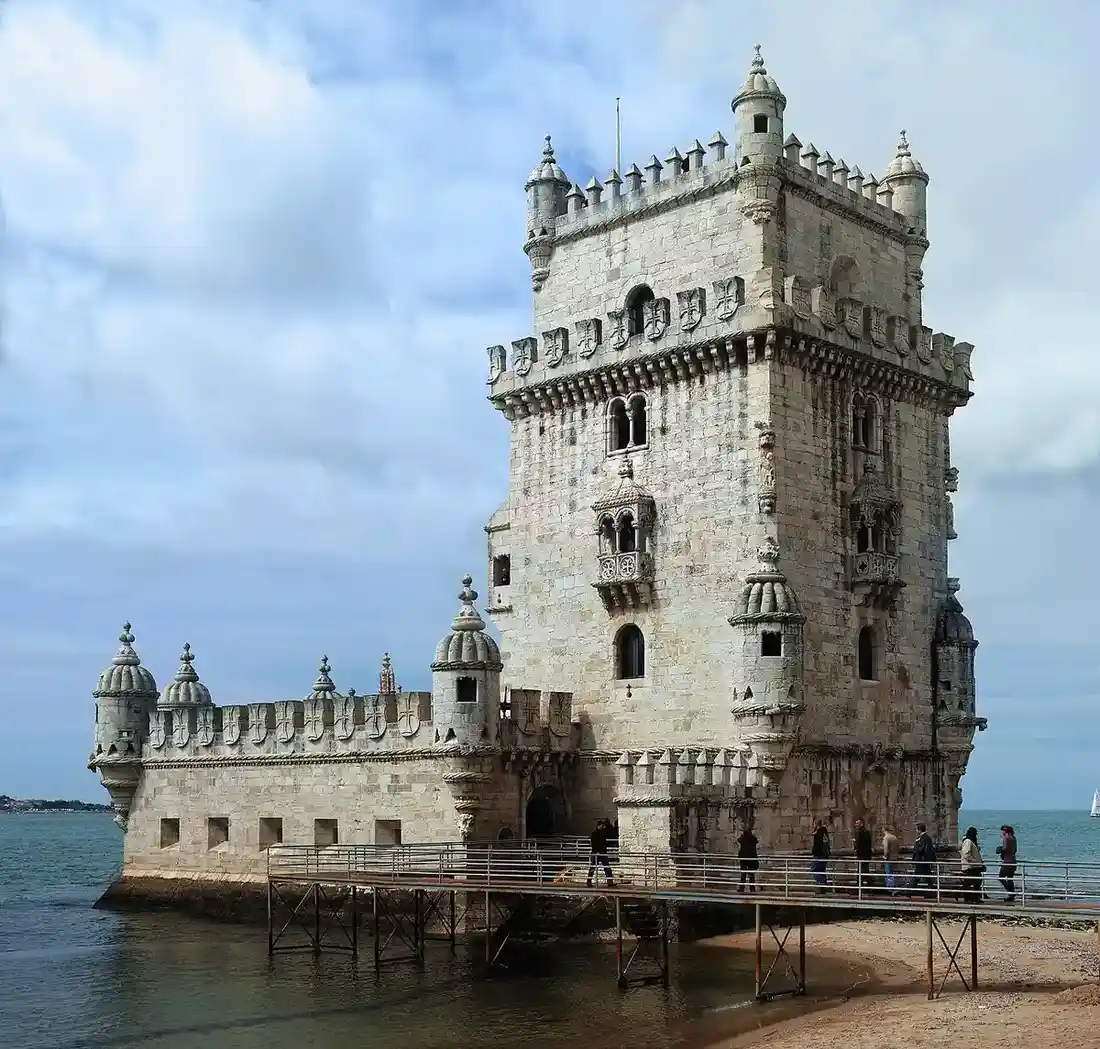
The Belém Tower on the Tagus, Lisbon
The Belém Tower on the Tagus — Manueline stonework at the river's edge. Photo: Alvesgaspar / Wikimedia Commons (CC BY-SA 3.0)

The Tagus doesn't hurry for anyone. In Lisbon, you learn to walk at the speed of looking.

Day 4 itinerary card: Lisbon to Porto, Ribeira
Share the day.

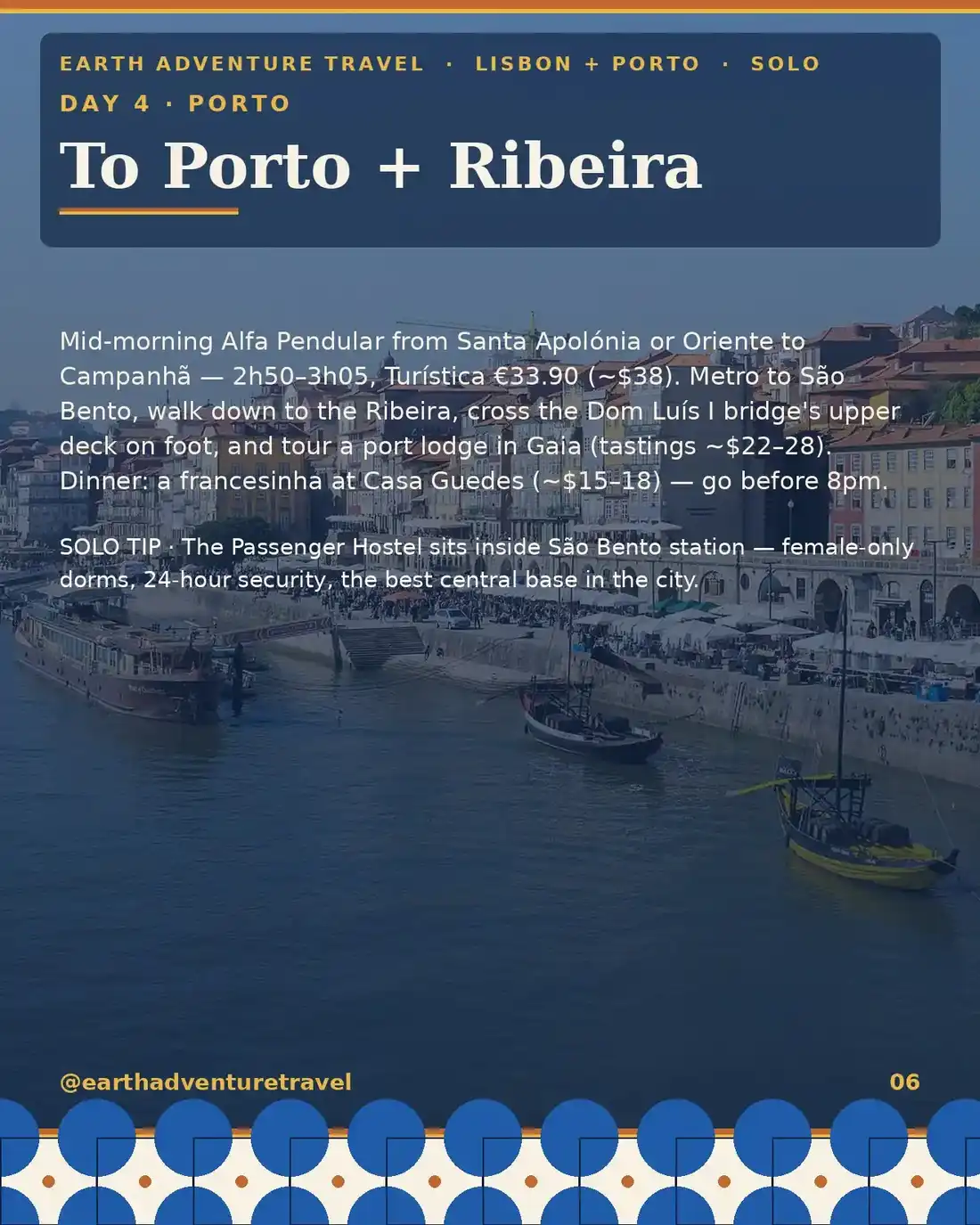
The Alfa Pendular leaves from Santa Apolónia (10 downhill minutes from Alfama) or Oriente: 2h50–3h05 to Porto-Campanhã. Turística $38; promo fares $24–29 booked ~2 weeks ahead at cp.pt; Conforto $56 for the wide seat. The budget play: Intercidades $30–31, 3h15–3h20. At Campanhã, the metro or a short taxi reaches Ribeira — drop bags and walk to the river.

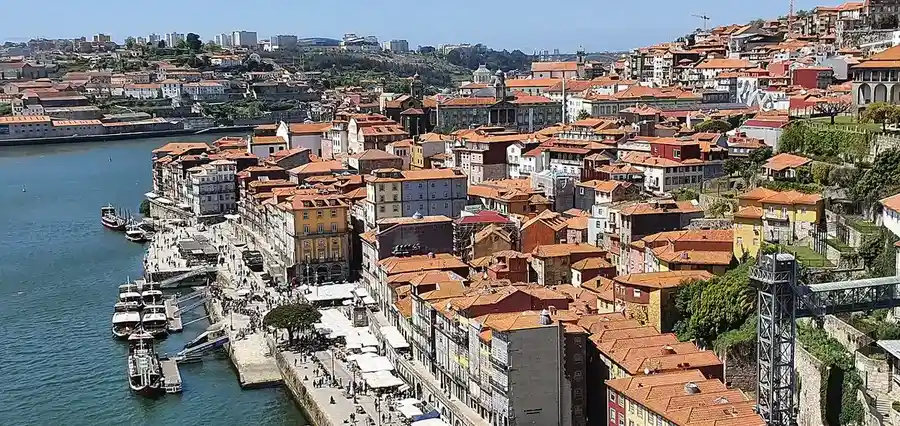
Afternoon: the Cais da Ribeira waterfront, then across the Dom Luís I Bridge upper deck on foot — free, and the single best Porto view. In Vila Nova de Gaia, the port lodges line the river: Taylor's, Graham's, Sandeman run cellar tours with tastings (around $15–25 — check each lodge's site for 2026 prices). Restrooms are easy today — Campanhã station, every lodge tour, the Ribeira cafés.

Evening back in Ribeira: Taberna dos Mercadores (tiny — book ahead) or Adega São Nicolau. Then the riverside at blue hour. Bad-weather pivot: the Palácio da Bolsa tour or Livraria Lello — book the timed entry online, never walk up.

The plan

  • Alfa Pendular Santa Apolónia → Campanhã (2h50, ~$24–38 booked ahead).
  • Ribeira waterfront, Dom Luís I upper deck on foot, Gaia port lodges.
  • Evening: dinner in Ribeira; bridge lights at blue hour.

Where to stay

  • The Passenger Hostel — inside São Bento station: female-only dorms, 24-hour security.
  • PILOT Design Hostel & Bar — social, groups form nightly.
  • Pestana Vintage Porto (Praça da Ribeira) — the splurge: Douro-view rooms.
Day 4 → Day 5: Douro tomorrow — regional trains leave from São Bento station.

Book the Alfa Pendular ~2 weeks out for the $24–29 promo fares.

Solo tip

Gaia's cellar streets empty after dark — taste by day, dine in Ribeira by 10 p.m. The Passenger Hostel's station location keeps you near a lit, staffed building.

Ribeira and the Dom Luís I Bridge from across the Douro, Porto
Ribeira and the Dom Luís I Bridge from across the Douro — Porto's postcard waterfront. Photo: Yair Haklai / Wikimedia Commons (CC BY-SA 4.0)
Day 5 itinerary card: Douro Valley, Pinhão
Share the day.

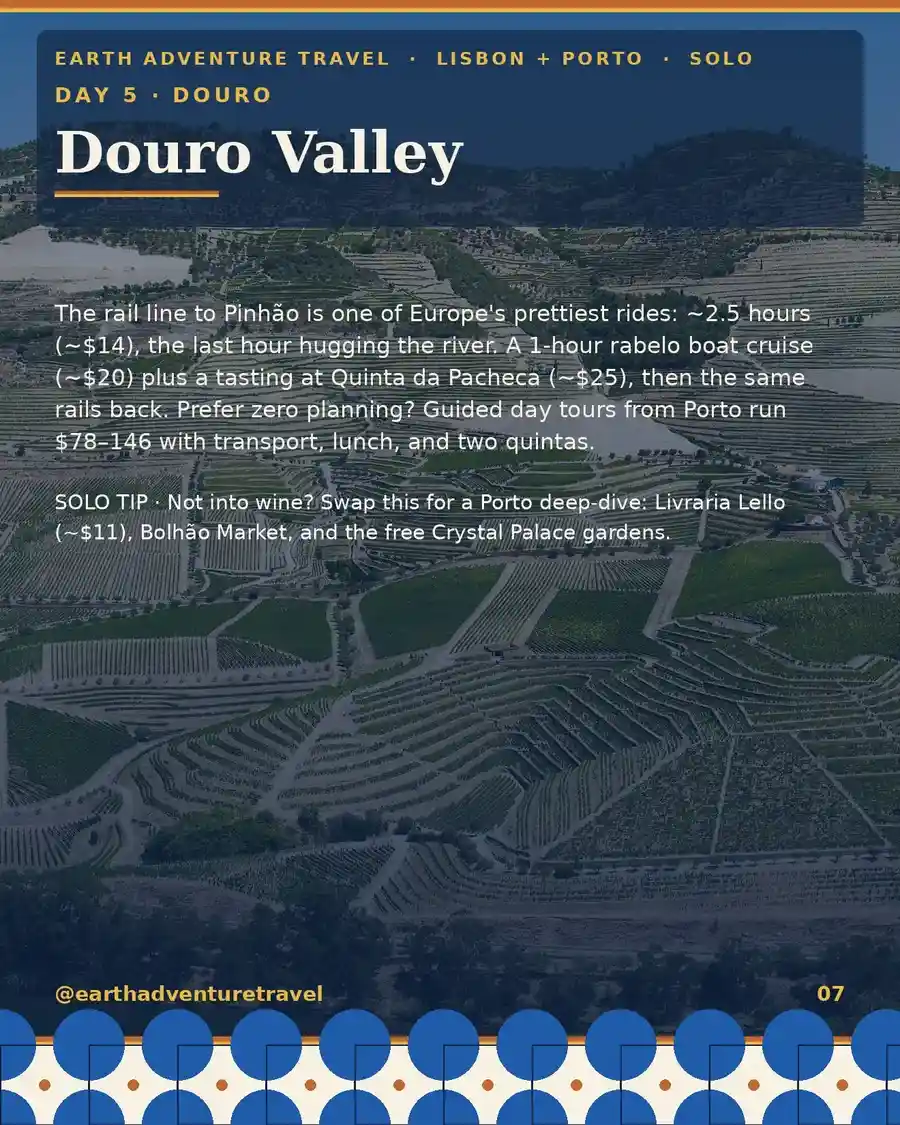
The DIY Douro starts at São Bento station: the regional train to Pinhão takes about 2.5 hours from ~$14 each way, and the ride is the sightseeing. Sit on the right side going east for the river views. From the riverfront, the 1-hour rabelo cruise runs ~$20–25; the Quinta da Pacheca tasting is ~$25 — book ahead, walk-ins get turned away at harvest.

The guided alternative: day tours from Porto $78–146 with transport, lunch, and two quintas — the social option, with communal lunches and someone else driving the N222's curves. Lunch: a quinta table or DOC in Folgosa do Douro (book ahead). The valley runs hotter than Porto; carry water and a hat — the Pinhão platform has no shade.

Return to Porto by evening. Restrooms: Pinhão station, the rabelo docks, every quinta. Bad-weather pivot: the quintas are indoor anyway — trade the cruise for a second tasting.

The plan

  • São Bento → Pinhão regional train (~2.5 h, ~$14 each way); right side going east.
  • Rabelo cruise (~$20–25), Pacheca tasting (~$25, booked ahead), quinta lunch.
  • Evening: return train to Porto; dinner in Ribeira.

Where to stay

  • Quinta da Pacheca — The Wine House Hotel (Lamego) — 18th-century manor, barrel rooms; the wine-country splurge.
  • The Vintage House Hotel (Pinhão) — 5-star on the riverbank; the Douro's grand dame.
  • Keep the Porto base — the DIY train makes this an easy day trip.
Day 5 → Day 6: Last full day — Bolhão market morning, São Bento's azulejo hall, fly home from OPO.

The right-side seat going east is the view seat. The valley runs hotter than Porto — pack a layer for the return.

Solo tip

DIY vs. guided is the solo traveler's real choice: the train is cheaper and the schedule is yours, but the guided tours' communal lunches are where solos meet each other.

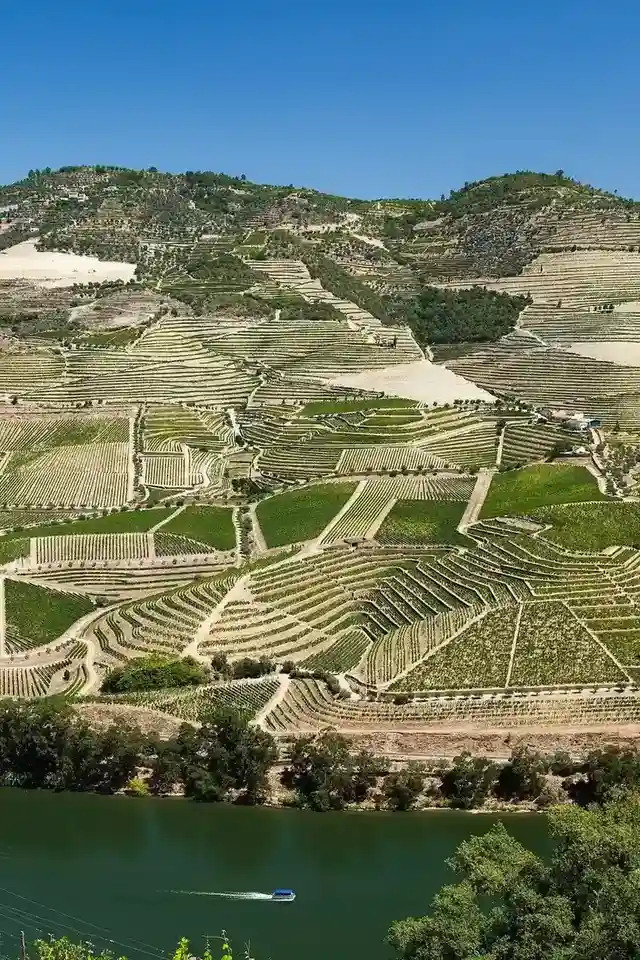
Terraced Douro Valley vineyards above the river with a boat
The Douro's terraced quintas above the river — the Day 5 view. Photo: Grand Parc / Wikimedia Commons (CC BY 2.0)
Day 6 itinerary card: Bolhão market, fly home
Share the day.

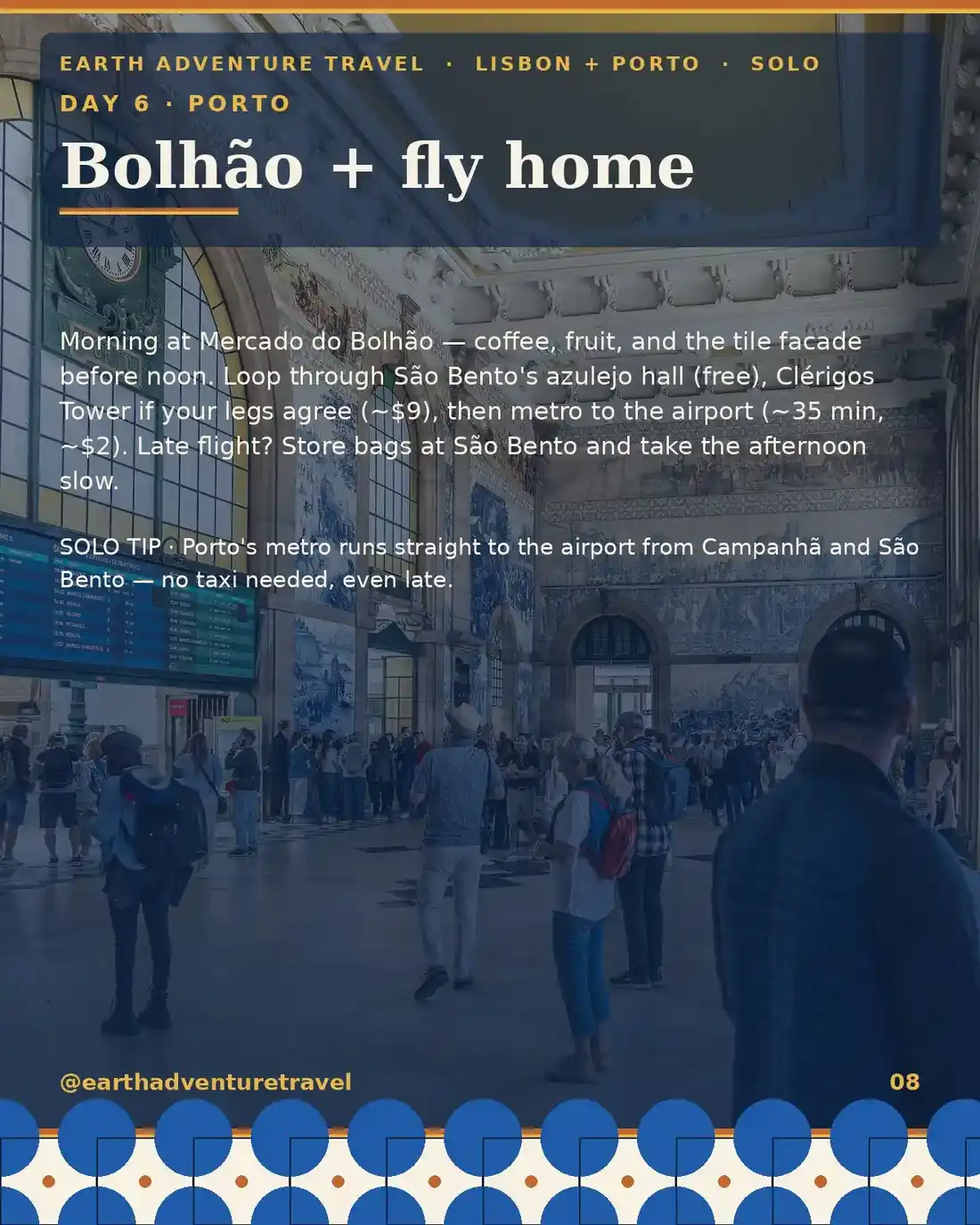
Last morning, sharp logistics. The Mercado do Bolhão — renovated, covered, glorious — is the breakfast plan: go at opening, graze the stalls, and buy the tinned fish and port to take home. Then down Rua de Santa Catarina to Café Majestic — the 1921 art-nouveau café; go early or queue. The market has restrooms; the cafés are the backup all morning.
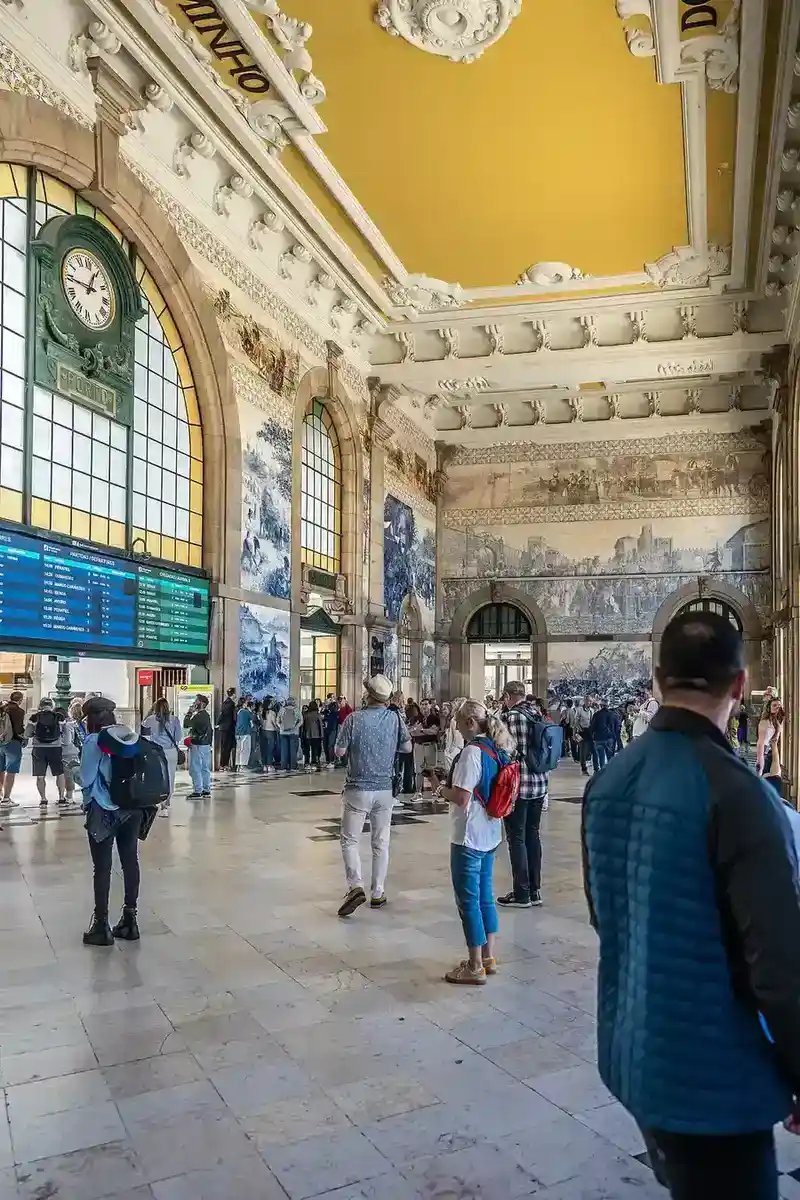
Midday: the São Bento station hall — 20,000 azulejo tiles of Portuguese history, free, ten minutes — then the Sé Cathedral terrace for the last river view. Lunch: the francesinha at Café Santiago (the locals' pick; queues at midday). Bad-weather pivot: the market is covered, and any port lodge you skipped takes walk-ins.

Then Metro Line E from Trindade to Francisco Sá Carneiro Airport (OPO) — about half an hour; buy the Andante card at the station. Be at OPO 2.5–3 hours before a transatlantic departure. OPO is compact and single-terminal — the easiest exit airport in Western Europe.

The plan

  • Mercado do Bolhão at opening — breakfast graze + souvenirs; Café Majestic.
  • São Bento azulejo hall (free), Sé terrace, francesinha lunch.
  • Metro Line E Trindade → OPO (~30 min); 2.5–3 h before departure.

Where to stay

  • No hotel tonight — you're flying home.
  • If the flight is tomorrow: Hotel Carris Porto Ribeira — 4-star on the river, 5 minutes to São Bento.
  • If delayed: the Passenger Hostel takes walk-ins when beds are free.

Day 6 → home: OPO tax-free past security is genuinely good — the tinned fish and the port you skipped in Gaia.
Line E is the cheapest airport run — the Andante card from Trindade beats every taxi fare.

Solo tip

Keep your bag between your feet on the metro, not on the empty seat — you're invisible to the only people who matter on transit: the pickpockets.

São Bento station's azulejo-tiled hall, Porto
São Bento's azulejo hall — 20,000 tiles of Portuguese history. Photo: Michael Gaylard / Wikimedia Commons (CC BY 4.0)
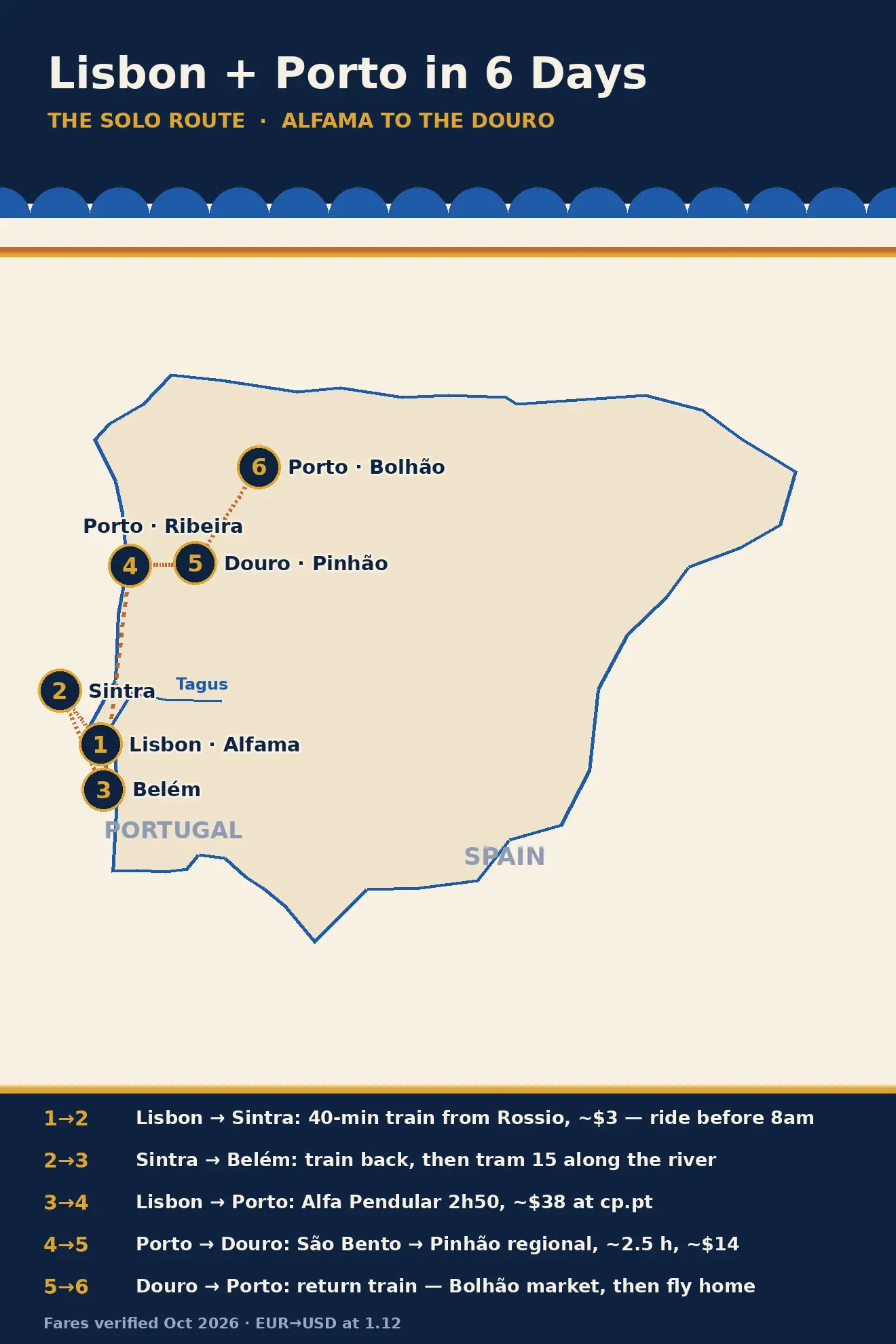
Lisbon + Porto route map: Lisbon (days 1–3), Sintra (day 2), Porto (days 4, 6), Douro Valley (day 5)
Save the route.

The people behind the plans

Who is Earth Adventure Travel?

We build routes for real life — heading out solo, wrangling kids, or spanning generations — and check every detail against official sources so the plan holds up when you get there.

Learn About Us

Plan & pack

Rough budget · solo

$600 – $1,500

6 days / 5 nights · lodging, food, trains, attractions · international flights excluded · €1 ≈ $1.12 (October 5, 2026)

  • Lodging — $250–650: hostel dorms $25–45/night (5 nights), private rooms $60–110, mid-range hotels $120–200/night.
  • Food — $240–420: tasca dinners $15–25, lunch $8–14, pastéis and coffee $3–5; groceries from Pingo Doce cut breakfast costs.
  • Trains & transit — $120–200: Alfa Pendular ~$24–38, Douro return ~$28, Sintra ~$6, metro/trams ~$30 on the Navegante card.
  • Attractions — $100–180: Pena Palace ~$22, port lodge tastings ~$15–25, viewpoints mostly free.
Booking deadlines, compared — miss these and you pay full price or queue
WhatBook aheadWhere2026 price
Pena Palace (timed entry)3–5 daysparquesdesintra.pt$22 palace+park
Alfa Pendular Lisbon–Porto~2 weekscp.pt$24–29 promo
Quinta da Pacheca tastingA few daysquinta site~$25
Douro guided day tour3–7 daystour operators$78–146
Tram 28No booking — ride before 8 a.m.onboard / zapping$3.70 / $1.93
Livraria Lello1–2 daysbook onlineTimed entry — never walk up

Pack for the trip

  • Broken-in walking shoes with grip — 12,000–18,000 steps a day on calçada cobblestones, which turn slick in rain.
  • Small crossbody or money belt — Tram 28 and Baixa crowds are pickpocket territory; front pockets only.
  • Light layers + packable rain shell — shoulder seasons swing between sunny miradouros and Atlantic showers.
  • Refillable water bottle — Lisbon's tap water is excellent; the Douro valley runs hot with few fountains.
  • Portable charger — maps, train QR codes, and timed-entry tickets drain phones by mid-afternoon.
  • One nicer outfit — fado houses and Gaia tasting rooms reward the traveler who didn't dress for the trail.
  • Padlock for hostel lockers — Yes Lisbon and the Passenger both provide lockers; bring your own lock.
  • Sunscreen + hat — Pena's terraces, the Douro platforms, and the Dom Luís I upper deck have zero shade.
  • Swimsuit (May–Oct) — hostel pools and the Douro river beaches are the trip's best unplanned afternoons.
  • Copies of bookings offline — Pena Palace and Alfa Pendular tickets live in your email; screenshot the QR codes.
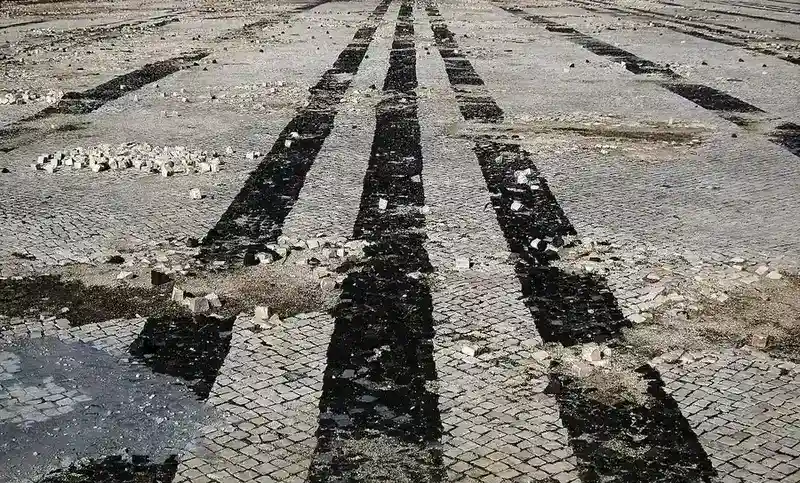
Portuguese calçada cobblestone pavement up close
Broken-in shoes with grip. Lisbon's calçada cobblestones — 15,000+ steps a day on hand-cut limestone that turns slick in rain. Photo: Bosc d'Anjou / Wikimedia Commons (CC BY 2.0)
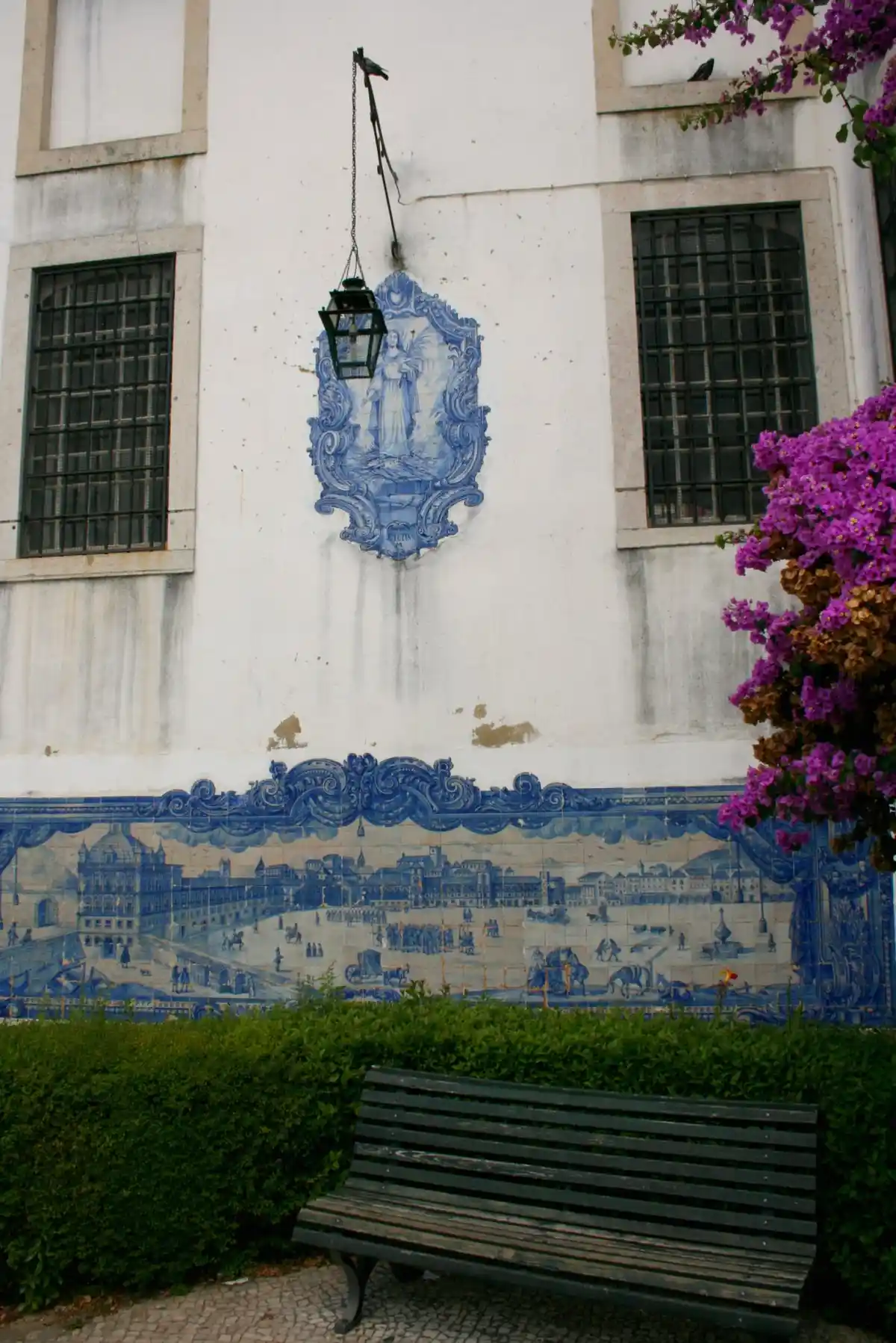
Tiled wall at the Miradouro de Santa Luzia, Lisbon
Light layers. Miradouro walls at golden hour — shoulder-season evenings cool fast once the sun drops behind the hills. Photo: Juan Antonio F. Segal / Wikimedia Commons (CC BY 2.0)
Tram 28 at Largo de Santa Luzia, Lisbon
Crossbody, front pockets. Tram 28 at Santa Luzia — ride before 8 a.m. when it's a tram, not a crush. Photo: Jakub Hałun / Wikimedia Commons (CC BY 4.0)

Eat like a local

Portugal rewards the hungry soloist. Breakfast like a local at a pastelaria — galão and a warm pastel de nata standing up, a couple of dollars. Lunch is the tasca: soup, a prego roll or grilled sardines, vinho verde by the glass. Dinner: one long seafood meal per city — Senhor Peixe in Alfama, a taberna in Ribeira. Counter seats are the norm, not the consolation prize — sit at the counter and the cook talks to you.

Day trips & swaps

Got a seventh day? Cascais pairs with Belém day — 40 minutes by train from Cais do Sodré, beaches and the Boca do Inferno cliffs. Évora is the inland swap: Roman temple, bone chapel, Alentejo wine, 1.5 hours by bus from Sete Rios. Rainy Sintra day? Trade Pena's park for the indoor Palácio Nacional de Sintra and add the Quinta da Regaleira gardens between showers.

Planning notes

Is Portugal safe for solo travelers — including solo women?

Yes — Portugal is one of the safest bets in Europe for traveling alone. It ranks #12 on CEOWORLD's 2026 safest-countries index (Tier 1 "Elite" for solo female travel) and #7 on the 2026 Global Peace Index; Lisbon scores 70.1 for personal security.

Normal city awareness applies — pickpockets work Tram 28 and the Baixa crowds, and Bairro Alto's bar streets deserve the usual drink-awareness. Violent crime against tourists is rare. The hostels on this route (The Passenger's female-only dorms, Yes Lisbon's social setup) are built for solos.

When is the best time to do Lisbon + Porto?

Go in the shoulder season: May–June or September–early October. You get warm, dry walking weather, the Douro quintas and river cruises running full schedules, and thinner crowds than July–August.

Winter is mild but wet — the Douro goes quiet and some quintas close. August brings peak heat, peak prices, and Pena Palace slots that sell out days ahead. This itinerary is built for the shoulder months.

How much does 6 days in Portugal cost for a solo traveler?

Roughly $600–$1,500 for 6 days and 5 nights, excluding international flights. Western Europe's solo daily band runs $75–150/day: hostel dorms $25–45/night, mid-range hotels $120–200/night, food $40–70/day.

The big-ticket items: Alfa Pendular ~$24–38, Douro DIY ~$55–65 all-in, Pena Palace ~$22, port tastings ~$15–25. Converted at €1 ≈ $1.12 (October 5, 2026).

Do I need to speak Portuguese in Lisbon and Porto?

Not for this route. English is widely spoken in hotels, restaurants, museums, and on tours in both cities; younger staff switch effortlessly.

Learn the courtesies — obrigado/obrigada (thank you, said by men/women), por favor, bom dia — and menus in tourist zones run in English. Away from the center, a translation app covers the gaps.

What is the best way to get from Lisbon to Porto?

The Alfa Pendular high-speed train. It runs 2h50–3h05 from Santa Apolónia or Oriente to Campanhã: Turística $38, with promo fares $24–29 booked ~2 weeks ahead at cp.pt.

The Intercidades ($30–31, 3h15–3h20) is the budget pick. Flying saves little once airport time is counted; the bus is cheaper but half the comfort.

Is Tram 28 worth it — and is it safe from pickpockets?

It is worth one ride for the Alfama loop — but it is Lisbon's #1 pickpocket hotspot. Ride before 8 a.m. or after 7 p.m., when it is a tram and not a crush.

Pay $1.93 with zapping instead of the $3.70 onboard fare. Tram 12 runs a quieter Alfama loop with a fraction of the crowds — the local's alternative.

Can I do the Douro Valley as a day trip from Porto?

Easily. The DIY version: regional train São Bento → Pinhão (~2.5 hours, ~$14 each way), a 1-hour rabelo cruise (~$20–25), and a Quinta da Pacheca tasting (~$25).

Guided day tours from Porto run $78–146 including transport, lunch, and two quintas — worth it if you want company and zero logistics. Book the tasting ahead either way.

Where should a solo traveler stay in Lisbon and Porto?

Lisbon: Yes Lisbon Hostel (Baixa — famous group dinner and pub crawl, the social pick), The Independente (quiet, Príncipe Real/Bairro Alto), or Memmo Alfama (design hotel with a Tagus-view terrace).

Porto: The Passenger Hostel (inside São Bento station — female-only dorms, 24-hour security) or PILOT Design Hostel & Bar (social). Book hostels 2–3 weeks out in shoulder season.

How do I meet people traveling solo in Portugal?

Portugal is built for it. Yes Lisbon Hostel's group dinner and pub crawl is the classic opener; free walking tours in Alfama and Porto's old town fill with solos; the Douro guided day tours run communal lunches.

Bairro Alto's bar streets and the Gaia cellar tastings are naturally social — and with solo bookings up 83%, you will not be the only one traveling alone.

Do Americans need ETIAS to visit Portugal in 2026?

Not yet. ETIAS is not live — no published start date as of late August 2026, with 2027 the working assumption; the fee is confirmed at $22 when it launches.

The EES biometric border system is live, so expect fingerprint and face scans on entry. US passport holders still get 90 days visa-free in the Schengen zone.

Is Sintra doable without a car?

Yes — the train is the move. Rossio station → Sintra runs ~40 minutes for ~$3 each way on the Navegante card.

From Sintra station, walk 20–30 minutes uphill through the park to Pena Palace or ride the park shuttle. Quinta da Regaleira is a 15-minute walk from the station; the Moorish Castle sits between the two. Parking near Pena is miserable anyway.

What if it rains during the trip?

Every stop has a strong indoor pivot. Lisbon: the Museu do Fado, the Money Museum, or the Calouste Gulbenkian. Sintra in rain: swap Pena's park for the indoor Palácio Nacional de Sintra.

Porto: the Palácio da Bolsa tour and Livraria Lello (book timed entry online). Douro in rain: the quintas are indoor anyway — trade the river cruise for a second tasting.

Before you lock the trip

Sources & official links

Prices converted at €1 ≈ $1.12 (October 5, 2026). Confirm fares, hours, and booking windows on the official sites before you travel — Portuguese pricing changes most often in January.

The trip index

Choose the landscape. Then choose the pace.

Every itinerary gives you a realistic route, daily rhythm, planning notes, and the details that make a solo trip work.

Use the filters above to see the routes that match.

No exact match—yet.

Clear a filter to see the closest routes already in the library.