National ParksFamily

Six days · rainforest, coast & mountains, one US-101 loop

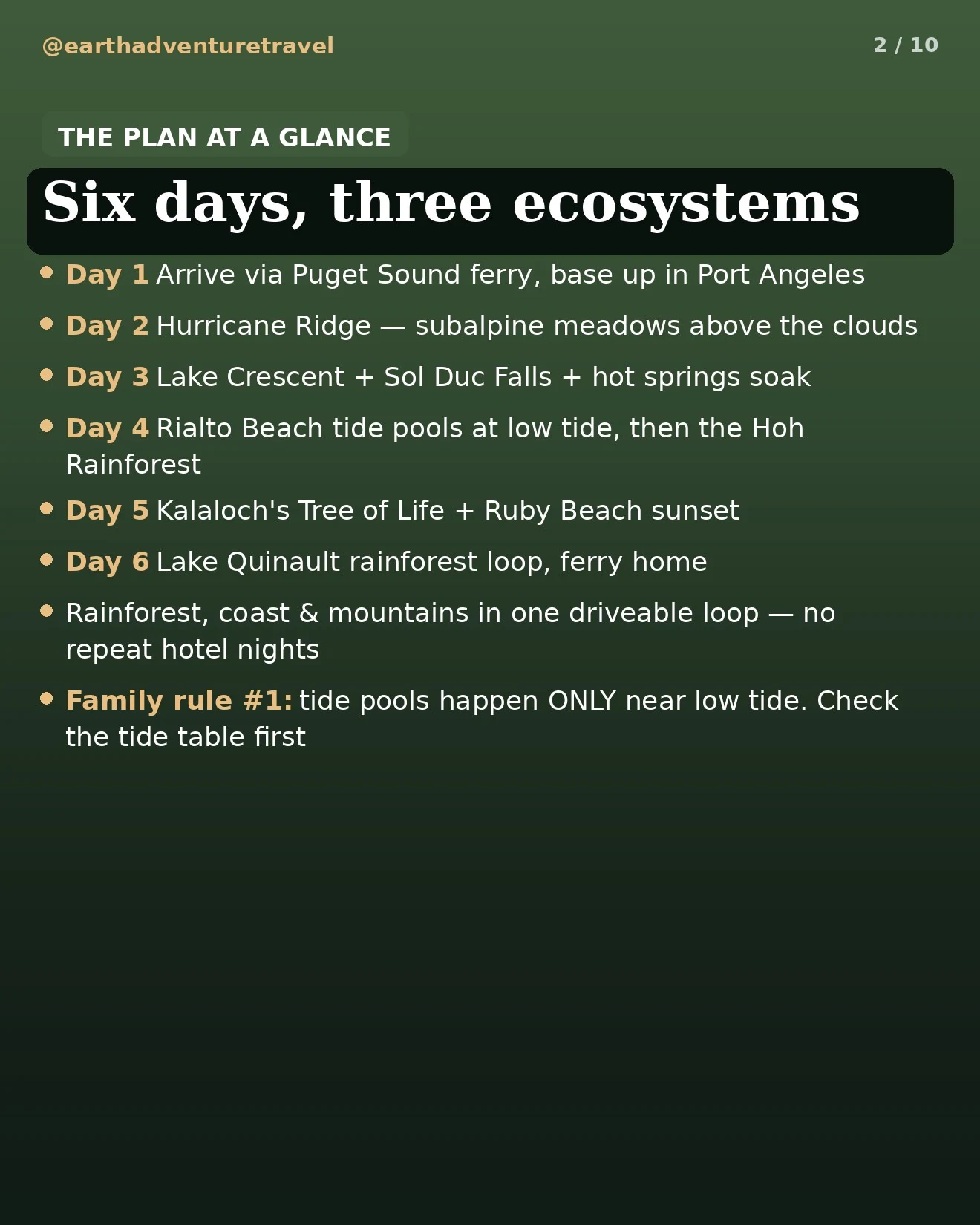
Olympic National Park in 6 Days: Rainforest, Coast & Mountains for Families

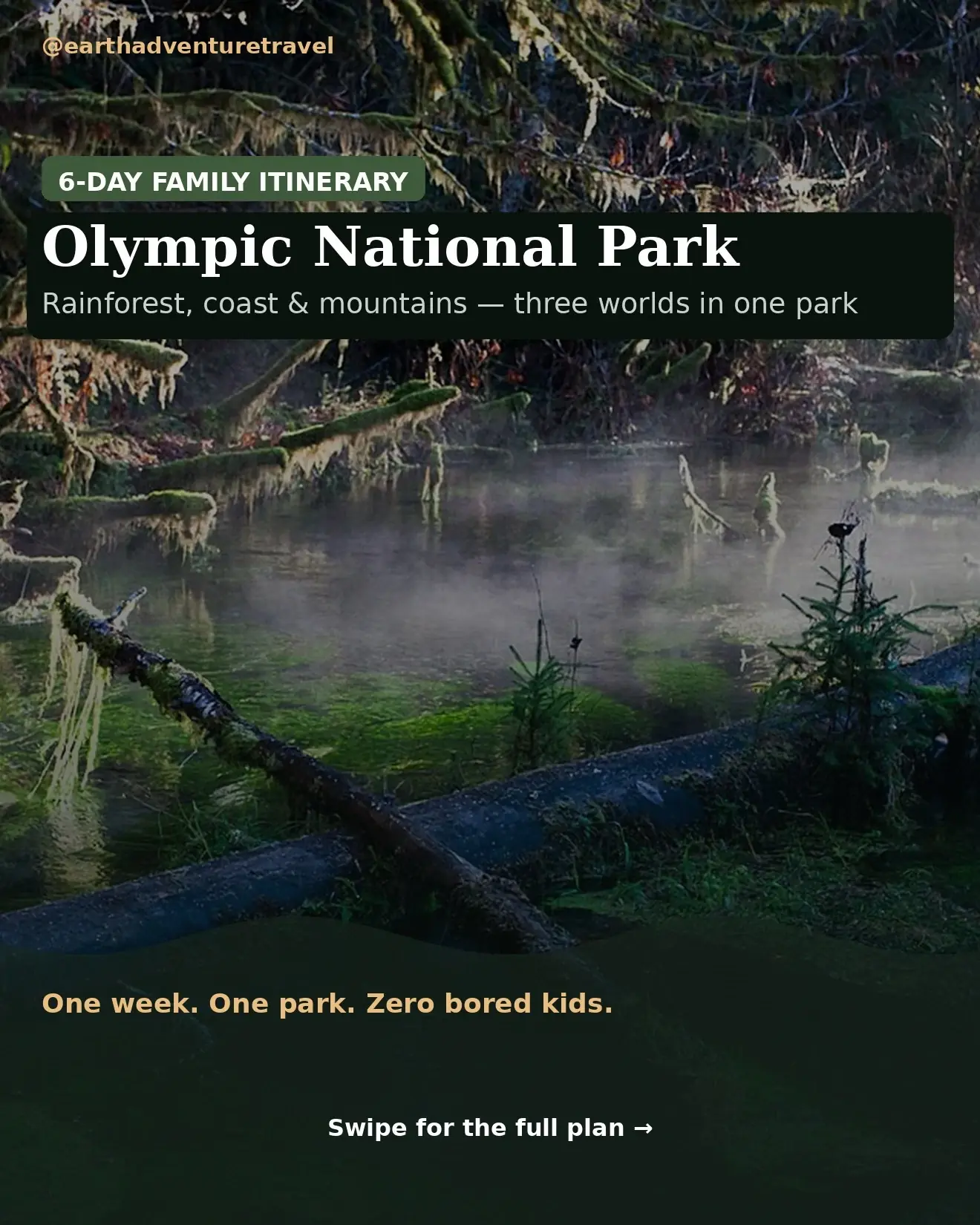
Moss-draped rainforest, tide-pool beaches, and alpine ridges — three worlds in one park, connected by a single drivable loop and paced so the kids stay curious.

National Parks & Wild PlacesCoastal Drives & Beach Towns

6 days / 5 nightsBest Jul–SepFamilyEstimate: $2.8K–$4.2K for 4
Illustrated Olympic National Park guide cover: rainforest, coast and mountains — a 6-day family itinerary
Original itinerary artwork
On this page
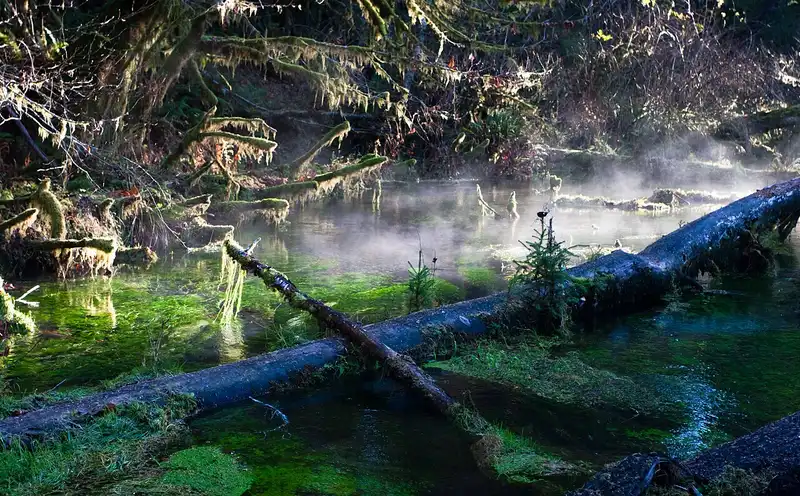
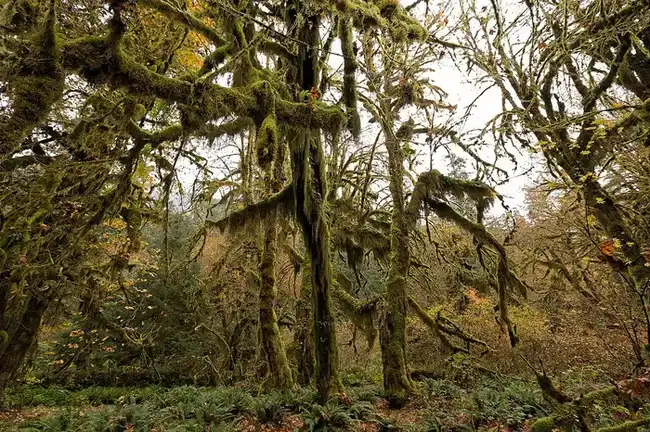
Moss-draped maples along the Hall of Mosses trail in the Hoh Rainforest
The Hall of Mosses — the Hoh Rainforest's cathedral of green. Photo: Brandon Kuschel / Wikimedia Commons (CC BY 3.0)

The 60-second version

At a glance

Who it's for
Families with kids roughly 5 and up who want variety — rainforest trails, tide pools, and mountain views without a single 12-mile day
Route
Port Angeles (2 nights) · Lake Crescent (1 night) · Kalaloch (1 night) · Quinault (1 night) — a US-101 loop, no backtracking
Best timing
Best for travel between July and September: Hurricane Ridge road and Sol Duc Road are reliably open, the Hoh gets its driest weeks, and low tides land in daylight for tide pooling
Pace
Easy-moderate — the longest hike is 3.4 miles round trip; most days mix a morning trail, a midday drive, and an afternoon beach or lake
Sleep
Four bases in five nights; book park lodges 6+ months out — Kalaloch and Lake Crescent sell out for summer
Good to know
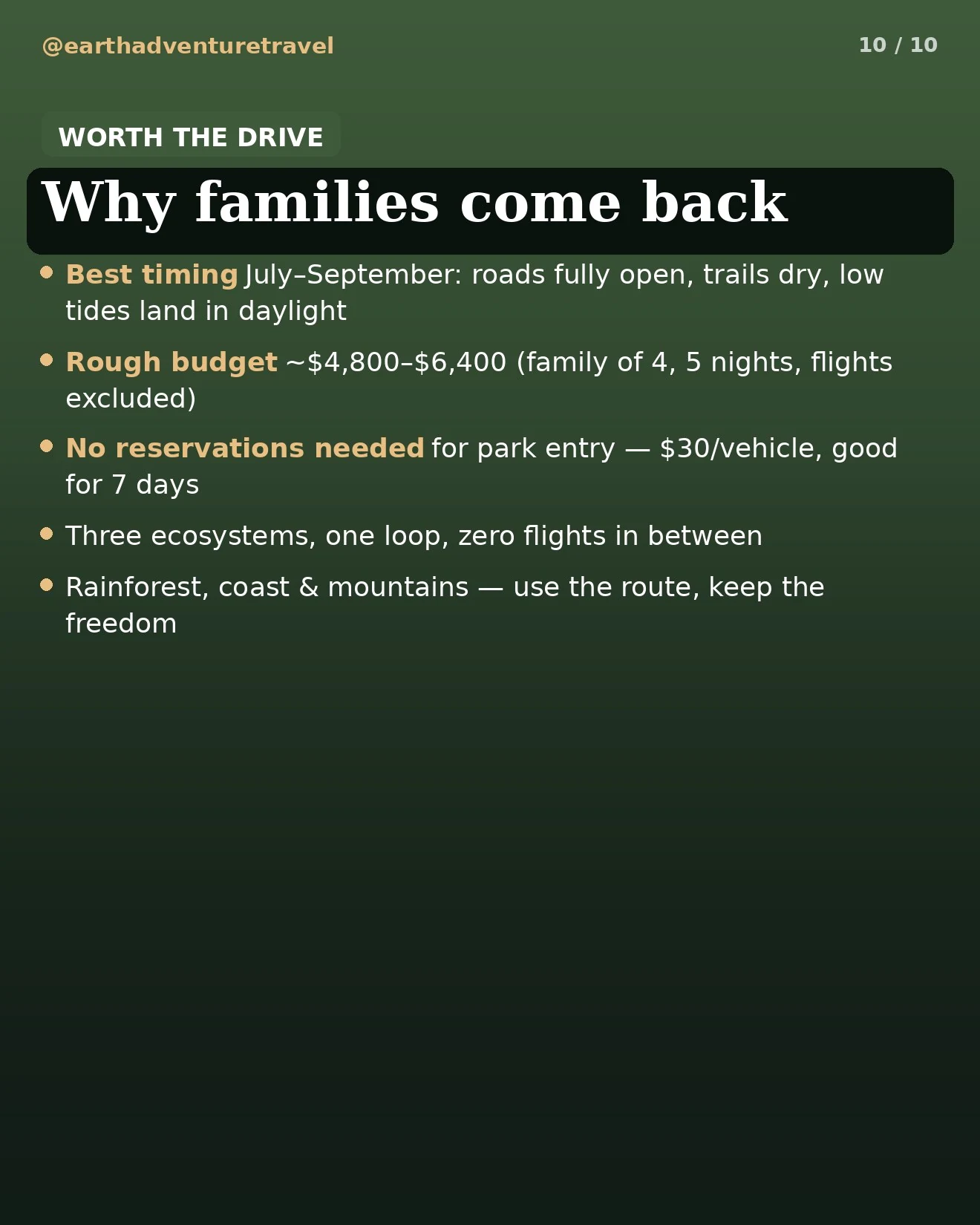
No timed entry and no reservations needed for the park itself — the $30 vehicle pass covers 7 days; the park is cashless, so buy the pass on Recreation.gov before you arrive

Rough budget · family of 4

$2,800 – $4,200

6 days / 5 nights · lodging, food, gas, park pass · flights and rental car excluded

Olympic National Park trip recap graphic: 6 days, rainforest, coast and mountains
Share the plan.

The idea

The direct answer: Olympic is the one national park where variety is the whole point — temperate rainforest, wild Pacific beaches, and alpine ridges, all inside a single drivable loop. This six-day route spends two nights in Port Angeles (Hurricane Ridge day), then moves counter-clockwise around US-101: Lake Crescent and Sol Duc, the coast at Rialto and the Hoh, Kalaloch and Ruby Beach, and out through the Quinault Rainforest. No timed entry, no reservation lotteries — just a $30 vehicle pass and a tide table.

The route works because it follows the park's geography instead of fighting it. Olympic's districts don't connect through the middle — the road goes around. So you go around: mountains first while legs are fresh, the coast timed to a daylight low tide, and the second rainforest as the calm finale. Every driving leg is under two hours, which is the difference between a family trip and a family endurance event.

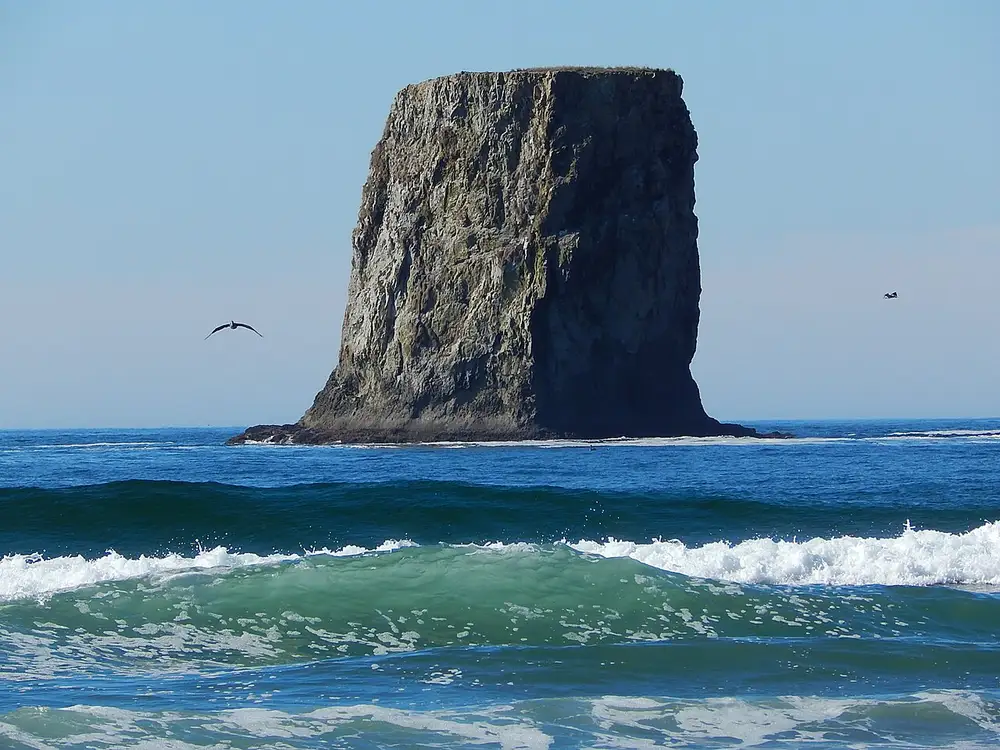
Sea stacks rising off Second Beach on the Olympic coast
Sea stacks off Second Beach — the coast at golden hour. Photo: Ron Clausen / Wikimedia Commons (CC BY-SA 4.0)

Two ground rules make it work. Plan around the tide, not the clock. Rialto's tide pools only exist within about two hours of a low near or below zero feet — check the NOAA La Push tide table before you lock Day 4, and be willing to swap Days 4 and 5 to chase the better low. And bring rain gear even in August. The Hoh gets roughly 12 feet of rain a year; a summer shower is a feature, not a failure — the moss glows brightest when it's wet.

6days, 4 bases, one US-101 loop
3worlds in one park: rainforest, coast, mountains
$307-day vehicle pass, no timed entry
12 ftof rain a year in the Hoh — pack the shells

The six-day route

Day 1 itinerary card: arrive Port Angeles, waterfront evening
Share the day.

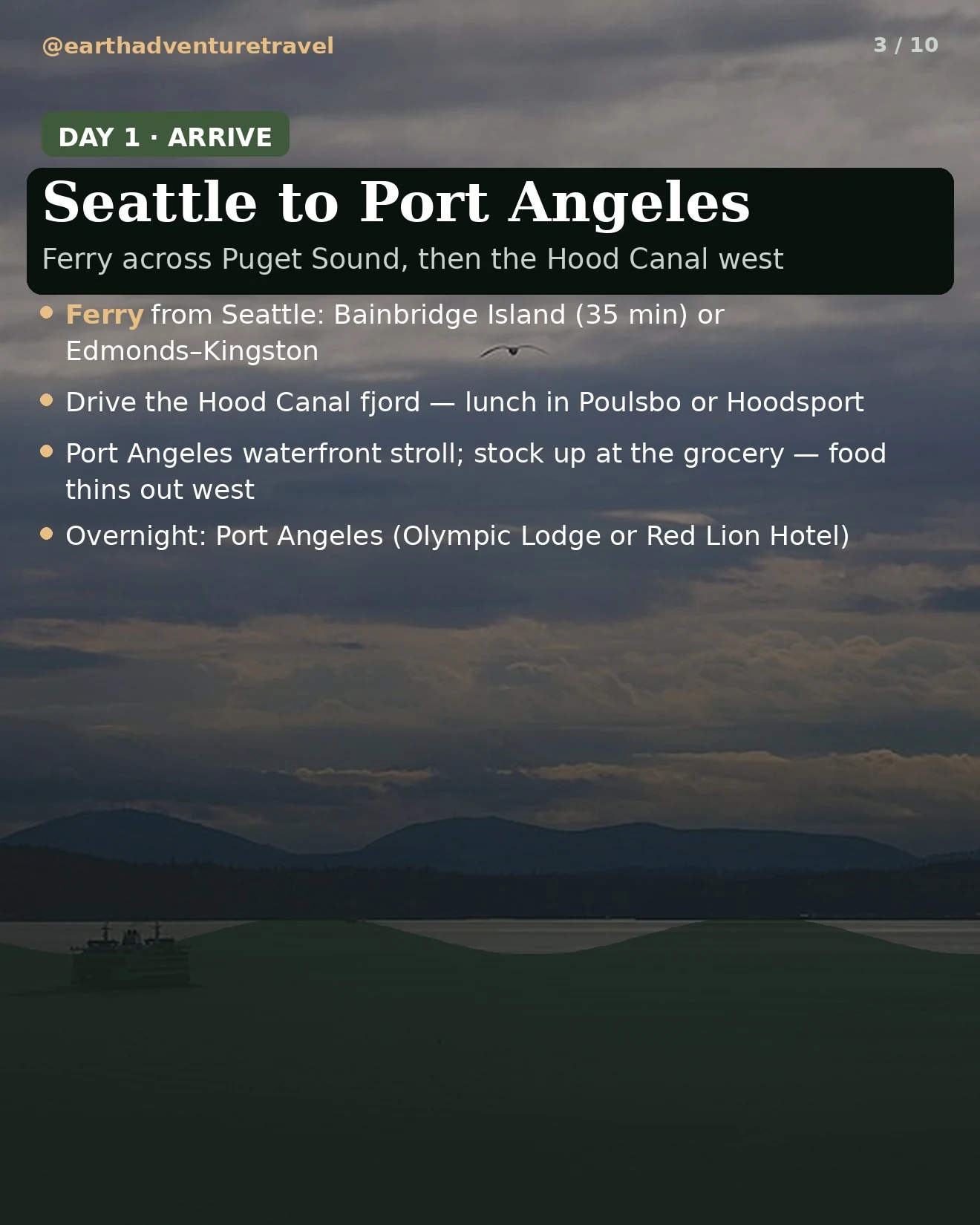
Most families fly into Seattle-Tacoma (SEA) and drive ~2.5–3 hours to Port Angeles. The prettiest route is the Edmonds–Kingston ferry (35-minute crossing, then WA-104 west to US-101) — reserve a vehicle spot in summer, because standby can cost you an hour at the dock. The no-ferry alternative runs I-5 south to Tacoma, then US-101 north around Hood Canal: about 3 hours. Either way, buy the $30 park vehicle pass on Recreation.gov before you arrive — the park is cashless.

Port Angeles earns its evening. The waterfront and Olympic Discovery Trail are flat and paved — perfect for shaking off the travel day — and Hollywood Beach exposes tide pools at low tide. The Feiro Marine Life Center on the pier is a small, hands-on aquarium with touch tanks that buys you a happy hour while the light lasts. Stock up on groceries and snacks here: this is the last real supermarket before Forks, and park lodges charge lodge prices.

Dinner is on the downtown waterfront — the Railroad Avenue strip holds the town's best family options. Keep it early; tomorrow's alarm is the trip's earliest. If the kids still have energy, walk the pier at sunset and watch the ferries cross to Victoria — Canada is 18 miles across the strait.

The plan

  • Land at SEA; drive to Port Angeles via Edmonds–Kingston ferry (reserved) or I-5 + US-101 (~2.5–3h).
  • Buy the $30 park pass on Recreation.gov en route; grocery stop in Port Angeles.
  • Evening: Olympic Discovery Trail stroll, Feiro Marine Life Center, waterfront dinner by 7 p.m.

Where to stay

  • Olympic Lodge — golf-course setting, indoor pool, family rooms.
  • Red Lion Hotel Port Angeles Harbor — on the waterfront, walkable to dinner.
  • E Front Street motels — clean, cheap, 5 minutes from everything.
Day 1 → Day 2: Hurricane Ridge Road leaves from the south end of town — 17 miles, ~45 minutes. Leave by 8 a.m.

Ferry math: reserve the Edmonds–Kingston sailing, or take I-5 and skip the gamble.
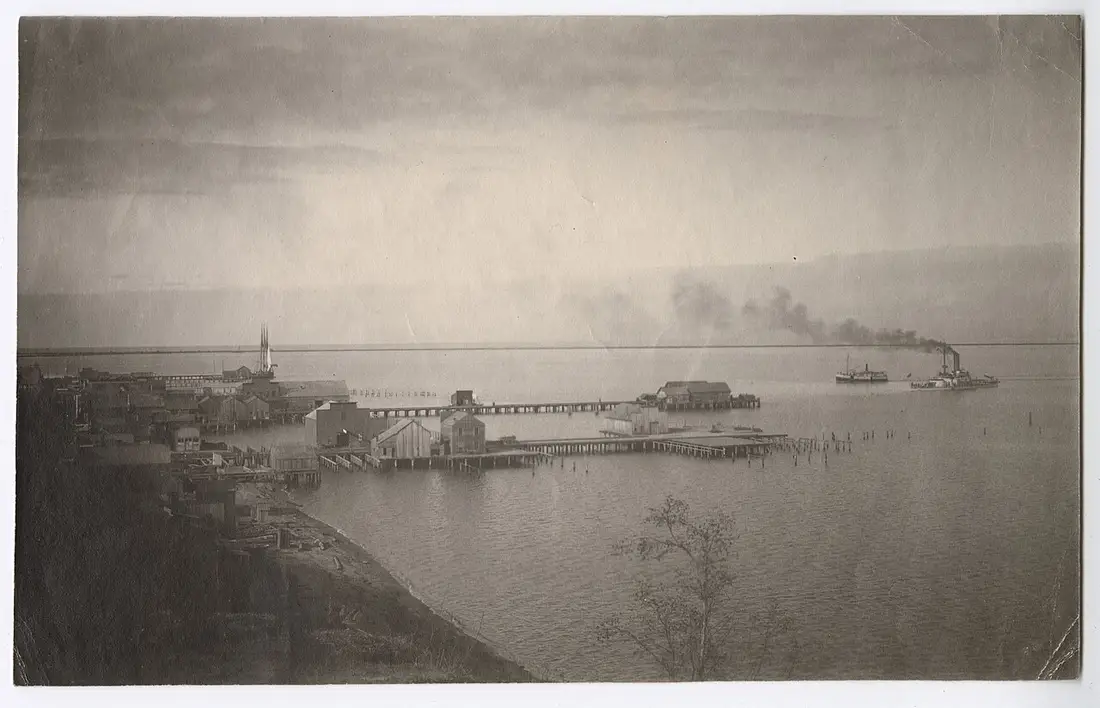
Port Angeles harbor, ca. 1900
Port Angeles harbor, ca. 1900 — the park's front door for over a century. Photo: DPLA / Wikimedia Commons (Public domain)
Day 2 itinerary card: Hurricane Ridge, alpine meadows
Share the day.

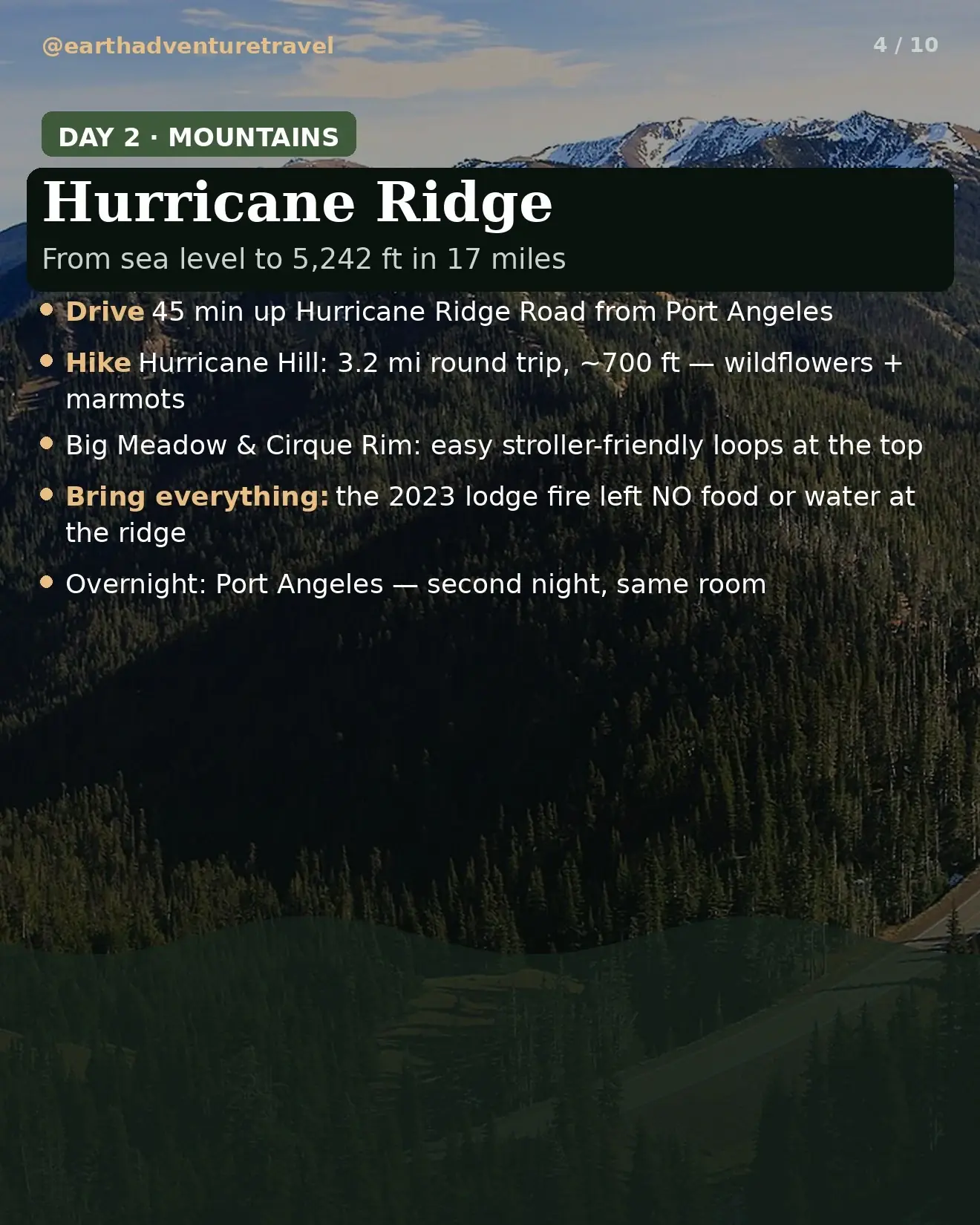
Hurricane Ridge Road climbs 17 miles and 5,242 feet from Port Angeles in about 45 minutes — one of the great short mountain drives in the park system, ending in a subalpine meadow facing Mount Olympus. The lot fills by 10 a.m. on summer weekends, so leave town by 8. The road is seasonal (typically late May–October — confirm on nps.gov/olym), and there is no food or water at the ridge: the Day Lodge burned in May 2023 and as of 2026 there is still no replacement. Pack 2 liters of water per person, lunch, and layers.

The hike is Hurricane Hill: 3.2–3.4 miles round trip, ~700 feet of gain, on a paved trail — genuinely kid-doable, with marmots whistling from the boulder fields and black-tailed deer grazing like they own the place. The grade is steady and the surface suits sturdy sneakers. Honest turnaround: Sunrise Point at 1 mile still gets the big view if little legs quit. Afternoon option: the 0.5-mile Cirque Rim loop from the lot.

The ridge runs 15–20°F cooler than town and the wind is real — fleece and a wind shell even in August, plus sun hats, because there's no shade at 5,242 feet. If the ridge is socked in, pivot: the Park Visitor Center in town (films, exhibits, junior ranger books) plus Madison Falls in the Elwha Valley — a 0.2-mile paved stroll to a 60-foot cascade. Dinner back in Port Angeles; the ridge day ends early and hungry.

The plan

  • Leave Port Angeles by 8 a.m.; 17 mi / ~45 min up Hurricane Ridge Road.
  • Morning: Hurricane Hill (3.2–3.4 mi RT, ~700 ft, paved) — marmots, meadows, the view.
  • Afternoon: Cirque Rim loop or the visitor center; early dinner in town.

Where to stay

  • Olympic Lodge — same base; the pool earns its keep.
  • Red Lion Hotel Port Angeles Harbor — waterfront rooms, easy logistics.
  • Pack tonight: tomorrow you move to Lake Crescent.
Day 2 → Day 3: Back down the ridge road (~45 min), then 25 miles west on US-101 (~35 min) — about 1h20 total to Barnes Point.

No water at the ridge — the burned lodge means zero fountains and zero food. Fill every bottle in town.

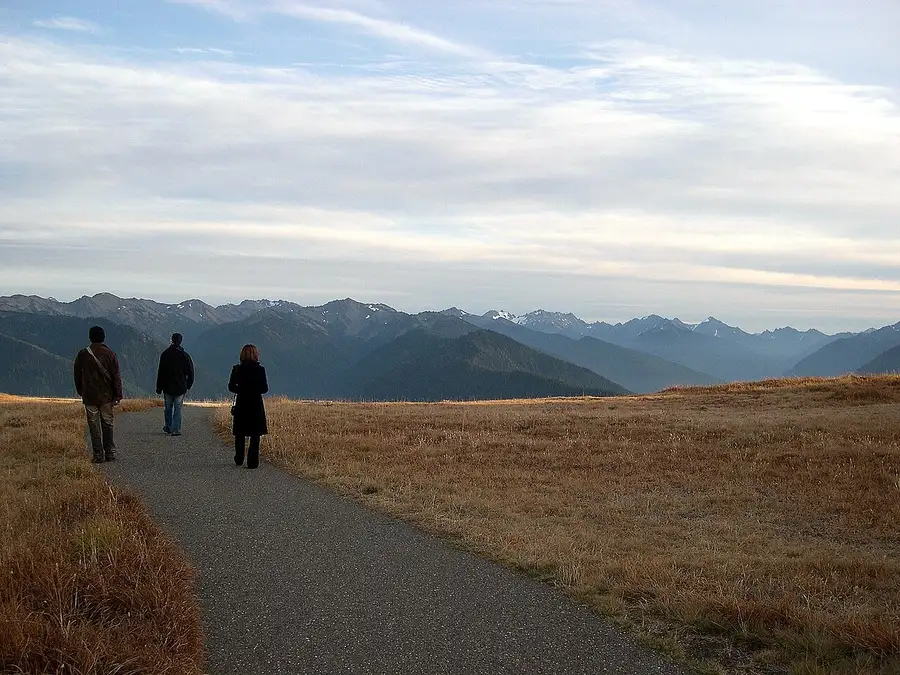
Hikers on the trail at Hurricane Ridge with the Olympic peaks behind
On the Hurricane Hill trail — marmots, meadows, and Mount Olympus. Photo: Javier Otero / Wikimedia Commons (CC BY 3.0)
Day 3 itinerary card: Lake Crescent and Sol Duc
Share the day.

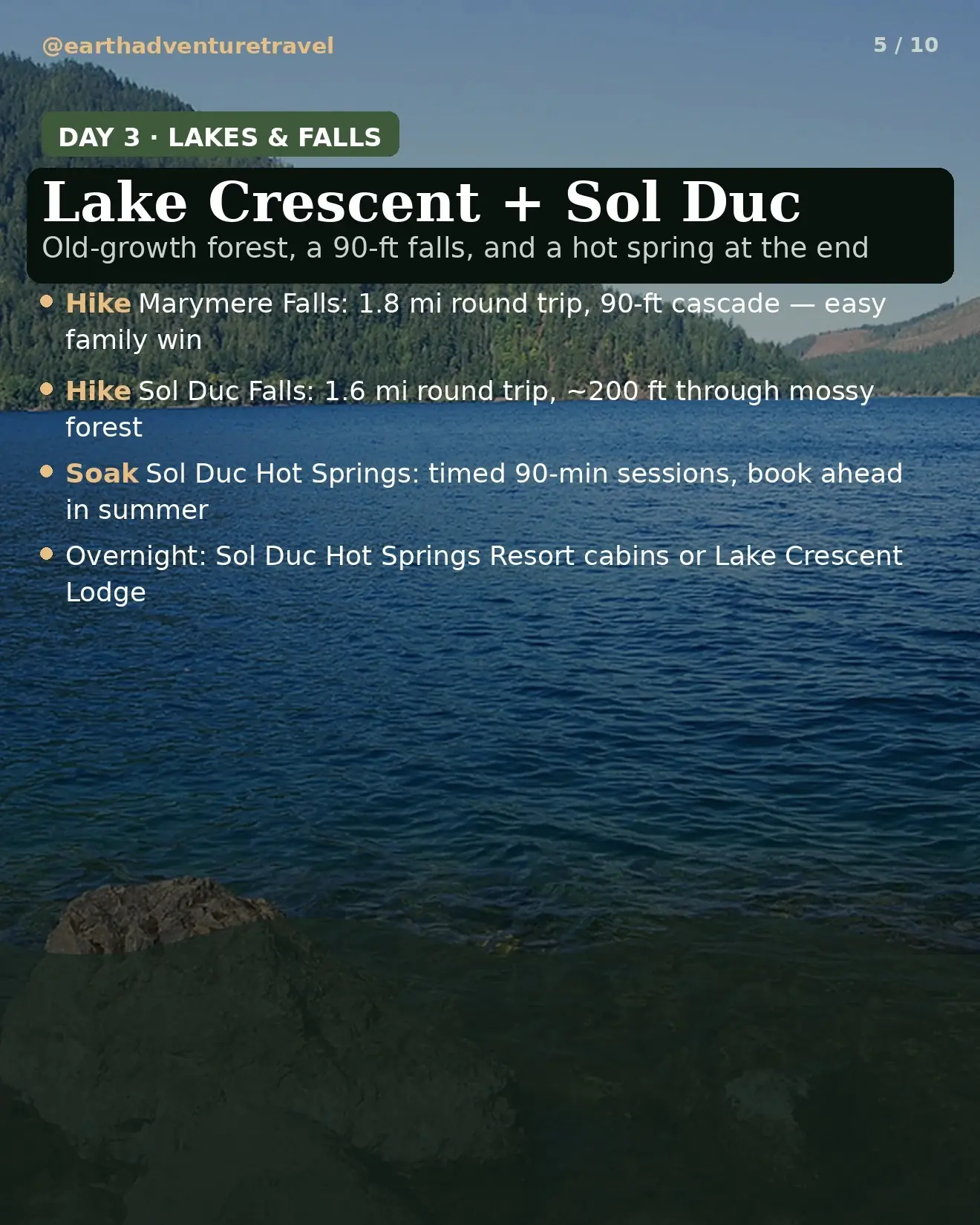
Drive west on US-101 about 25 miles to Barnes Point on Lake Crescent — 624 feet deep and famously blue. Start with Marymere Falls: 0.9 miles one way (1.8 round trip) from the Storm King Ranger Station, an easy forest walk ending at a 90-foot waterfall — the last stretch climbs stairs, a carry for toddlers but fine for anyone 5 and up. The lot fills by late morning; the ranger station has restrooms and water, the last reliable facilities until Sol Duc. After the falls, swim: East Beach has the gentlest entry, and the Lake Crescent Lodge beach rents kayaks in summer.

Afternoon, take the 12-mile Sol Duc Road south off US-101 (seasonal — closed in winter). The Sol Duc Falls trail is 1.6 miles round trip with ~200 feet of gain through old growth to a triple-drop falls in a narrow gorge. Then the reward: the Sol Duc Hot Springs Resort runs timed 90-minute soak sessions in mineral pools — book ahead in summer. The resort is open March 20–November 1, 2026; confirm current soak prices on the resort site. Bring swimsuits and towels.

You're sleeping at the lake tonight, so the afternoon has no deadline. If Sol Duc is closed or the soak is sold out, the fallback is a second lake swim plus the Spruce Railroad Trail — a flat rail-trail along the north shore with a historic tunnel. Dinner at the Lake Crescent Lodge dining room (reservations smart) or Granny's Café in Joyce — roadside burgers and shakes.

The plan

  • Morning: Marymere Falls (1.8 mi RT); swim at East Beach or the lodge.
  • Afternoon: Sol Duc Falls (1.6 mi RT) → timed 90-min soak (booked ahead).
  • Evening: Lake Crescent Lodge dining room or Granny's Café in Joyce.

Where to stay

  • Lake Crescent Lodge (55 units, 1916) — book 6+ months out.
  • Sol Duc Hot Springs Resort — stay where you soak.
  • Log Cabin Resort (28 units) — quieter, kitchenettes.
Day 3 → Day 4: West on US-101 — ~1h45 to Rialto via WA-110. Check the tide table.
Book the soak before the room. Sol Duc's sessions sell out summer weekends — reserve first, plan around it.

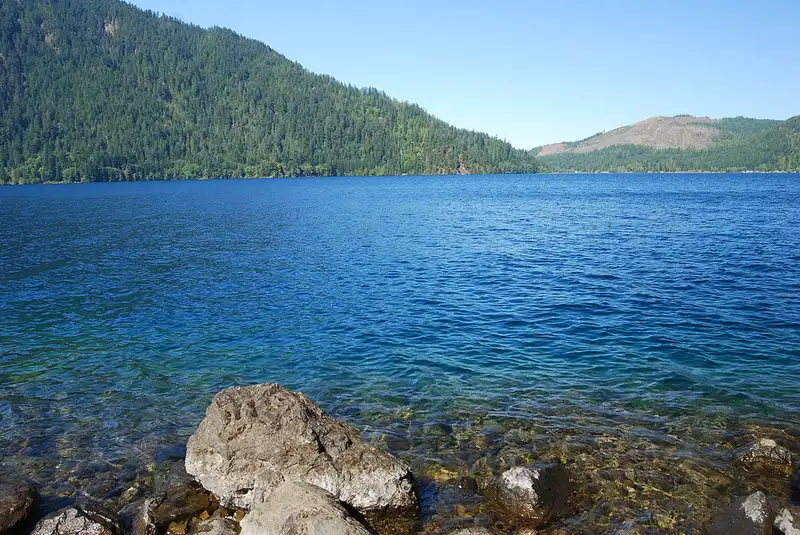
The deep blue water of Lake Crescent below forested ridges
Lake Crescent — 624 feet deep and famously blue. Photo: Kashyap Hosdurga / Wikimedia Commons (CC BY 2.0)

Olympic doesn't hand you its three worlds — rainforest, coast, and ridge — it makes you earn each one with a different pair of shoes.

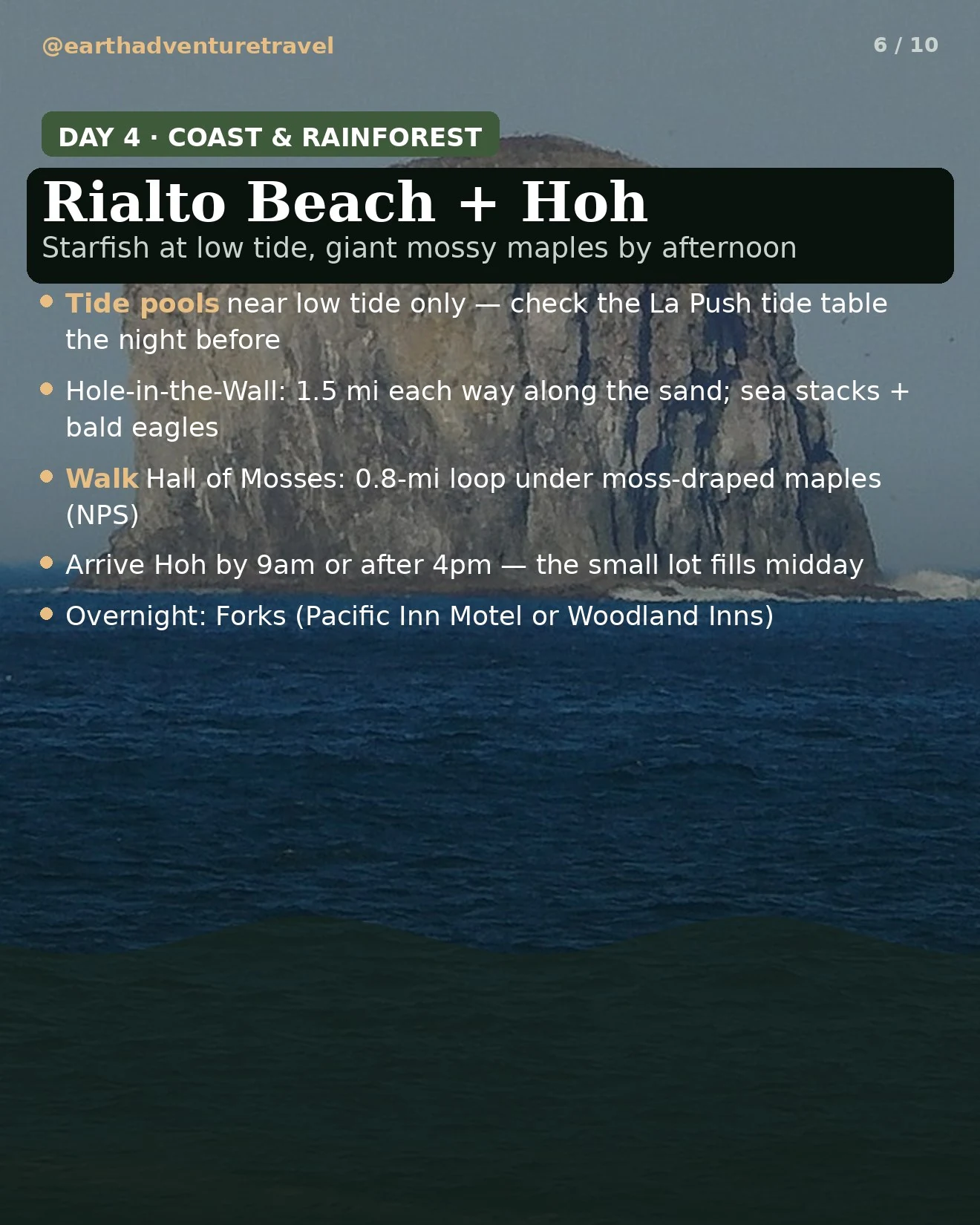
Day 4 itinerary card: Rialto Beach and the Hoh Rainforest
Share the day.

Rialto Beach runs on the tide table, not your schedule. The tide pools only exist within about two hours of a low near or below 0 feet — at high tide the same rocks are underwater and dangerous. Check the NOAA La Push predictions (or tidetime.org) the night before: from the Mora Road lot, it's a flat walk north to Hole-in-the-Wall, 1.5 miles each way, where the sea stacks hold the best pools. Wear sturdy closed-toe shoes — the beach is cobble and the rocks are slick. Note: Mora Road work closed the Rialto area through about October 15, 2026; check nps.gov/olym first.
Afternoon belongs to the Hoh Rainforest, 12 miles up the Hoh Road spur off US-101. The Hall of Mosses is a 0.8-mile loop with under 100 feet of gain — compacted gravel, stroller-manageable when dry — through maples draped in clubmoss. Roosevelt elk graze near the visitor center at dawn and dusk. The warning: the entrance pay-station line backs up 1–2 hours from 9 a.m. to 5 p.m. in summer, so arrive before 9 a.m. or after 4 p.m. The visitor center has restrooms and water; the trails have neither.

This is the longest driving day — roughly an hour between Rialto and the Hoh — so order it by the tide: morning low means Rialto first; afternoon low means the reverse. If the kids are done after one stop, skip the guilt: the Hall of Mosses at golden hour beats a forced march. Dinner in Forks — Pacific Pizza is the family default — or picnic at the Hoh among the elk.
The plan

  • Rialto Beach at low tide (Hole-in-the-Wall 3 mi RT, sturdy shoes).
  • Hoh: Hall of Mosses (0.8-mi loop) before 9 a.m. or after 4 p.m.
  • Evening: Forks for dinner (Pacific Pizza); overnight Forks or Kalaloch.

Where to stay

  • Kalaloch Lodge — bluff-top cabins; set for Day 5's beaches.
  • Pacific Inn Motel (Forks) — clean, simple, best value.
  • Woodland Inns Motel (Forks) — quiet, kitchenettes.
Day 4 → Day 5: South on US-101 — about an hour to Kalaloch.

Low tide or bust. A high-tide "tide pool" trip is just a wet walk — no daylight low, swap days.

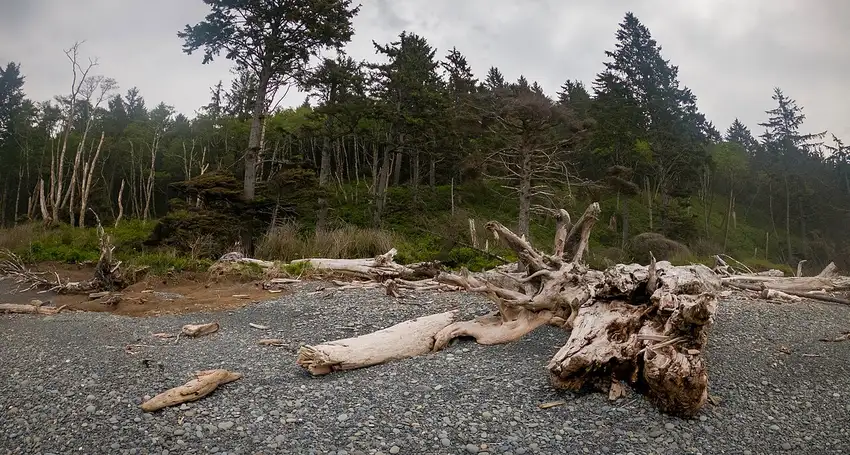
Driftwood scattered across Rialto Beach
Driftwood on Rialto Beach — sturdy shoes required on the cobble. Photo: Sea Cow / Wikimedia Commons (CC BY-SA 4.0)
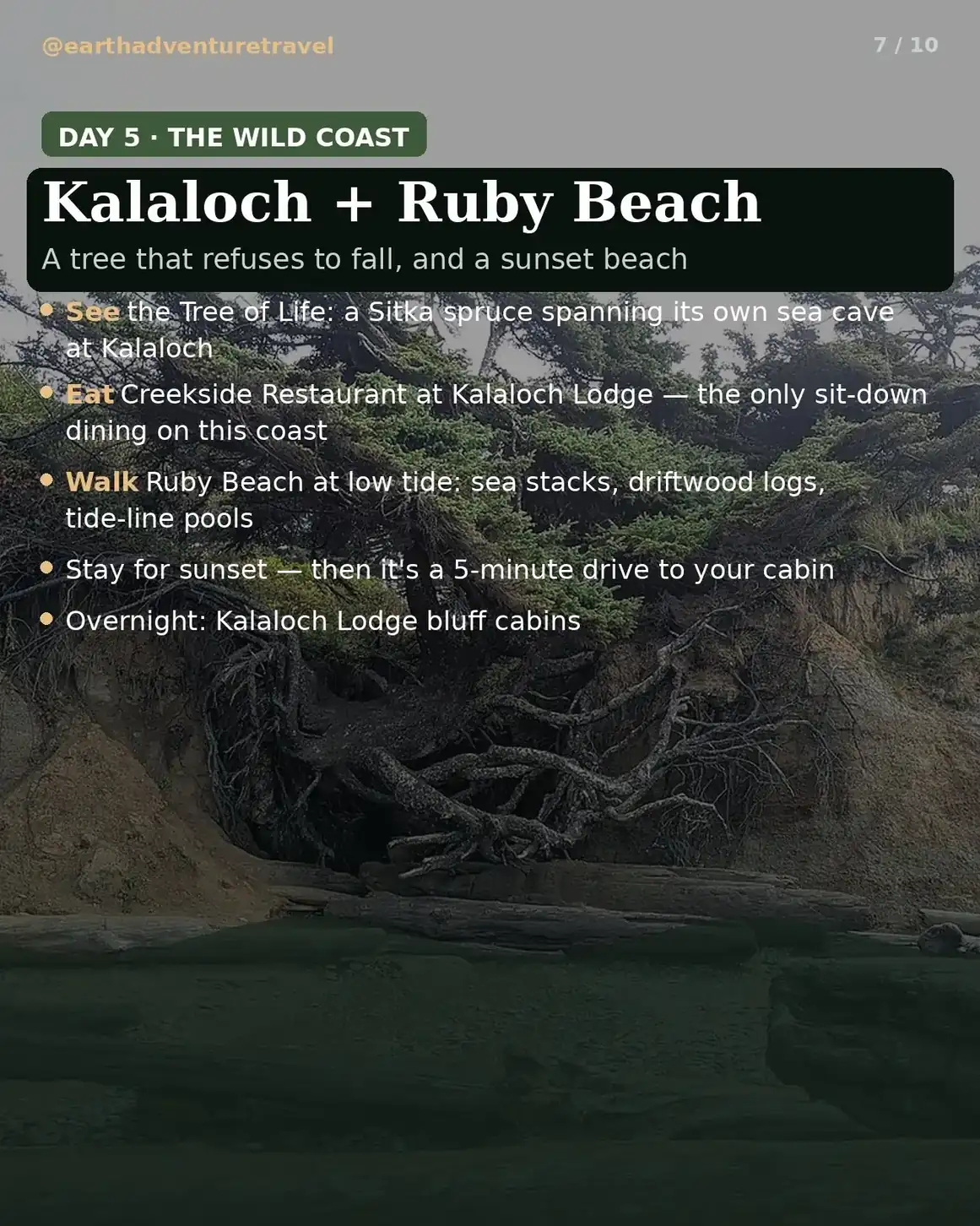
Day 5 itinerary card: Kalaloch and Ruby Beach
Share the day.

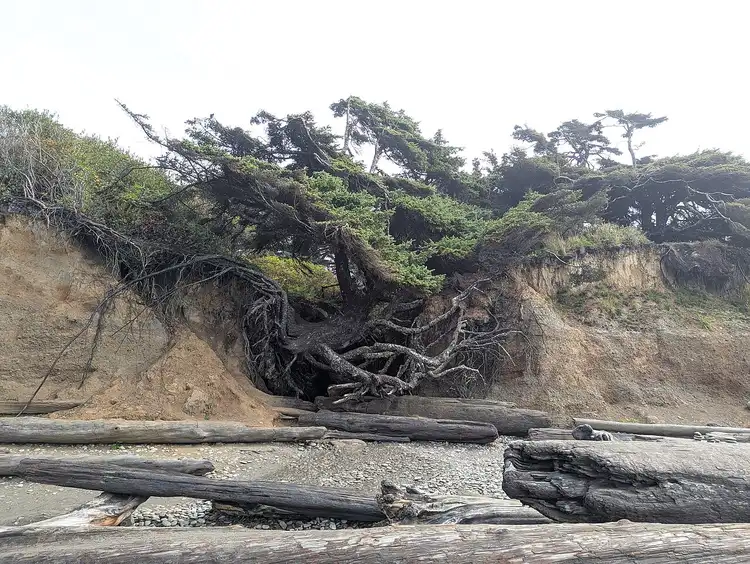
Start at the Kalaloch Tree of Life — a Sitka spruce spanning an eroded sea cave like a living bridge, just north of the Kalaloch Campground entrance picnic area. Recent storms enlarged the cave underneath, which makes the tree more dramatic and more fragile: view from the beach, don't climb the roots. It's a 10-minute walk from the road and the most "wait, that's real?" moment on the coast for kids. Then 5 minutes north to Ruby Beach: a 0.2-mile trail drops to the park's most photographed shoreline — sea stacks, crashing surf, tide pools at low tide.

This is deliberately the trip's easiest day. After Ruby Beach, Beach 4 (0.5-mile trail, far fewer people) makes a quiet afternoon of beachcombing — agates, driftwood forts, bald eagles working the surf line. The coast runs 15–20°F cooler than inland with a near-constant breeze, so the fleece earns its suitcase space. Kalaloch's beaches face due west: stay for sunset if the marine layer cooperates — the sun dropping behind the sea stacks is the trip's best free show.

Facilities on this stretch are only at Kalaloch Lodge — restrooms, the Creekside Restaurant (certified-green, reservations wise), and a small camp store. No gas and no cell service between Forks and Queets: fill the tank in Forks and download offline maps. If a full coastal storm rolls in, the plan is the Hoh — the rainforest loves rain — or a slow morning watching the surf.

The plan

  • Morning: Tree of Life (10-min walk) → Ruby Beach (0.2-mi trail).
  • Afternoon: Beach 4 for beachcombing; sunset behind the stacks if it clears.
  • Evening: Creekside Restaurant at Kalaloch Lodge; pack for Quinault.

Where to stay

  • Kalaloch Lodge (34 cabins, bluff-top) — book 6+ months out.
  • Kalaloch Campground — oceanfront sites; reserve on Recreation.gov.
  • Fallback: Forks motels — 45 minutes north, more availability.
Day 5 → Day 6: South on US-101 — ~45 minutes to Lake Quinault. Easy morning.

No gas, no signal between Forks and Queets — fill up in Forks, screenshot directions.

The Tree of Life, a Sitka spruce spanning an eroded sea cave at Kalaloch
The Tree of Life at Kalaloch — view from the beach, don't climb. Photo: Sven-the-Green / Wikimedia Commons (CC0)
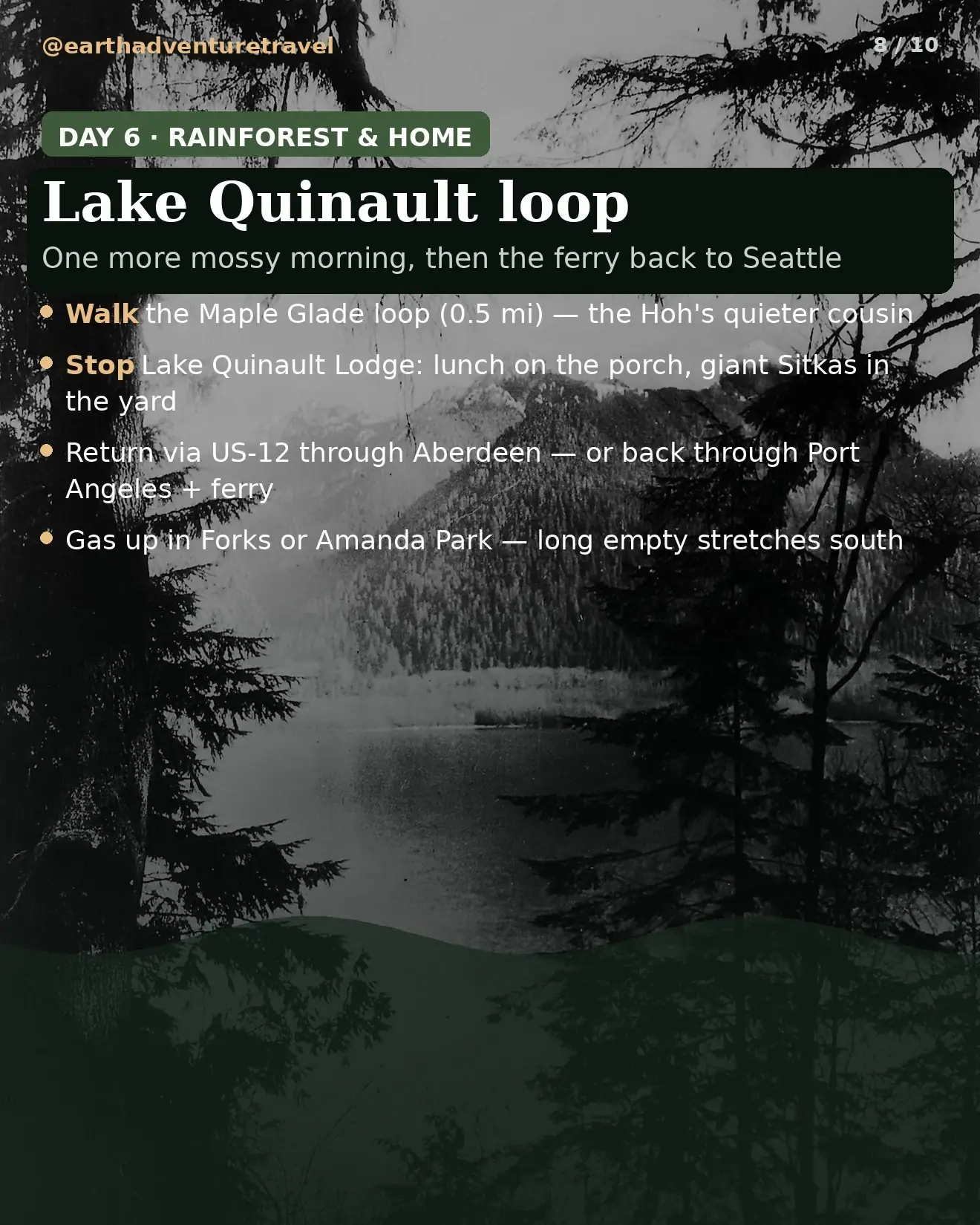
Day 6 itinerary card: Quinault Rainforest and the drive home
Share the day.

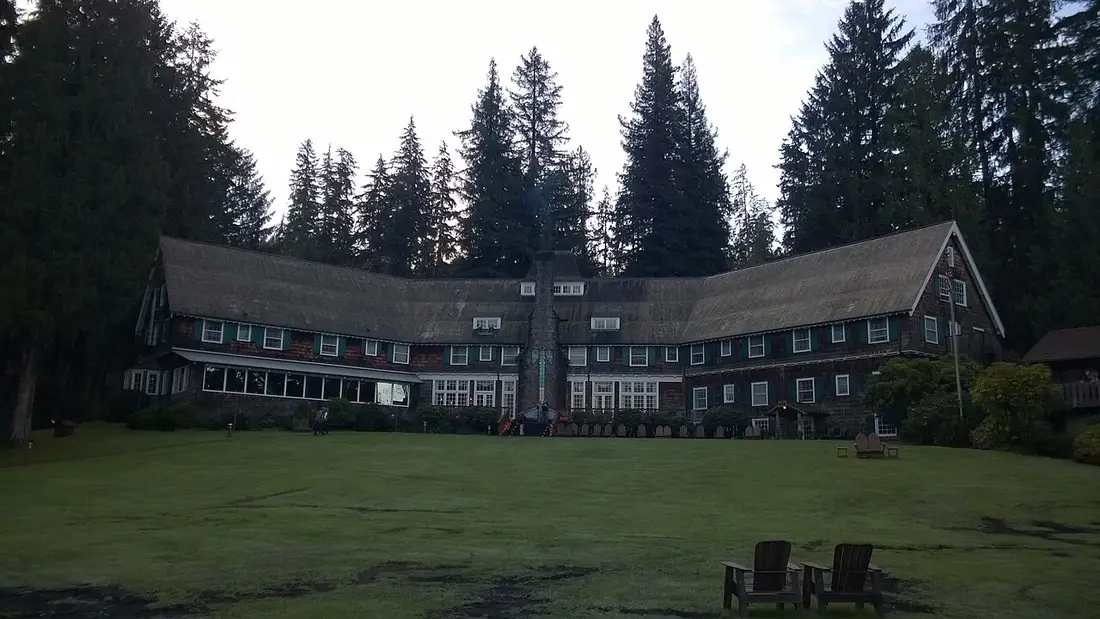
The Quinault Rainforest is the trip's exhale — the same temperate rainforest as the Hoh, but quieter and wrapped around a lake. The Maple Glade Trail is a 0.5-mile loop through big-leaf maples so mossy the forest floor looks upholstered — the easiest "wow" walk in the park and perfect for a last morning with tired legs. The historic Lake Quinault Lodge (1926) has a big lawn for a picnic breakfast and a fireplace lobby for a rainy sendoff.

Then drive: Lake Quinault to Seattle is about 3 hours via US-101 east and WA-8 to I-5 — or about 3.5 hours to Portland via US-101 south. US-101 is two lanes with logging trucks and slow RVs, so leave a real buffer before any flight. There are no services on the lake's north shore, so top off at the lodge or in Amanda Park before the eastbound leg.

Before you go: let the kids vote for their favorite of the trip's three worlds — rainforest, coast, mountains (it's never unanimous) — and double-check the car for the rain gear you'll need again someday. The $30 vehicle pass covers 7 days, so a slow morning costs nothing extra.

The plan

  • Morning: Maple Glade loop (0.5 mi) or Rain Forest Nature Trail; lodge lawn breakfast.
  • Midday: depart — Quinault → Seattle ~3h via US-101 E + WA-8 (leave a buffer; two lanes).
  • Buffer: no services on the lake's north shore — fuel and snacks before the eastbound leg.

Where to stay

  • No hotel tonight — you're heading home.
  • If the flight is tomorrow: Lake Quinault Lodge — one more night on the lake beats an airport hotel.
  • If delayed in Seattle: the Sea-Tac airport hotel cluster — 15 minutes from the rental-car return.
Day 6 → home: The loop is complete — mountains, lake, coast, rainforest, coast again, rainforest again. That's Olympic.

The earlier departure is always the right call on the last day — a missed connection costs more than an extra hour at the lake.

The historic Lake Quinault Lodge on the lake shore
Lake Quinault Lodge — the rainforest finale. Photo: Washington Our Home / Wikimedia Commons (CC BY-SA 4.0)
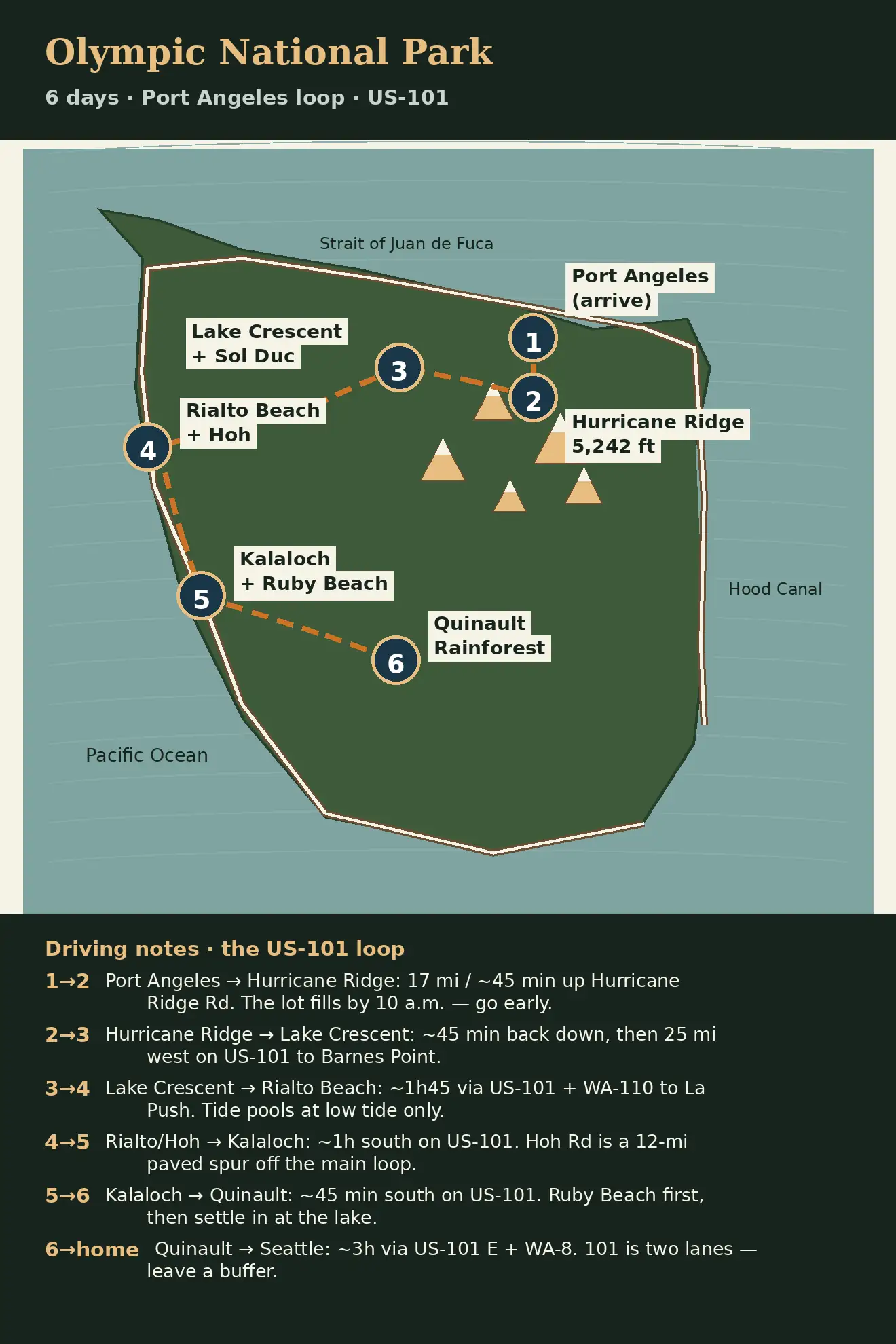
Olympic National Park route map: Port Angeles (days 1–2), Lake Crescent and Sol Duc (day 3), Rialto Beach and the Hoh (day 4), Kalaloch and Ruby Beach (day 5), Quinault (day 6)
Save the route.

The people behind the plans

Who is Earth Adventure Travel?

We build routes for real life — wrangling kids, spanning generations, or heading out solo — and check every detail against official sources so the plan holds up when you get there.

Learn About Us

Plan & pack

Rough budget · family of 4

$2,800 – $4,200

6 days / 5 nights · lodging, food, gas, park pass · flights and rental car excluded

  • Lodging — $1,100–1,700: 5 nights across four bases; park lodges (Lake Crescent, Kalaloch) run $200–350/night in summer, Forks and Port Angeles motels $130–220.
  • Food — $800–1,100: lodge dining rooms, Forks pizza nights, Joyce burgers, and groceries from Port Angeles for picnic lunches.
  • Gas & driving — $200–350: roughly 600 miles of US-101 loop plus the Seattle legs; no tolls, no ferries required.
  • Attractions — $130–250: $30 park vehicle pass (7 days), Sol Duc timed soak sessions, Feiro Marine Life Center, kayak rental at Lake Crescent.
Booking deadlines, compared — the park needs no reservation, but the lodges and soaks do
WhatBook aheadWhere2026 price
Park vehicle passBefore arrival (cashless park)recreation.gov$30 / 7 days
America the Beautiful passAnytimerecreation.gov / park entrances$80 / year
Kalaloch Lodge6+ months (34 cabins)concessionaire site$200–350/night summer
Lake Crescent Lodge6+ months (55 units)concessionaire site$200–350/night summer
Sol Duc Hot Springs soakWeeks ahead (90-min timed sessions)resort siteCheck current rates
Edmonds–Kingston ferryDays ahead in summerwsdot.wa.gov/ferriesVehicle + driver fare varies
Hurricane RidgeNo booking needednps.gov/olymIncluded in park pass

Pack for the trip

  • Rain jacket + rain pants — the Hoh gets ~12 feet of rain a year; a summer shower is likely, not unlucky.
  • Grippy hiking shoes — Sol Duc Falls and Marymere Falls trails are rooty and slick when wet.
  • Tide-pool shoes — old sneakers or water shoes for Rialto's cobble; the rocks are razor-slick.
  • Warm mid-layer + wind shell — the coast and the ridge both run 15–20°F cooler than the valleys.
  • Swimsuit + quick-dry towel — Sol Duc's timed soak sessions and the Lake Crescent swim both demand them.
  • 2L refillable water bottles — there is no water at Hurricane Ridge and none on the Hoh trails.
  • Binoculars — Roosevelt elk in the Hoh, bald eagles at Rialto, marmots at Hurricane Ridge.
  • Tide table printout — Rialto's pools are low-tide-only; cell service dies on the coast.
  • Sun hat + sunscreen — Hurricane Ridge is fully exposed at 5,242 feet.
  • Offline maps downloaded — no signal between Forks and Queets; screenshot every driving leg.
Rain-soaked mossy forest in the Hoh Rainforest
Rain gear, always. The Hoh gets ~12 feet of rain a year — the moss glows brightest when it's wet. Photo: PKThundr7 / Wikimedia Commons (CC BY 4.0)
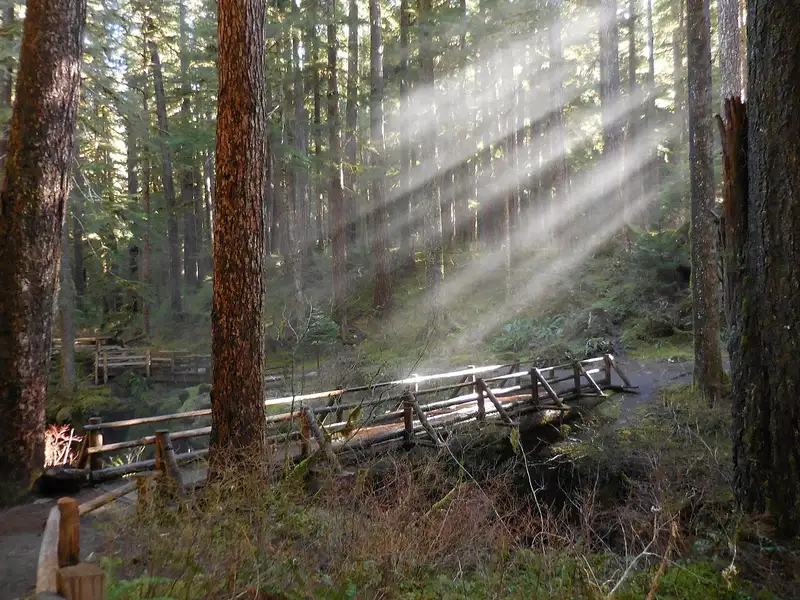
Sunbeams through old growth on the Sol Duc Falls trail
Grippy shoes. The Sol Duc Falls trail — rooty, shaded, and slick after rain. Photo: Olympic National Park / Wikimedia Commons (Public domain)
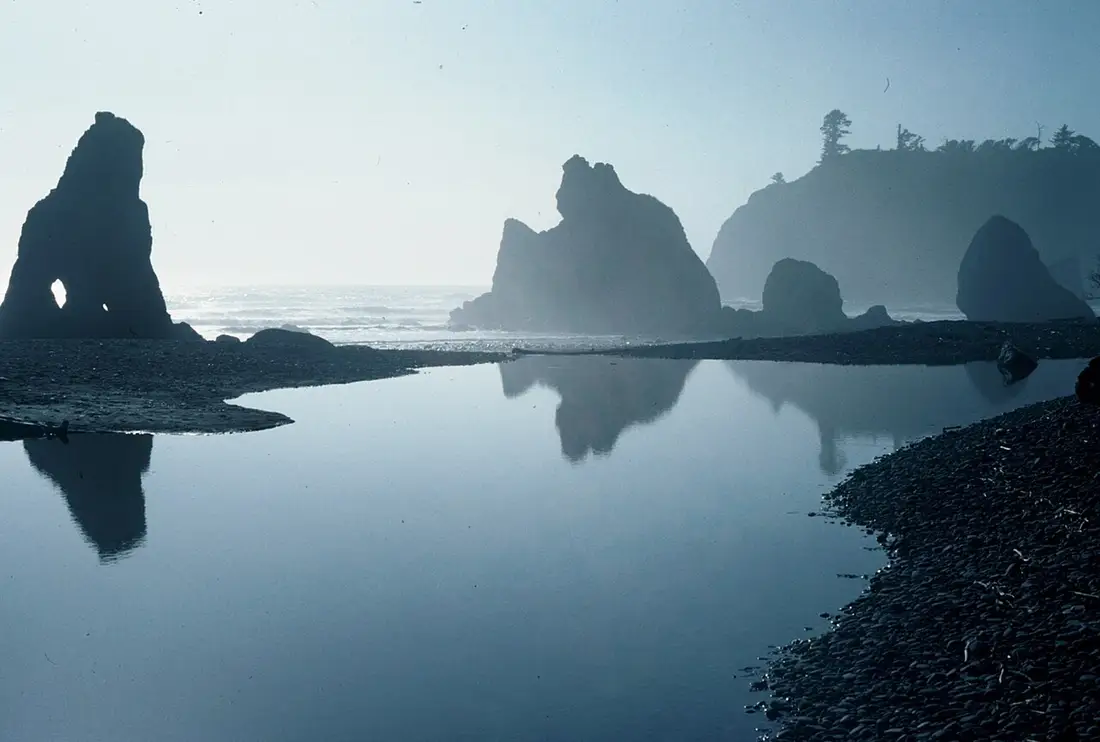
Fog rolling over the sea stacks at Ruby Beach
Warm layers. Fog at Ruby Beach — the coast runs 15–20°F cooler than inland. Photo: Ron Clausen / Wikimedia Commons (CC BY-SA 4.0)

Eat like a local

The park's food story is lodge dining rooms and small-town staples. Creekside Restaurant at Kalaloch (certified-green) and the Lake Crescent Lodge dining room are the two reservations worth making. Granny's Café in Joyce does the classic roadside burger-and-shake stop on the way west, and Pacific Pizza in Forks is the family default after a long coast day. Everywhere else: pack picnic lunches from the Port Angeles grocery run — the park's best lunch spots have no food service.

Day trips & swaps

Got a seventh day? Add the Elwha Valley (Madison Falls, former dam-removal country) near Port Angeles, or Second Beach near La Push for the coast's best sea-stack views. Rainy ridge day? The Hoh loves rain — move the rainforest up and save the ridge for sun. Skipping the Sol Duc soak? The Spruce Railroad Trail along Lake Crescent fills the afternoon. Flying home from Portland instead of Seattle cuts the Day 6 drive.

Planning notes

When is the best time to visit Olympic National Park with kids?

July through September is the sweet spot. Hurricane Ridge Road and Sol Duc Road are reliably open, the Hoh gets its driest weeks, and summer's low tides fall in daylight hours — which is when tide pooling actually works.

June can be lovely but the ridge road sometimes opens late; October brings rain and the Mora Road construction zone. Winter means chains, closures, and a very different trip.

Is Olympic National Park good for kids? What ages?

It's one of the best parks for kids roughly 5 and up. The Hall of Mosses (0.8 miles), Marymere Falls (1.8 miles), and the beaches are all short-payoff outings, and tide pools are nature's touch tank.

Toddlers can manage the paved Hurricane Hill trail in a carrier and the lake beaches, but the driving legs and the Hoh entrance lines test little patience. Teens get the ridge views, the soak, and the sea stacks.

How much does 6 days in Olympic cost for a family of 4?

Roughly $2,800–$4,200 for 6 days and 5 nights, excluding flights and the rental car. Lodging is the lever: park lodges run $200–350/night in summer, Forks and Port Angeles motels $130–220.

Food runs $130–180/day for four, gas about $200–350 for the ~600-mile loop, and the park pass is just $30 for 7 days. The Sol Duc soak and a kayak rental are the only real activity costs.

Do we need timed-entry reservations for Olympic?

No — Olympic has no timed entry and no vehicle reservations. The $30 private-vehicle pass covers 7 days, and the park is cashless, so buy it on Recreation.gov before you arrive.

What does need booking: Kalaloch and Lake Crescent lodges (6+ months out for summer), Sol Duc's timed 90-minute soak sessions, and the Edmonds–Kingston ferry in peak season.

How do the tide pools at Rialto Beach work?

Go only within about two hours of a low tide near or below 0 feet. Check the NOAA La Push tide predictions the night before — at high tide the pools are underwater and the rocks are dangerous.

Walk 1.5 miles north to Hole-in-the-Wall for the best pools, wear sturdy closed-toe shoes (the cobble is slick), and never turn your back on the ocean. If there's no daylight low, swap your beach and Hoh days.

What if it rains the whole trip?

The rainforest days get better in rain — the Hoh glows when it's wet. Pack real rain gear (jacket and pants, not a poncho) and treat showers as a feature.

If the ridge is socked in, pivot to the Port Angeles visitor center and Madison Falls; if the coast storms, do the Hoh instead of the beach. Only a full gale ruins a day — and those are rare in July–September.

Where should we stay — Port Angeles, Forks, or Kalaloch?

All three, in sequence — that's the point of the loop. Port Angeles (2 nights) for the ridge, Lake Crescent (1 night) for the falls and the soak, then Kalaloch or Forks (1 night) for the coast, and Quinault (1 night) for the finale.

Don't try to base in one town: Olympic's districts don't connect through the middle, so a single base means 2+ hour drives every day. Move with the loop.

Is the Hurricane Ridge road scary to drive?

It's winding but wide, paved, and guardrailed — not a white-knuckle road. Seventeen miles and 45 minutes from Port Angeles, with pullouts the whole way up.

The real challenge is the parking lot, which fills by 10 a.m. on summer weekends — leave by 8. In winter the road requires chains or traction tires and closes frequently; this itinerary is a summer plan.

What's the status of the Rialto Beach road closure?

Mora Road construction closed the Rialto Beach area through about October 15, 2026. Check nps.gov/olym for the current status before you lock Day 4 around it.

If Rialto is still closed, Ruby Beach and Beach 4 (Day 5) cover the sea-stack experience, and Second Beach near La Push is the backup tide-pool spot at low tide.

Are there bears? Is Olympic safe for kids?

Black bears live in the park but encounters on these trails are rare. Make noise on quiet trails, never feed wildlife, and store food in your car — not your tent — if you camp.

The real kid hazards are the ocean (sneaker waves, slick rocks — never turn your back) and the Hoh's parking-line boredom. Roosevelt elk are common and impressive; admire from the trail, never approach.

Can we do Olympic in 3 days instead of 6?

You can see highlights in 3 days, but you'll skip a whole world. The honest 3-day cut: Hurricane Ridge, the Hoh, and Rialto Beach — mountains, rainforest, coast.

What you'd miss: Lake Crescent and the Sol Duc soak, Kalaloch's beaches, and every slow morning. With kids, the 6-day pace is the trip; the 3-day version is a highlight reel with long drives.

Can grandparents do this trip?

Yes — most of it is short and paved. Hall of Mosses (0.8 mi, flat), Maple Glade (0.5 mi), and the Hurricane Hill trail (paved, steady grade) all suit active grandparents; the lodges and the Sol Duc soak are built for lingering.

The hard parts: Rialto's cobble beach (skip Hole-in-the-Wall, enjoy the overlook), Marymere's stairs, and the long Day 4. The Quinault finale is the gentlest day by design.

Before you lock the trip

Sources & official links

Fees verified October 2026. Confirm road seasons, the Mora/Rialto construction status, and Sol Duc soak prices on the official sites before you travel — mountain roads and coastal work zones change fastest.

The trip index

Choose the landscape. Then choose the pace.

Every itinerary gives you a realistic route, daily rhythm, planning notes, and the details that make a family trip work.

Use the filters above to see the routes that match.

No exact match—yet.

Clear a filter to see the closest routes already in the library.