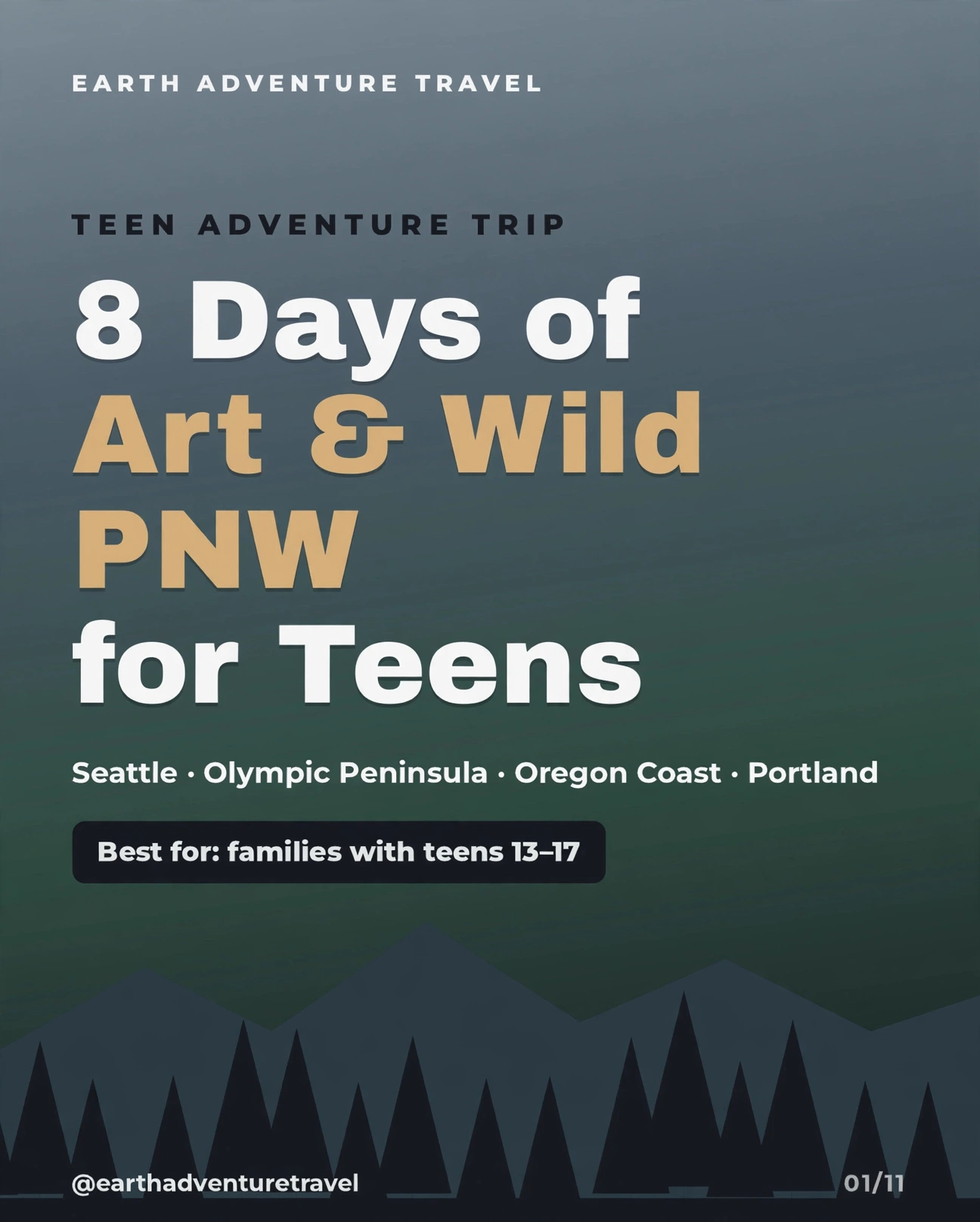
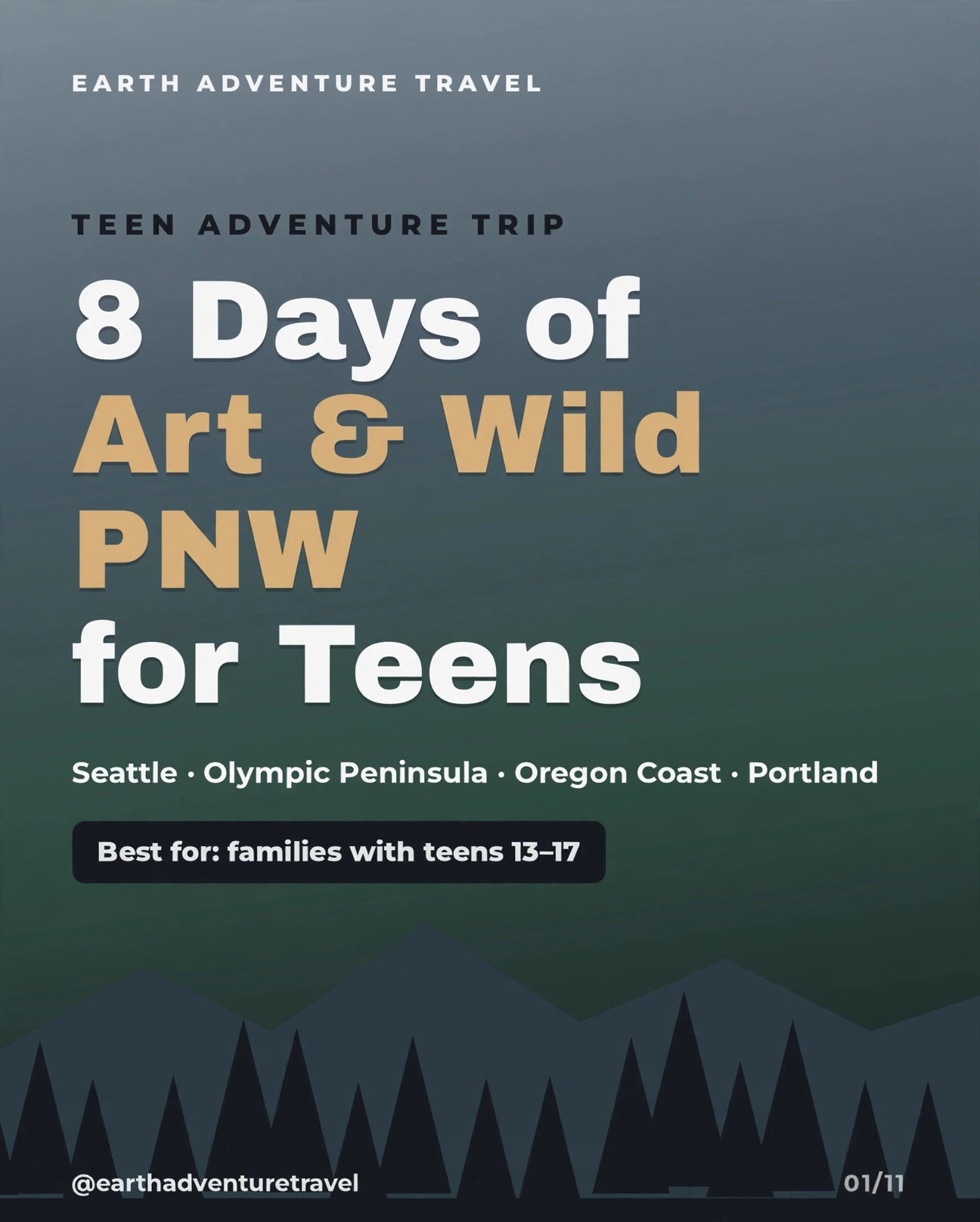
Eight summer days · Washington to Oregon

Art & wild Pacific Northwest 2026 teen road trip

A teen-first road trip where glassblowing, photography, books, rainforest, and tide pools all belong to the same creative adventure.

8 days / 7 nightsBest July–early SeptemberFor art-loving teens 13–17Estimate: $5,500–$8,500 for 4
Illustrated cover for an eight-day art and wilderness Pacific Northwest trip for teens

The idea

We built the route around the teen.

We wanted more than scenery from this plan. We wanted authorship: a chance for teens to choose the shot, navigate a bookstore alone, shape molten glass, read the tide, or decide when a misty forest path has given up its best frame.

We move from Seattle’s made-by-hand culture into the Olympic Peninsula’s quieter, stranger world, then follow the coast south to Cannon Beach and finish with Portland design and the Columbia River Gorge. The contrast is the point. One day is saturated glass color; another is moss, sea stacks, driftwood, and fog.

We kept the schedule active but not over-scripted. One long transfer from Washington’s outer coast to Cannon Beach is balanced by early starts that earn calmer trails and better light. We’d give teens real independence in controlled doses: a solo hour at Pike Place, a color-coded meeting room at Powell’s, or responsibility for one day’s photo stops and food plan.

2026 GUIDE

Last verified: October 2026

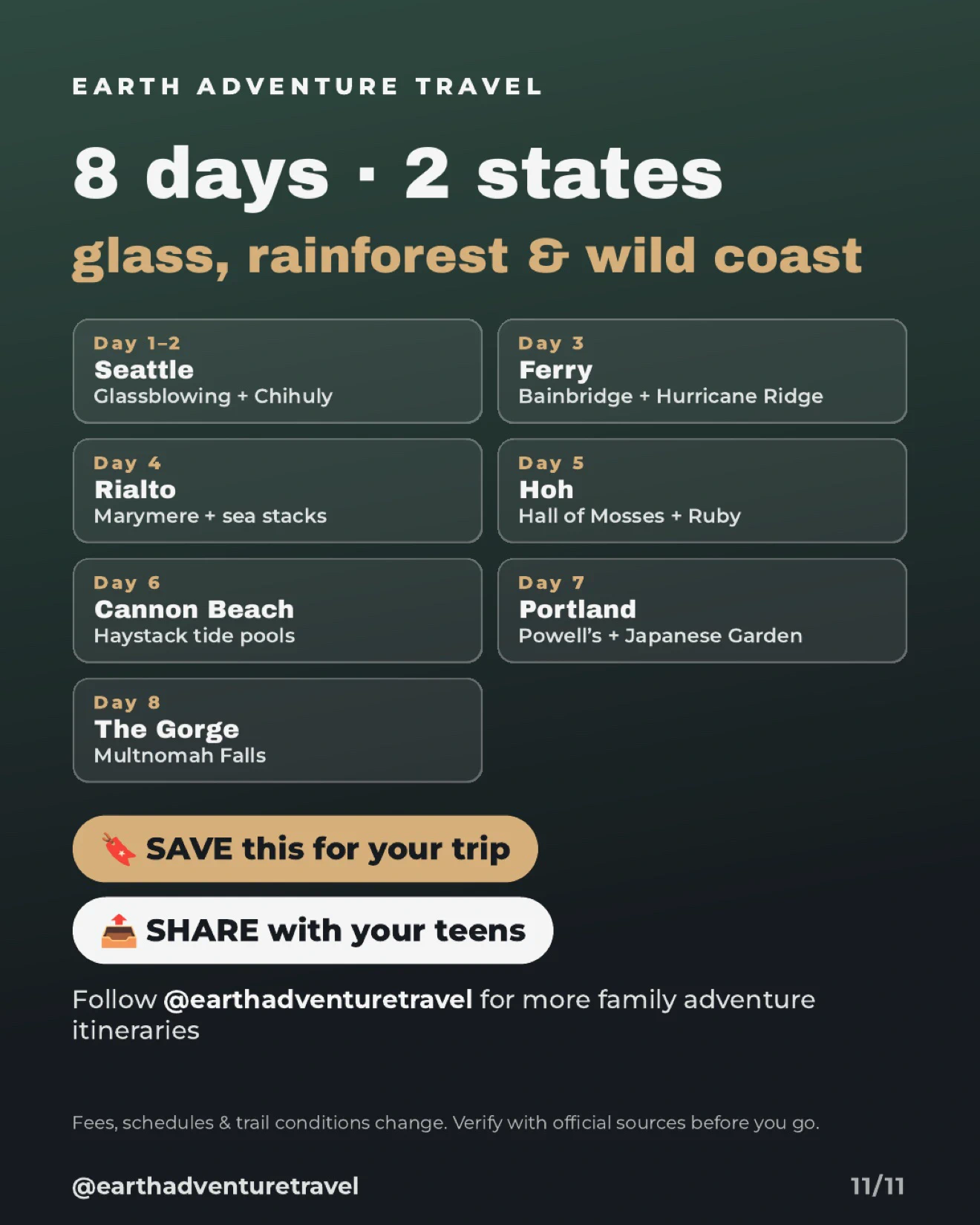
8days
2states
0.8 miHall of Mosses loop
620 ftMultnomah Falls

The route

We make something. Then we go somewhere wild.

At each stop, we give teens a concrete creative brief instead of a vague command to “enjoy the view.” We keep it simple: one favorite object, five macro details, a skyline sequence, or a page of visual notes.

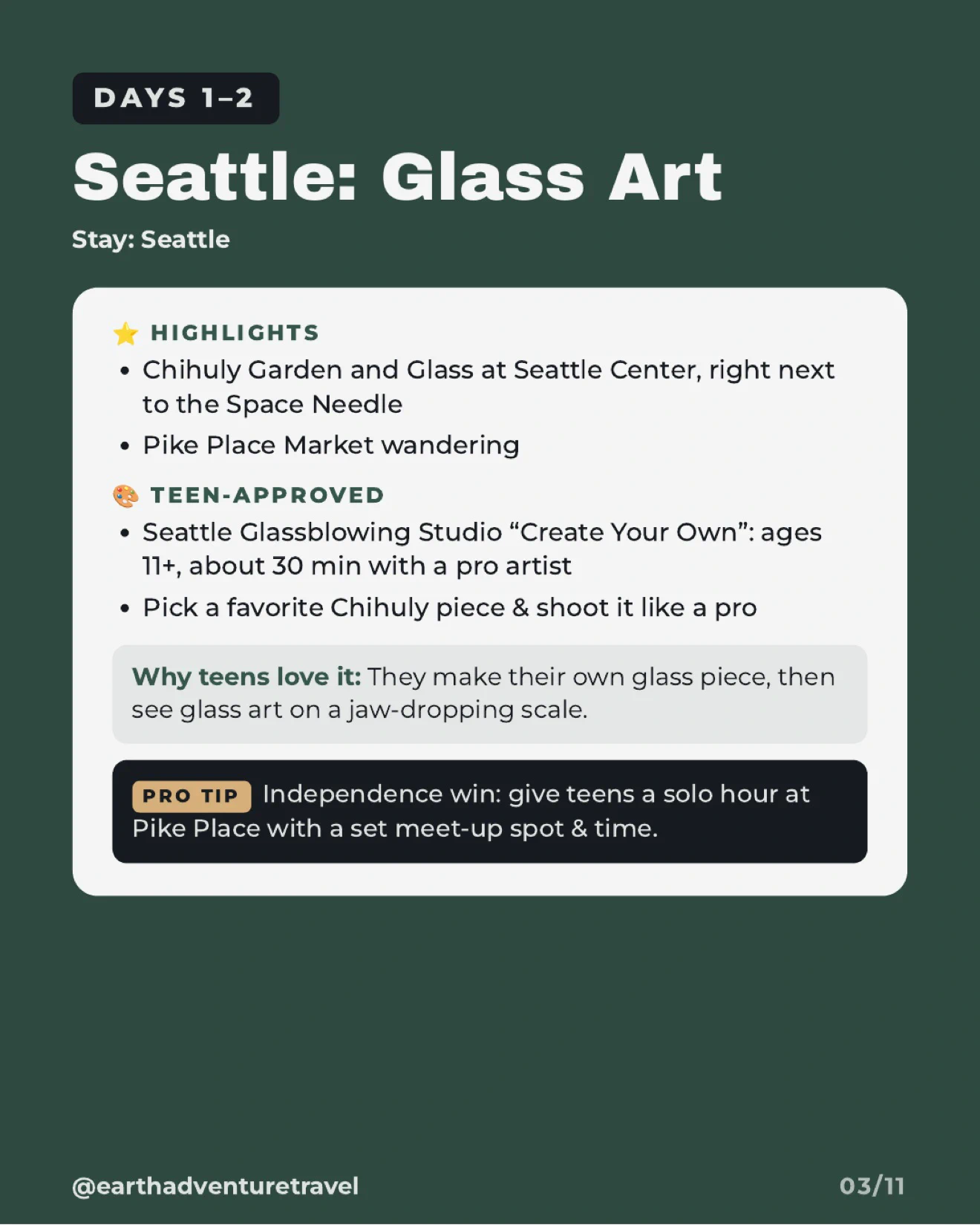
Days 1 and 2 itinerary graphic for glass art and independent exploring in Seattle
01–02Seattle · make & wander

Start with glass, color, and a little freedom.

Use two nights in Seattle to set the tone: this trip is not a sequence of family photo obligations. At Chihuly Garden and Glass, ask each teen to choose one work and photograph it as if they were art-directing a magazine spread. The scale, color, and greenhouse light reward patience rather than speed.

Pair the museum with a create-your-own glassblowing session, then make Pike Place Market the independence exercise. Set a clear meeting point and time, agree on the roaming zone, and let teens spend an hour following their own interests—food, vinyl, crafts, street photography, or the waterfront.

Stay: Seattle · Creative anchor: glassblowing · Independence win: one hour at Pike Place

Creative brief: Make one image that shows scale, one that isolates color, and one that finds a detail everyone else walked past.
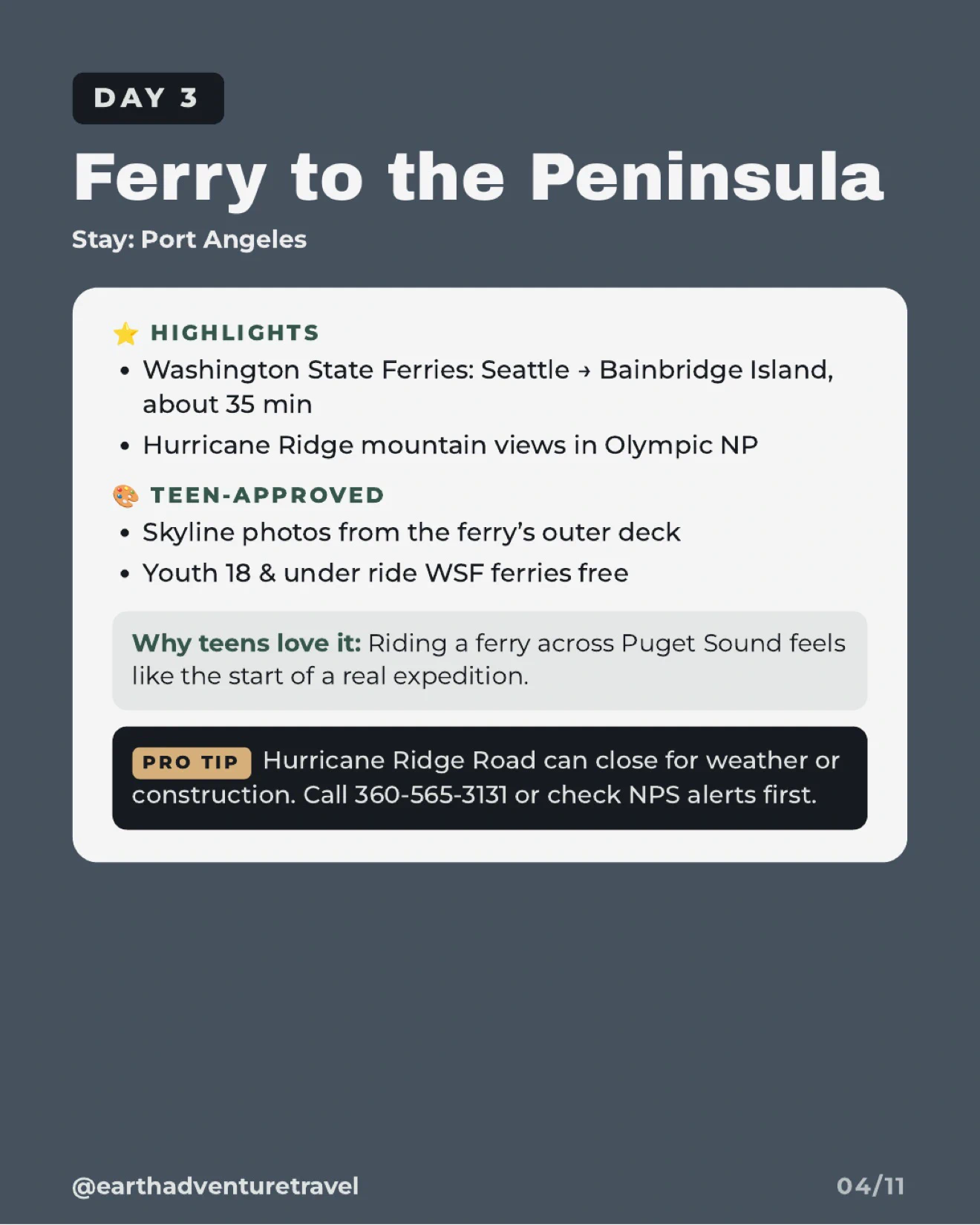
Day 3 itinerary graphic for the ferry from Seattle to the Olympic Peninsula
03Crossing · Seattle to Port Angeles

Let the ferry feel like the start of an expedition.

Drive onto the Seattle–Bainbridge ferry and move outside for the crossing. The skyline recedes, the Olympic Mountains come forward, and a normal travel day turns cinematic. Youth 18 and under ride Washington State Ferries free, which makes the crossing an unusually good-value piece of the experience.

Continue toward Port Angeles and use Hurricane Ridge as the day’s weather-dependent high point. The ridge is about the horizon: broad mountain layers, changing cloud, and the feeling of finally being on the peninsula. Road access can change with conditions or construction, so check alerts before committing the afternoon.

Stay: Port Angeles · Ferry: about 35 minutes · Mountain access is condition-dependent

Shot list: Photograph the skyline in three stages—close, halfway across, and almost gone. The sequence tells the story better than one postcard frame.
“When we give teens a real role, the trip changes from something they’re taken on into something we made together.”
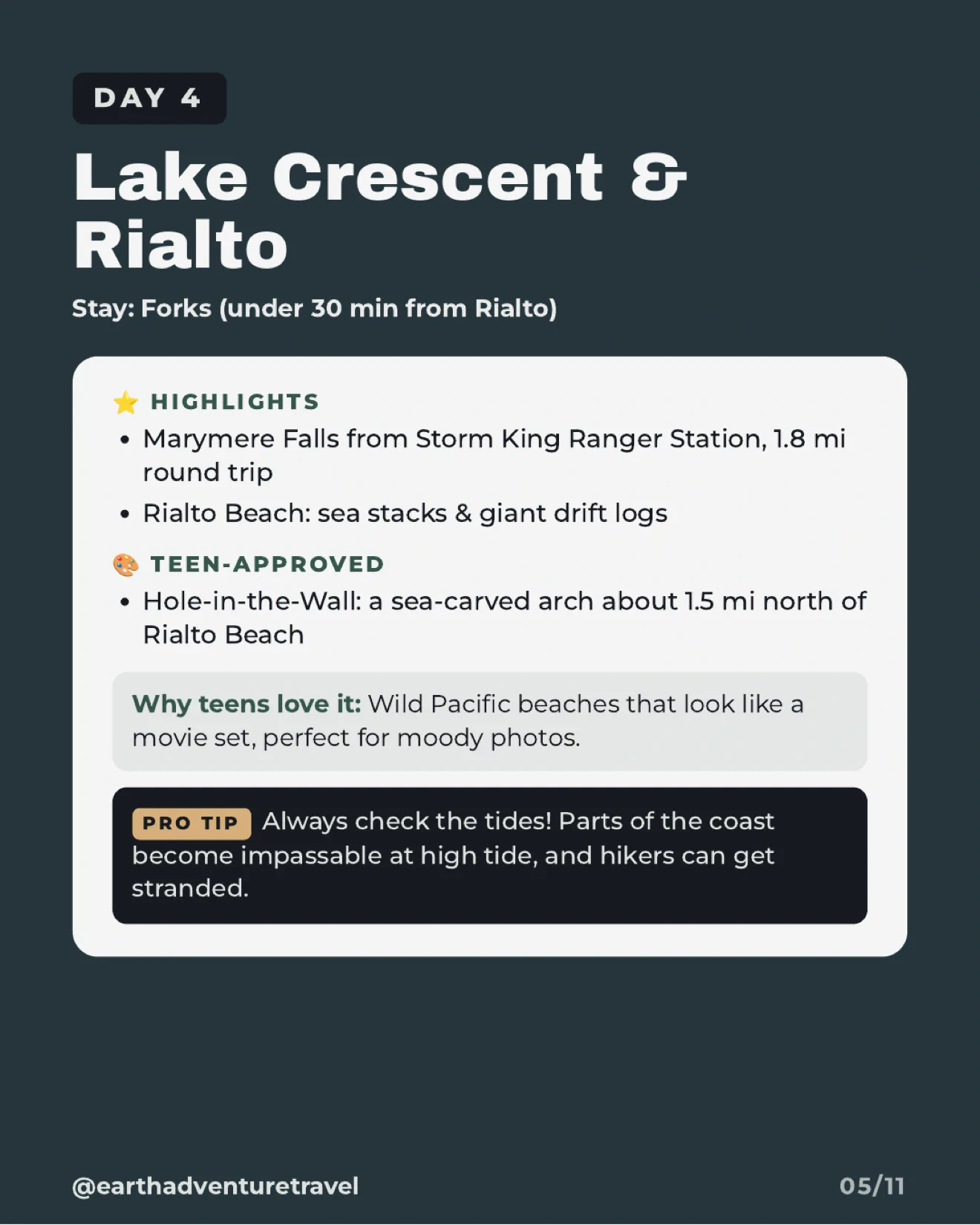
Day 4 itinerary graphic for Lake Crescent, Marymere Falls, and Rialto Beach
04Lake Crescent · wild coast

Trade polished glass for driftwood and sea stacks.

Begin at Lake Crescent, where the forest walk to Marymere Falls is short enough to preserve energy for the coast. The route from the Storm King area is about 1.8 miles round trip, moving through dense green forest before the waterfall reveal.

Then continue to Forks and Rialto Beach. This is the moodiest visual day of the trip: enormous drift logs, dark cobbles, sea stacks, and Pacific weather that can change the palette by the minute. Hole-in-the-Wall is roughly 1½ miles north, but it is a tide-dependent objective—not a box to tick regardless of conditions.

Stay: Forks · Marymere Falls: about 1.8 miles round trip · Save a current tide table offline

Safety first: Never assume the return route will remain passable. Check the tide before setting out, leave margin, and do not climb on wet drift logs.
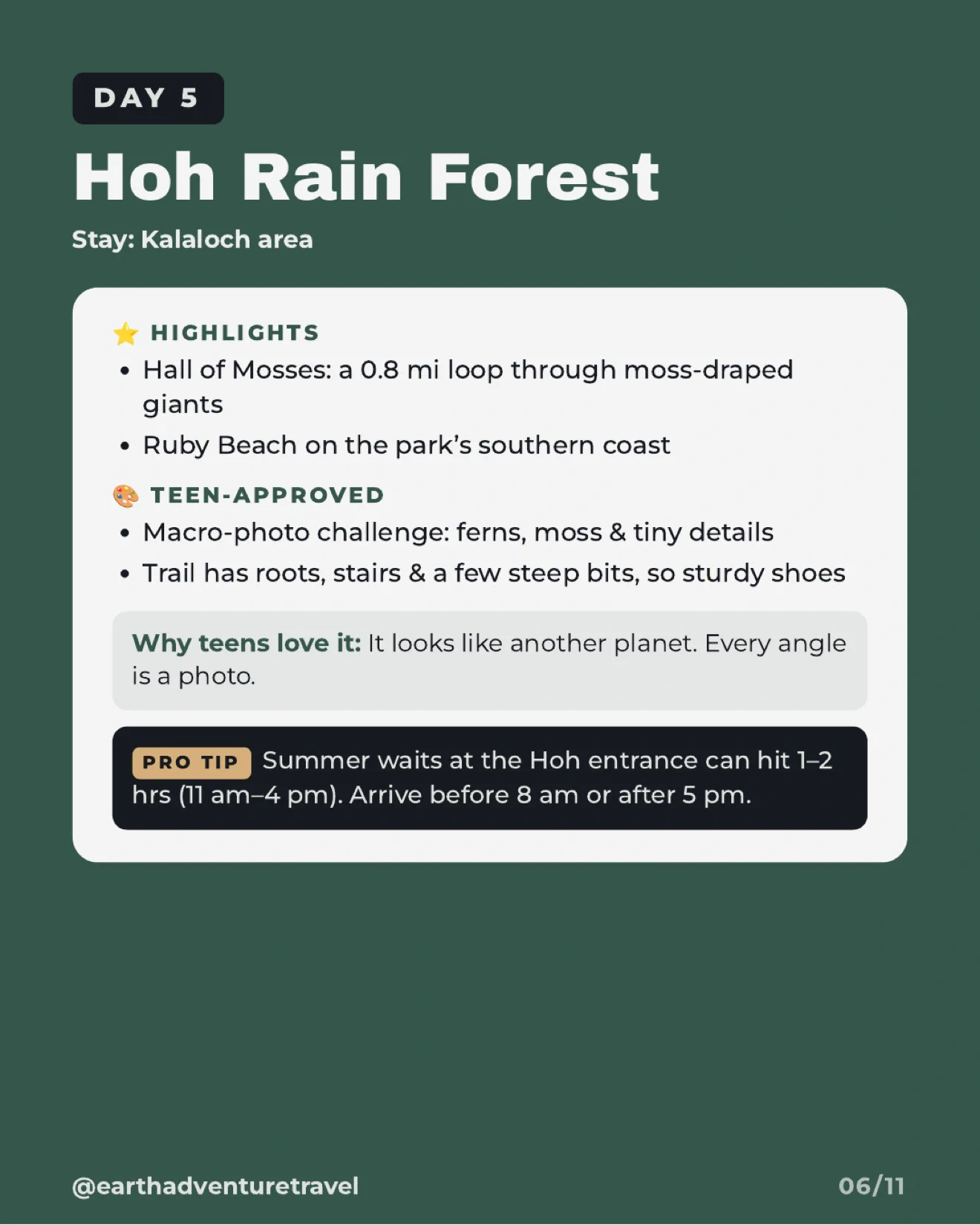
Day 5 itinerary graphic for the Hoh Rain Forest and Ruby Beach
05Hoh · look closer

Photograph the forest that rewards attention.

Arrive at the Hoh Rain Forest before 8 a.m. if possible. Summer entry waits can stretch long by late morning, while the early forest is cooler, quieter, and better for slow observation. The Hall of Mosses is a 0.8-mile loop through maple limbs and moss-draped giants; roots, stairs, and a few steep sections still call for sturdy shoes.

Give everyone the same macro-photo challenge: five textures, three shades of green, one frame with no visible sky, and one tiny detail that could be mistaken for another planet. Later, move south toward Ruby Beach and let the day widen from intimate forest patterns to open coast.

Stay: Kalaloch area · Hall of Mosses: 0.8-mile loop · Aim for before 8 a.m. or after 5 p.m.

Do less, see more: The forest’s best material is not at the end of the loop. Stop for bark, lichen, ferns, water beads, and the spaces between roots.
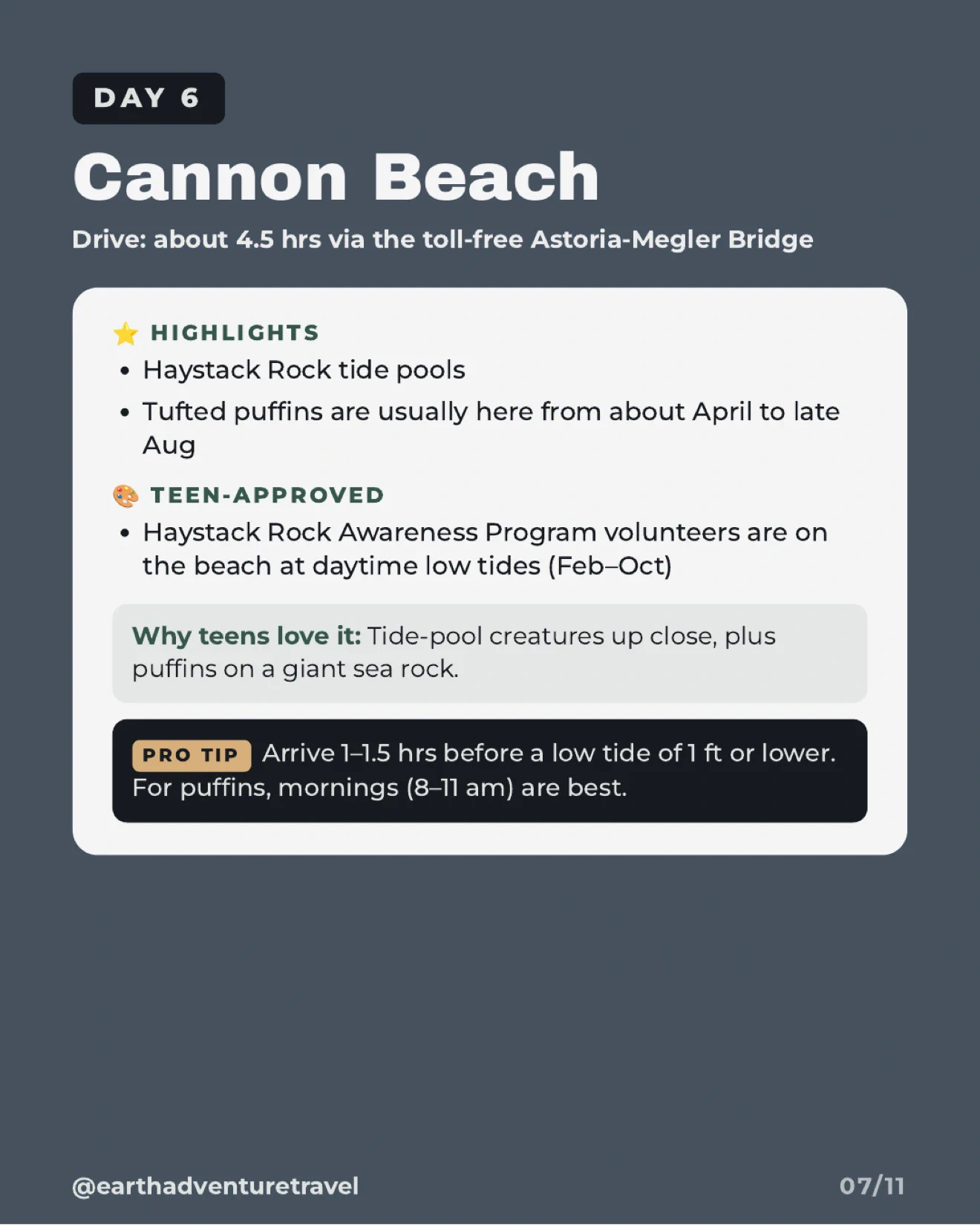
Day 6 itinerary graphic for Cannon Beach and Haystack Rock tide pools
06Long road · Cannon Beach

Arrive when the ocean reveals the hidden world.

This is the trip’s long transfer—about 4½ hours via the toll-free Astoria–Megler Bridge—so protect the day from unnecessary detours. Cannon Beach earns the drive when timing meets the tide: arrive 60–90 minutes before a low tide of one foot or lower, then watch the base of Haystack Rock open into pools of anemones, crabs, and other intertidal life.

Tufted puffins are usually present from about April into late August, though they nest high on the rock and are best viewed with binoculars. Mornings are typically the better window. Haystack Rock Awareness Program volunteers are often on the beach at daytime low tides to help visitors look without damaging the habitat.

Drive: about 4½ hours · Tide timing is essential · Bring binoculars for puffins

Ethic of the day: Observe, photograph, and leave every creature attached where it belongs. A close look does not require a touch.
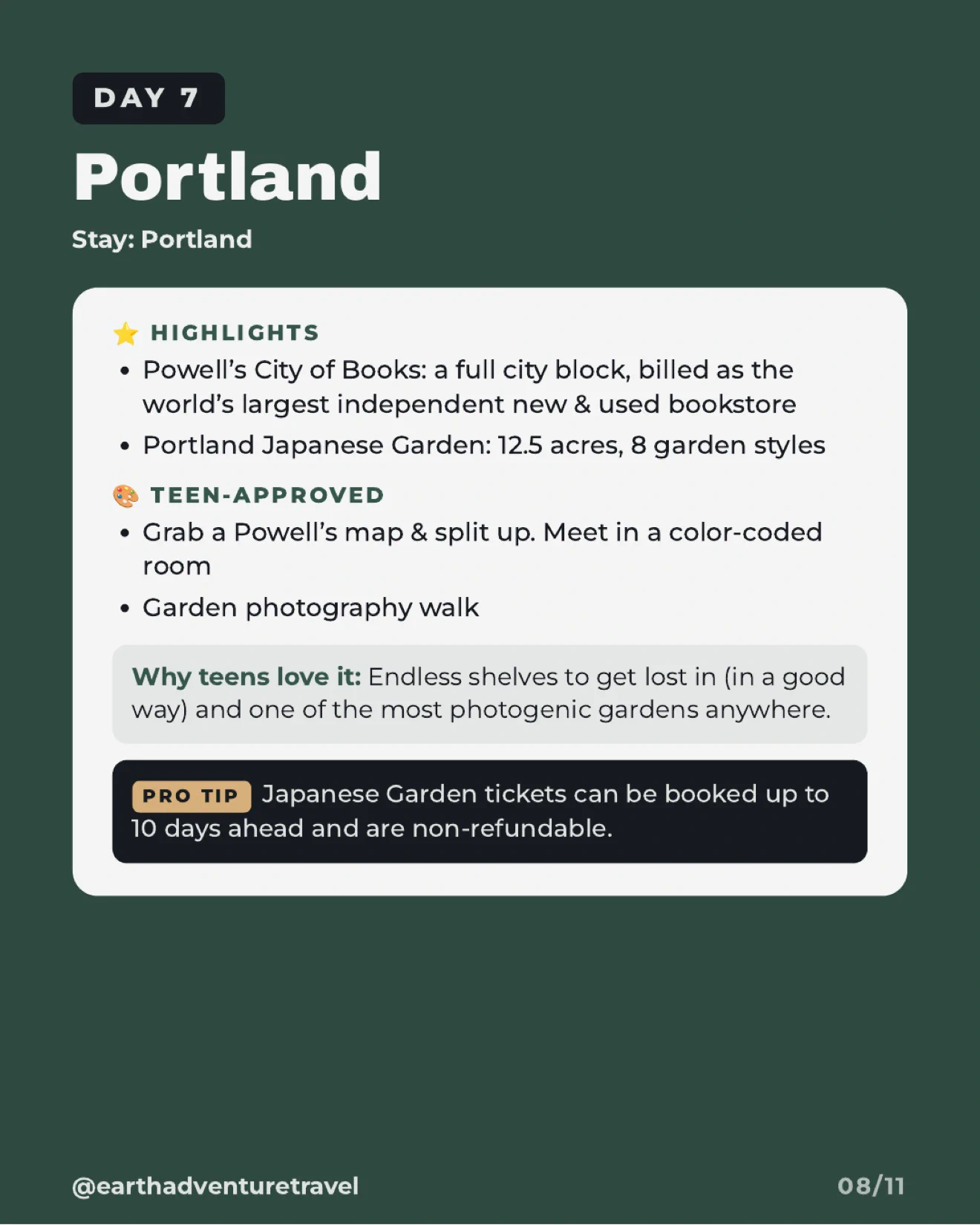
Day 7 itinerary graphic for Powell's City of Books and Portland Japanese Garden
07Portland · books & composition

Split up among a million possible interests.

Powell’s City of Books fills a city block, and its color-coded rooms create a natural independence exercise. Grab a map, choose a reunion point, and let everyone follow their own shelves. The goal is not merely buying a book—it is the rare pleasure of getting productively lost.

Shift from shelves to designed landscape at Portland Japanese Garden. Its 12.5 acres and eight garden styles make a strong photography walk: reflections, negative space, framed views, texture, and restraint. Book ahead if the day is fixed; tickets can be released up to ten days ahead and are non-refundable.

Stay: Portland · Independence win: split up at Powell’s · Visual study: garden composition

One-photo rule: At the garden, wait ten minutes before taking the first picture. Looking first usually produces the strongest frame.
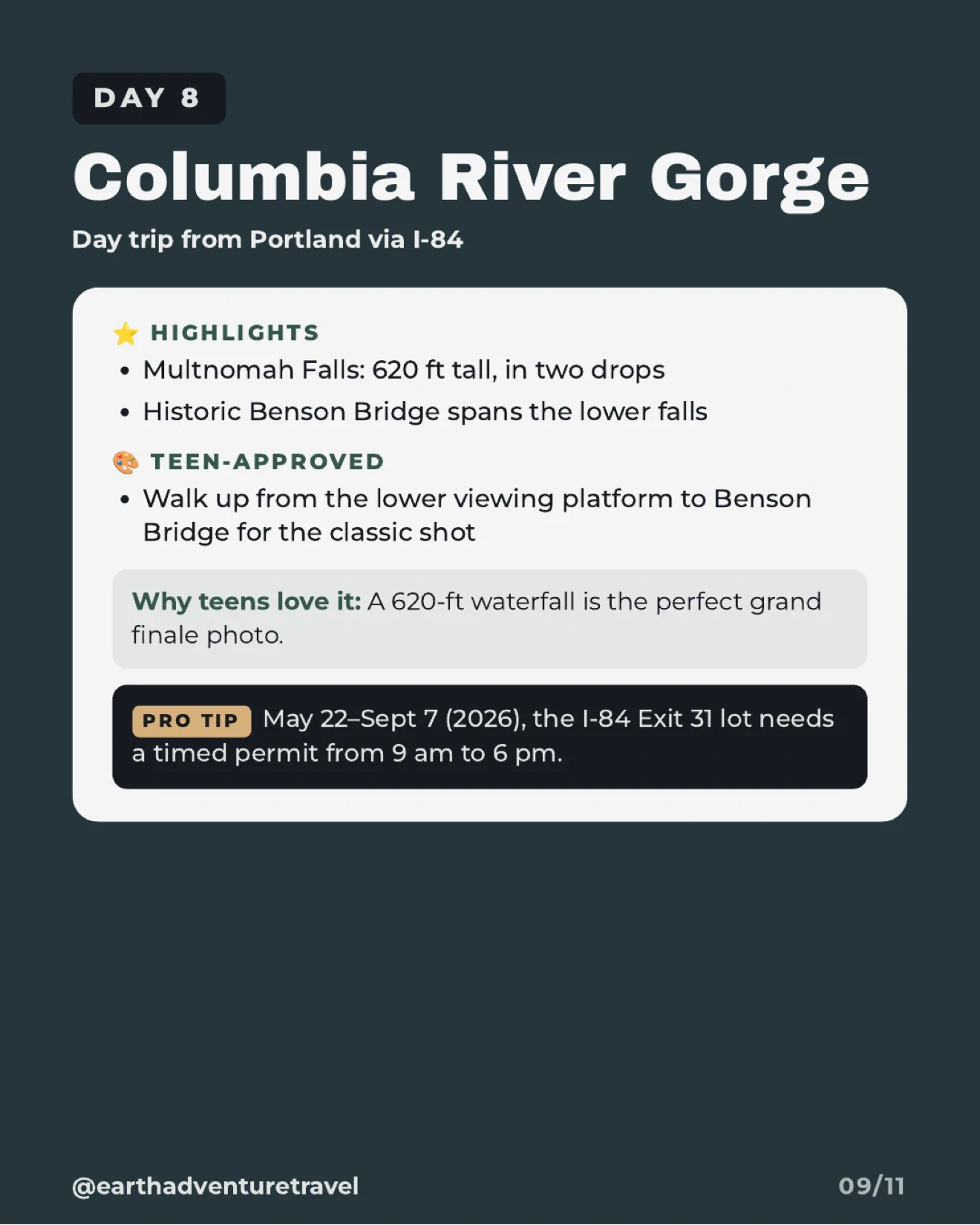
Day 8 itinerary graphic for Multnomah Falls in the Columbia River Gorge
08Columbia Gorge · grand finale

Finish under a 620-foot waterfall.

Use Portland as the base for a Columbia River Gorge day trip, with Multnomah Falls as the final visual exclamation point. The waterfall drops 620 feet in two stages, and the short walk from the lower platform to Benson Bridge gives the classic view into the lower cascade.

For the 2026 summer season, the I-84 Exit 31 lot required a timed permit from 9 a.m. to 6 p.m. between May 22 and September 7. Permit windows can change, so verify the current rules and road conditions for your own dates.

Day trip from Portland via I-84 · Permit rules can change · Recheck before departure

Final assignment: Choose one image from each day and sequence the eight as a visual story—made object to wild coast, close detail to big finale.

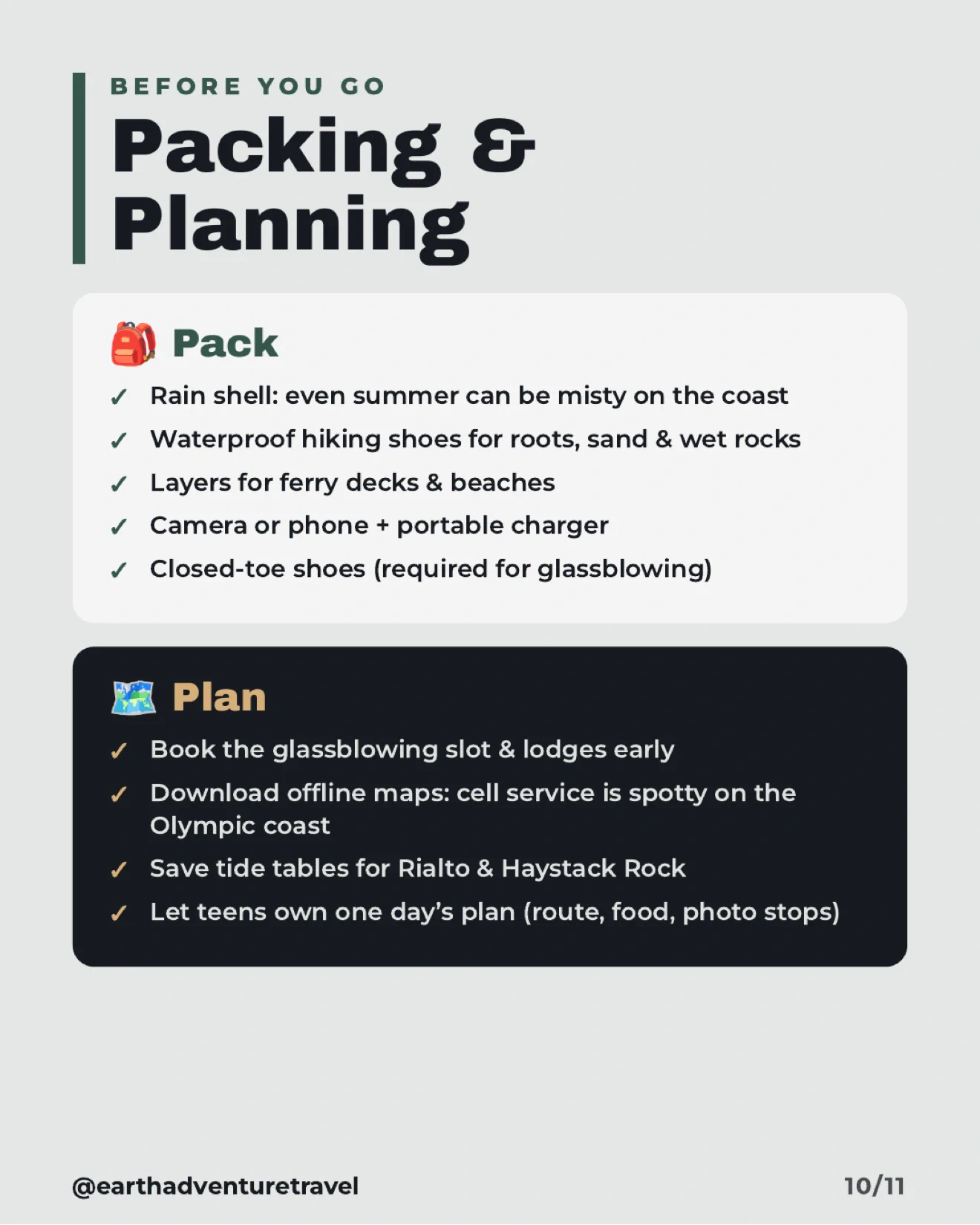
Before you go

Pack for wet edges and creative detours.

The budget is an estimate, not a quote. Lodging, rental cars, activity slots, tides, ferry operations, permits, fire conditions, and trail access all need a fresh check before booking.

Rough budget · family of 4

$5.5K–$8.5K
Seven nights · hotels and lodges · rental car and activities · flights excluded
  • Seattle and Oregon Coast lodging are the biggest variables
  • Book glassblowing and lodges early
  • Olympic National Park vehicle entry adds a park fee
  • Timed-access rules may apply at Multnomah Falls

What earns space

  • Rain shell for misty coast and forest
  • Waterproof hiking shoes for roots, sand, and wet rock
  • Warm layers for ferry decks and beaches
  • Camera or phone plus portable charger
  • Closed-toe shoes for glassblowing
  • Offline maps for the Olympic coast
  • Saved tide tables for Rialto and Haystack Rock
  • A sketchbook for color, texture, and notes

Quick answers

Planning notes

Is this trip only for teens who already make art?

No. The route works for teens who like photography, books, design, music, nature, or simply having something specific to notice. The creative prompts are invitations, not assignments to grade.

How much independence should teens get?

Match it to the teen and the setting. Pike Place and Powell’s can support short solo windows with a fixed boundary, meeting point, time, charged phone, and clear backup plan. The coast, forest, and gorge should stay group activities.

Can we skip the long drive to Cannon Beach?

Yes. The transfer is the route’s hardest day. A Washington-only version could add more time around the Olympic Peninsula, but it would lose Haystack Rock, Portland, and the Gorge finale.

What weather issue matters most?

Summer is generally the driest period, but coastal mist and rain remain normal. Wildfire smoke can also affect late-summer visibility and air quality. Favor refundable lodging where practical and check conditions close to departure.

What should be booked first?

Secure lodging, the rental car, and the glassblowing slot first. Then check ferry notices, tide windows, park alerts, and any timed permit requirements once the trip dates are firm.

Plan with confidence

Trip checks

Chihuly Garden and Glass ↗Current hours and admission
Olympic National Park: Hoh ↗Access, alerts, and visitor guidance
Washington State Ferries ↗Schedules and travel planning
Haystack Rock overview ↗Puffin season and tide-pool context
Published information reviewed in 2026. Recheck prices, access, tides, and permit rules for your travel dates.

The trip index

Choose the landscape. Then choose the pace.

Every itinerary gives you a realistic route, daily rhythm, planning notes, and the details that make a family trip work.

No exact match—yet.

Clear a filter to see the closest routes already in the library.

Sources & verification

Last verified: October 2026.

Every price, date, and hour in this guide was checked against the official source above.