InternationalFamilyMultigen

Eight days · Rome, Florence & the Amalfi Coast, kid-tested pacing

The First-Timer's Italy: an 8-Day Rome, Florence & Amalfi Coast Itinerary

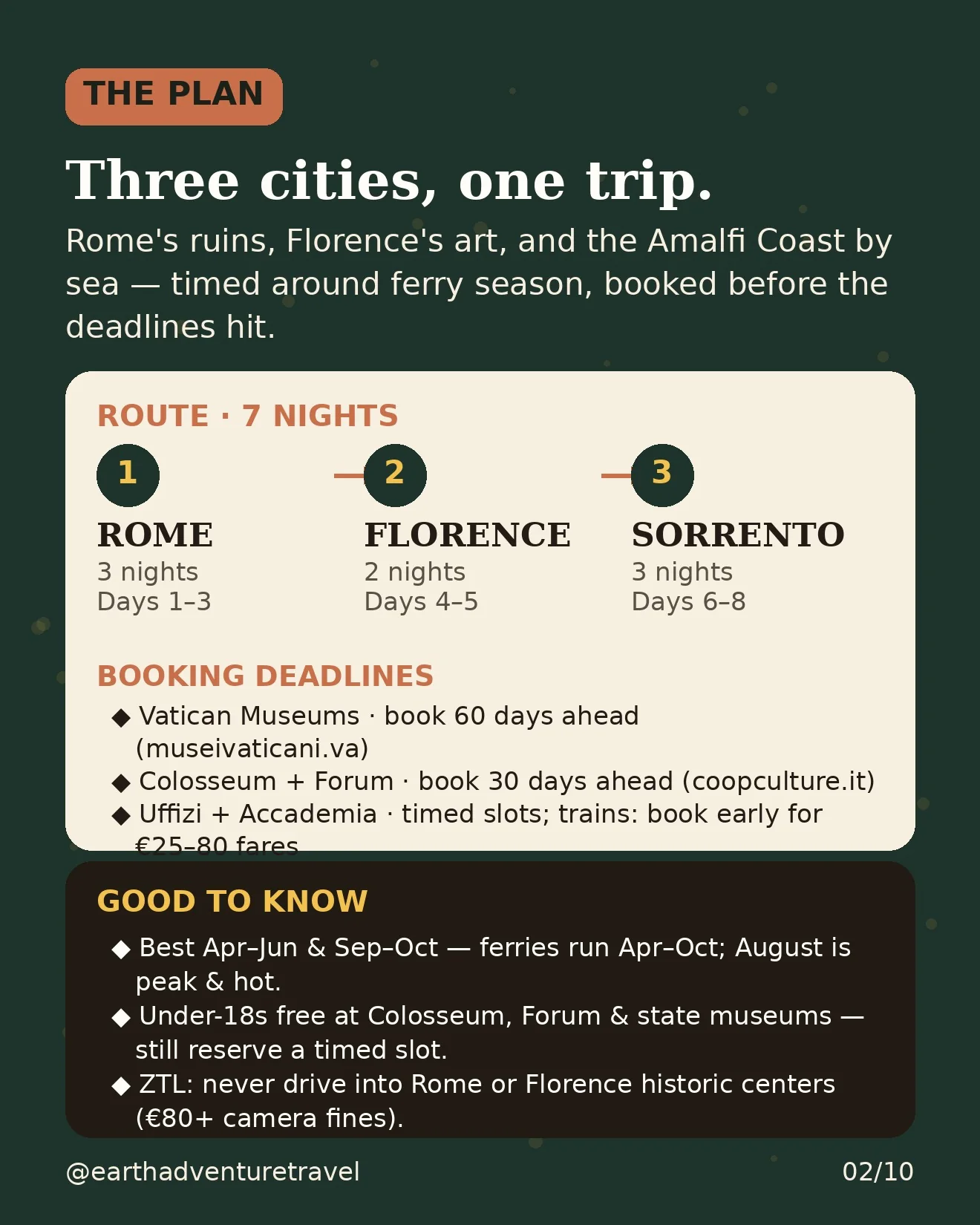
Rome's ruins, Florence's art, and the Amalfi Coast by sea — timed around ferry season, booked before the deadlines hit, and paced so the kids remember the trip fondly.

InternationalHistoric & Cultural RoutesFood & Drink Trails

8 days / 7 nightsBest Apr–Jun & Sep–OctFamily · multigenEstimate: $4.3K–$6K for 4
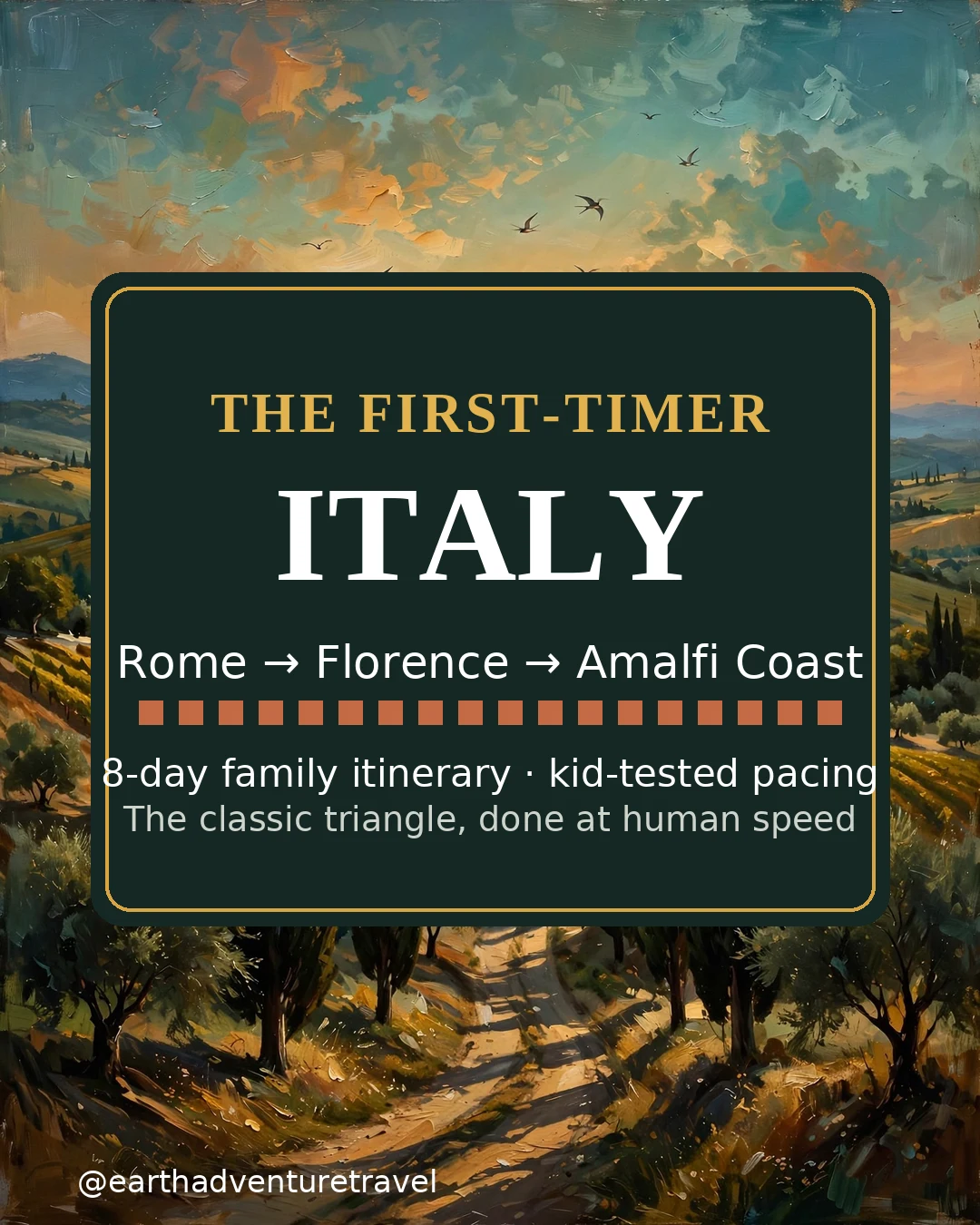
Illustrated Italy guide cover: Rome, Florence, and the Amalfi Coast — an 8-day family itinerary
Original itinerary artwork
On this page
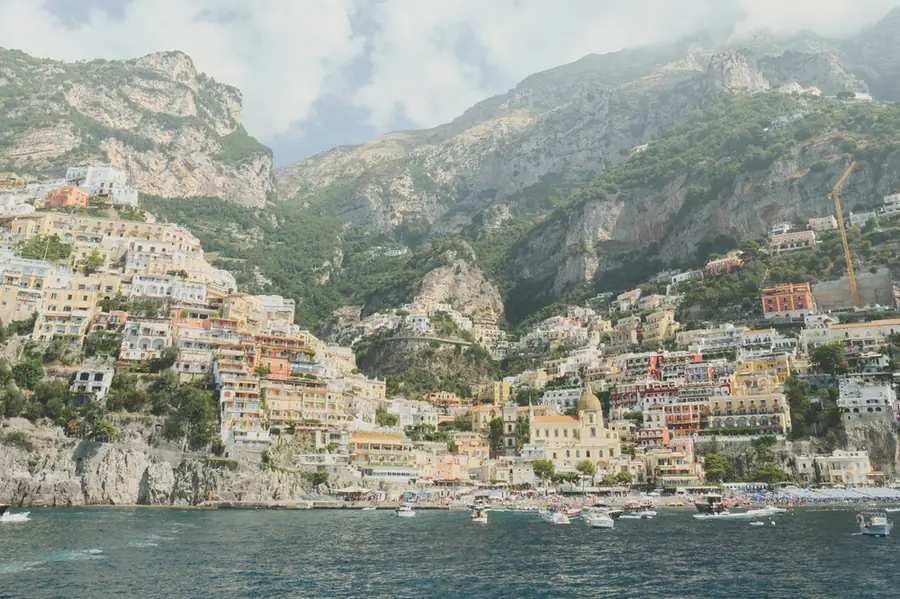
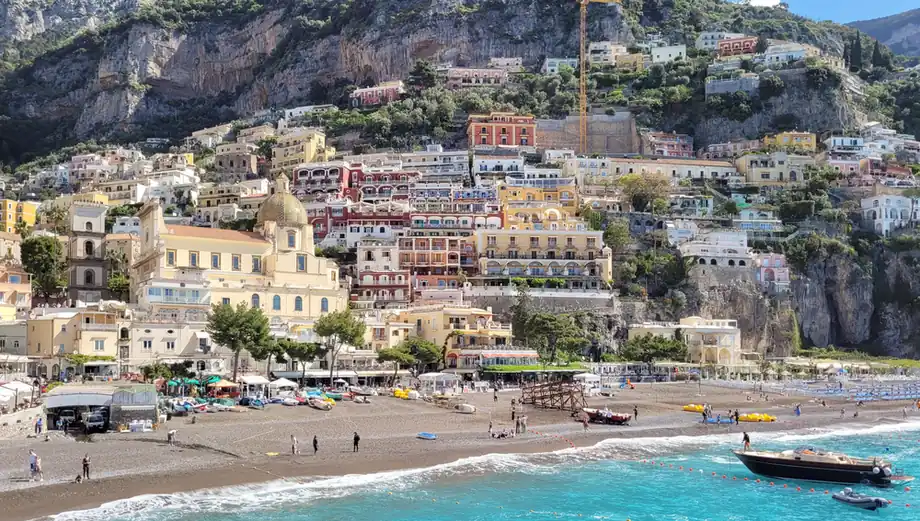
Positano's pastel houses cascading to the sea, seen from the water
Positano's pastel cascade, seen from the water. Photo: Bernard Gagnon / Wikimedia Commons (CC BY 4.0)

The 60-second version

At a glance

Who it's for
First-time Italy visitors: families with kids 6+ and multigenerational crews
Route
Rome (3 nights) · Florence (2 nights) · Sorrento (3 nights)
Best timing
Best for travel between April and October: the Amalfi ferries run April–October only, and May–June plus September–early October bring mild walking weather without the August crush
Pace
Moderate — 12,000–18,000 steps a day, two train travel days, one slow morning built in
Sleep
Rome 3 nights → Florence 2 nights → Sorrento 3 nights; three bases, no packing roulette
Good to know
Book the Vatican Museums 60 days out and the Colosseum 30 days out — both sell out; kids under 18 enter free at most state sites

Rough budget · family of 4

$4,300 – $6,000

8 days / 7 nights · lodging, food, trains, attractions · international flights excluded · €1 ≈ $1.12 (October 5, 2026)

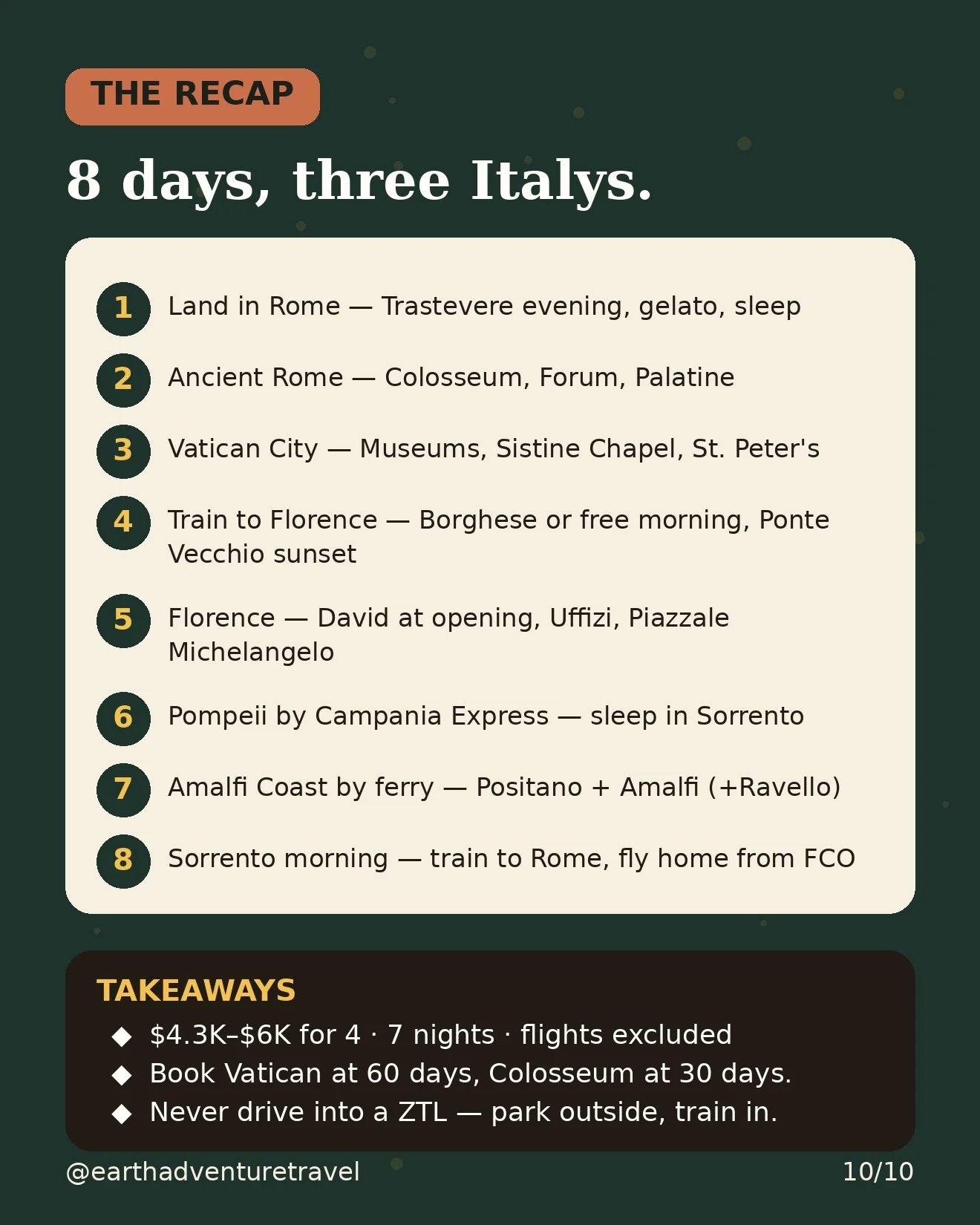
Italy trip recap graphic: 8 days, three Italys — Rome, Florence, Sorrento
Share the plan.

The idea

The direct answer: this is the classic first-timer triangle — Rome, Florence, and the Amalfi Coast — done in eight days at human speed instead of the usual five-day sprint. Three nights in Rome cover the Colosseum and the Vatican without a single 6 a.m. alarm; two nights in Florence put you in front of the David at opening and on the Piazzale at golden hour; three nights in Sorrento give you Pompeii and a full ferry day on the coast. Every ticket deadline is mapped below, all costs are in USD, and the pacing assumes kids, grandparents, or both.

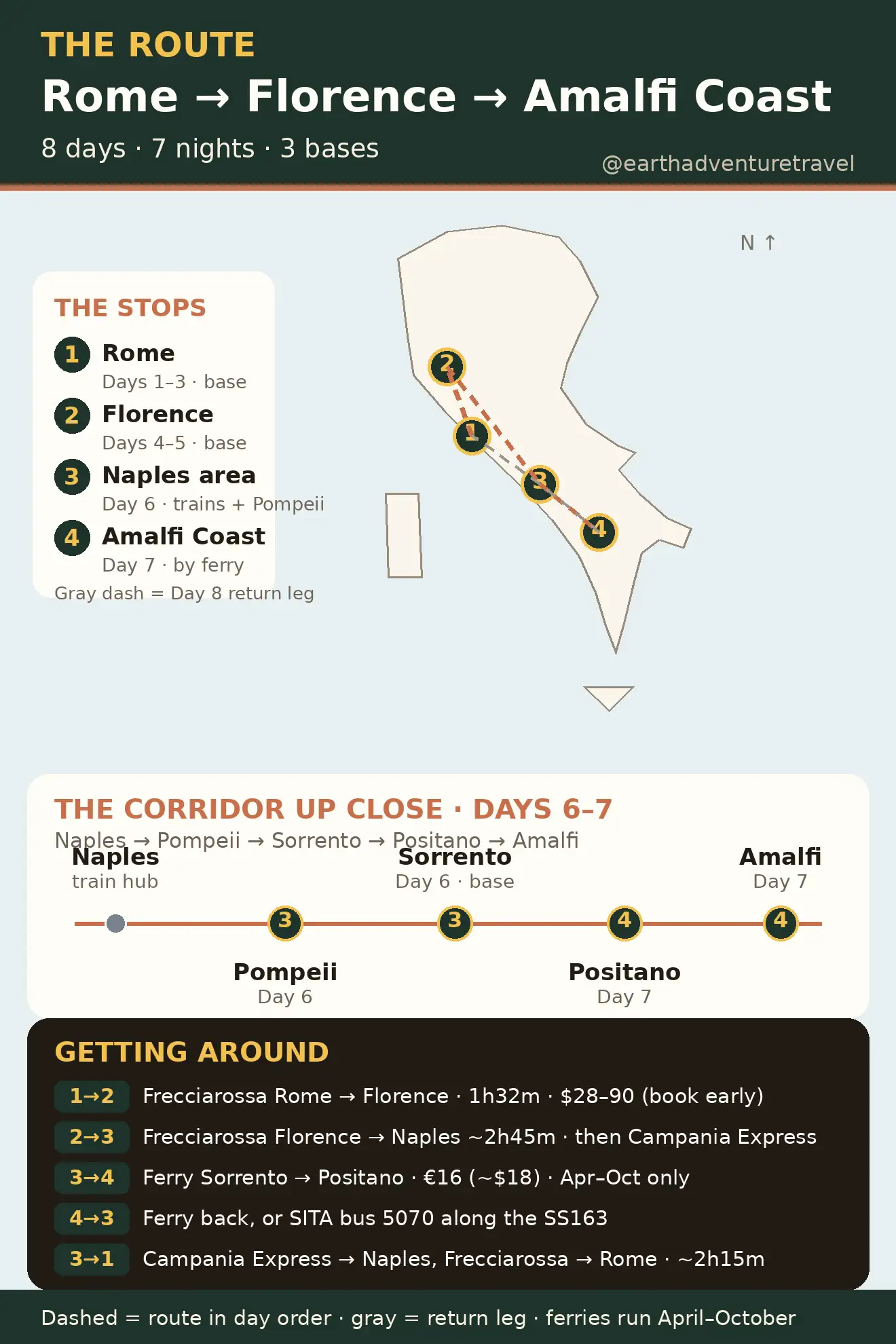
The route works because it stops fighting Italy's geography. Rome and Florence connect on the 1h32m Frecciarossa; Florence to Naples is one more high-speed leg; from Naples the Campania Express drops you at Pompeii's door and carries you on to Sorrento, the calmest base on the coast. No rental car, no ZTL camera fines, no white-knuckle SS163 driving — the boats and trains do the scenic work while you sit down.

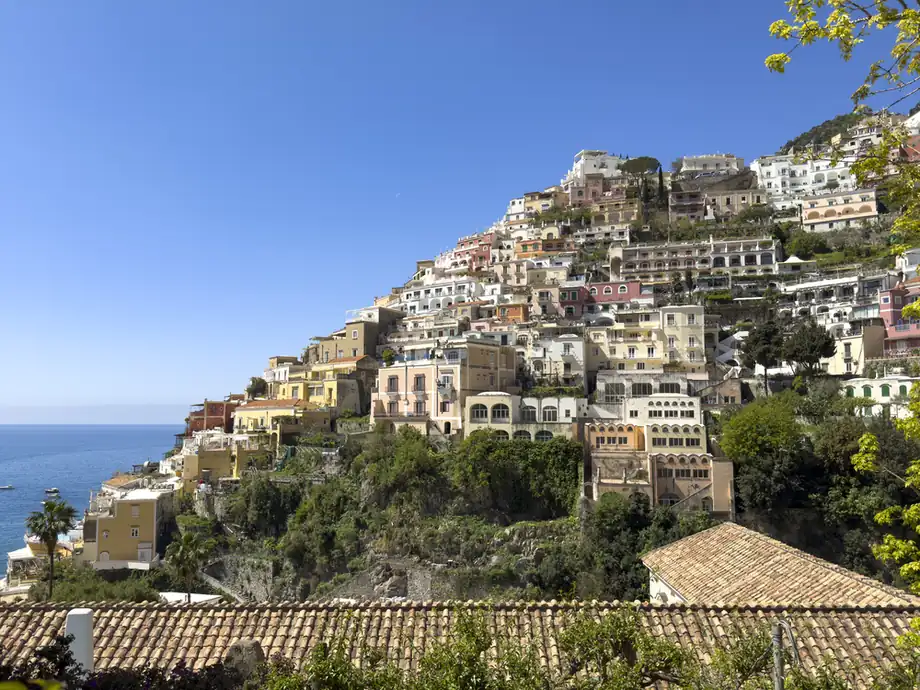
Positano climbing its cliff above the Tyrrhenian Sea
Positano climbing its cliff — the reward at the end of the triangle. Photo: Alexis Lours / Wikimedia Commons (CC BY 4.0)

Two ground rules make it work. Book the two big deadlines first. Vatican Museums tickets release 60 days ahead on museivaticani.va and the Colosseum releases exactly 30 days ahead at 9 a.m. Rome time on coopculture.it — miss those windows and you will pay triple through resellers or miss out entirely. And let the trains be the rest stops. Italy's fast trains are smooth, reserved-seat, and on time; the Rome–Florence and Florence–Naples legs are the trip's built-in naps, snack breaks, and scenery.

8days, 3 bases, 0 rental cars
Apr–Octferry season on the coast
60 / 30days ahead: Vatican / Colosseum booking deadlines
$4.3–6Kfor a family of 4, 8 days

The eight-day route

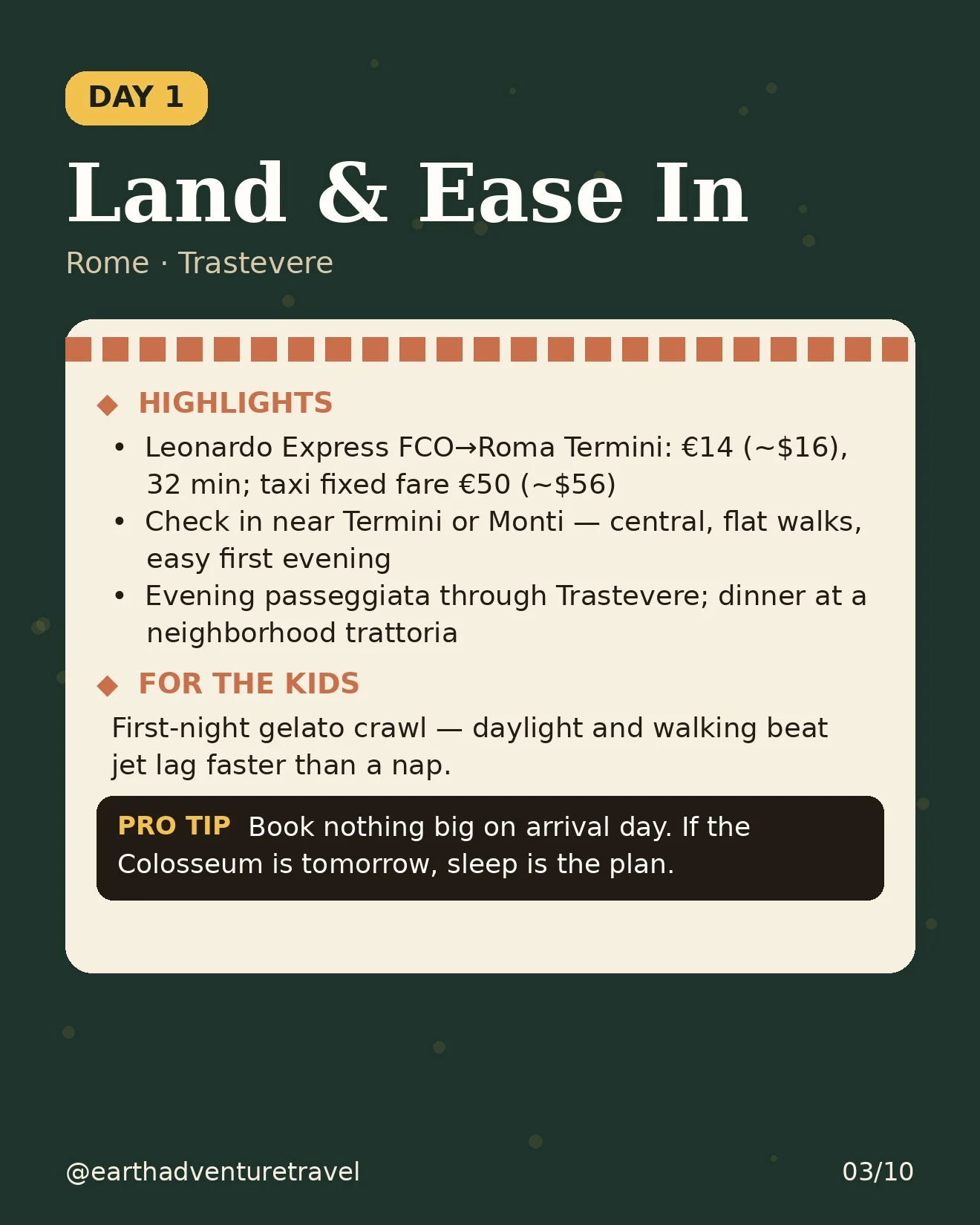
Day 1 itinerary card: land in Rome, Trastevere evening
Share the day.

Touch down at Fiumicino (FCO) and ride the Leonardo Express to Roma Termini — €14 (~$16), 32 minutes, no stops, departing every 15–30 minutes. Buy tickets at the arrivals-hall machines or the Trenitalia app before boarding. A taxi to anywhere inside the Aurelian Walls is a fixed €50 (~$56) fare by law — confirm "tariffa fissa" before loading bags. Zip phones and wallets at Termini — it's Rome's pickpocket capital.

Check in near Termini or Monti — flat, central, metro-connected, which beats charm on night one. Drop bags and resist the bed — daylight beats jet lag faster than any nap. Late afternoon, cross Ponte Sisto into Trastevere for the evening passeggiata, wander the lanes around Santa Maria in Trastevere (free; 12th-century gold mosaics worth five quiet minutes), then dinner at a neighborhood trattoria.

For the kids, make it a gelato crawl: one small cone per stop, three stops, nobody naps. Fatamorgana (natural ingredients) and Fior di Luna (Via della Lungaretta) are the two worth seeking out. Book nothing big today — if the Colosseum is tomorrow, sleep is the plan.

The plan

  • Land at FCO; Leonardo Express to Termini (€14/~$16, 32 min) or fixed-fare taxi (€50/~$56).
  • Check in near Termini or Monti; rest, then Ponte Sisto → Trastevere lanes.
  • Evening passeggiata + three-stop gelato crawl; trattoria dinner by 8 p.m.

Where to stay

  • Hotel Santa Maria (Trastevere) — quiet courtyard, family rooms.
  • Hotel Artemide (Via Nazionale) — proper quad rooms two blocks from Termini; easy Day 4 train.
  • Monti Palace Hotel — rooftop with Colosseum views; flat walk to the Forum tomorrow.
Day 1 → Day 2: Stay put — the Colosseum is one Metro B stop (Colosseo) from Termini or a 15-minute flat walk from Monti.

If the flight was brutal, skip Trastevere and sleep. The neighborhood will still be there tomorrow — jet lag wins every fight on day one.
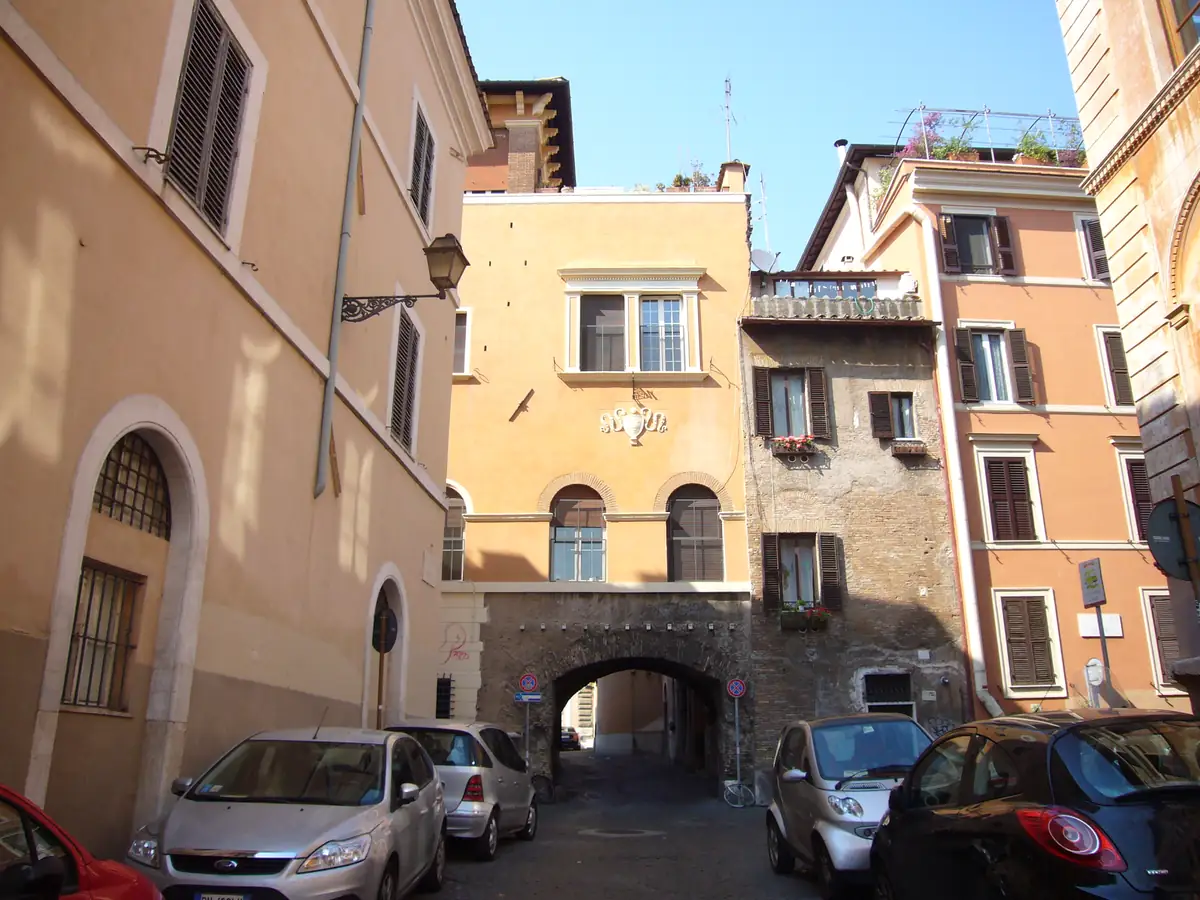
Warm stone lanes and archways in Trastevere, Rome
Trastevere's warm stone lanes — Day 1 evening walk. Photo: Lalupa / Wikimedia Commons (CC BY-SA 4.0)
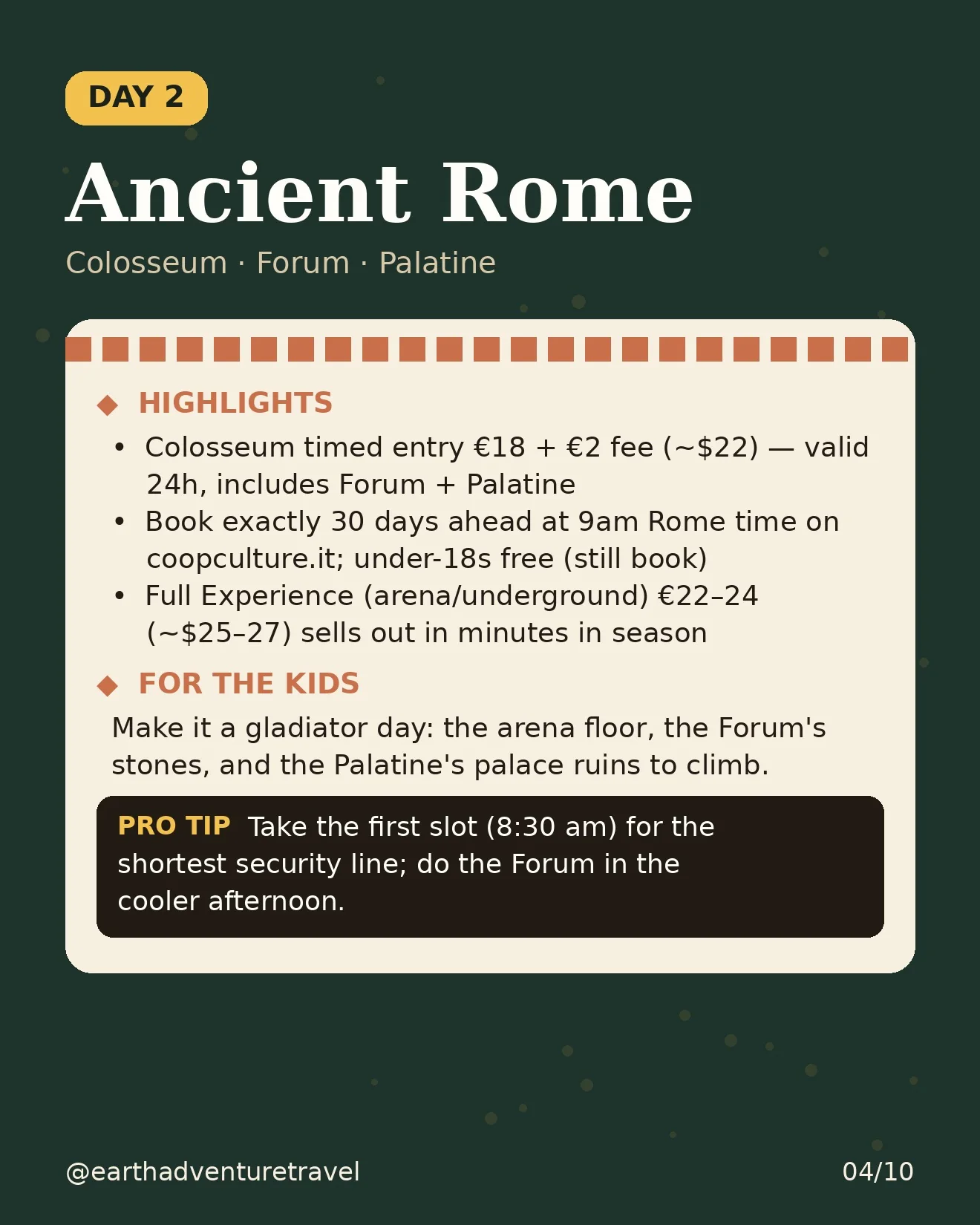
Day 2 itinerary card: Colosseum, Forum, Palatine
Share the day.

Take the first slot (8:30 a.m.) at the Colosseum — the security line is shortest before 9 and the travertine glows in morning light. The standard ticket is €18 + €2 booking fee (~$22), valid 24 hours and including the Roman Forum and Palatine Hill; book exactly 30 days ahead at 9 a.m. Rome time on coopculture.it. Kids under 18 enter free but still need the €2 (~$2) timed reservation. The Full Experience ticket (€22–24, ~$25–27) sells out in minutes in season. Bring ID — tickets are nominative.

Do the Colosseum first (2 hours; there's an elevator to the upper tier), then lunch, then the Forum and Palatine in the cooler afternoon. Enter the Forum at the Via Sacra entrance and walk downhill through 2,000 years — Arch of Titus, House of the Vestals, the Curia — then climb the Palatine for the Hippodrome and the terrace over the Forum. The ground is uneven ancient basalt: broken-in shoes and a carrier, not a stroller.

Make it a gladiator day: count the 80 numbered arches, find the trapdoors on the arena floor, and let the kids lead the Forum on a spot-the-oldest-stone mission. Bad-weather fallback: Palazzo Massimo alle Terme (10 minutes from Termini, rarely crowded). Dinner in Monti — Trapizzino's stuffed pizza pockets or Roscioli Salumeria's carbonara.

The plan

  • 8:30 a.m. Colosseum first slot (booked 30 days out); 2 hours inside.
  • Midday: lunch in Monti; rest — the afternoon is the long walk.
  • Afternoon: Forum via Via Sacra entrance, then up the Palatine (same ticket).

Where to stay

  • Same Rome base as Day 1 — no need to move hotels.
  • Hotel Quirinale — family-welcoming, two minutes from Termini.
  • Apartment alternative: a Monti or Trastevere short-let with a washing machine.
Day 2 → Day 3: Vatican day tomorrow — Metro A to Ottaviano (10-minute walk to the Museums) or a €15 (~$17) taxi; leave by 7:30 a.m.

First Sunday of the month is free at the Colosseum — but lines top two hours with no advance booking.

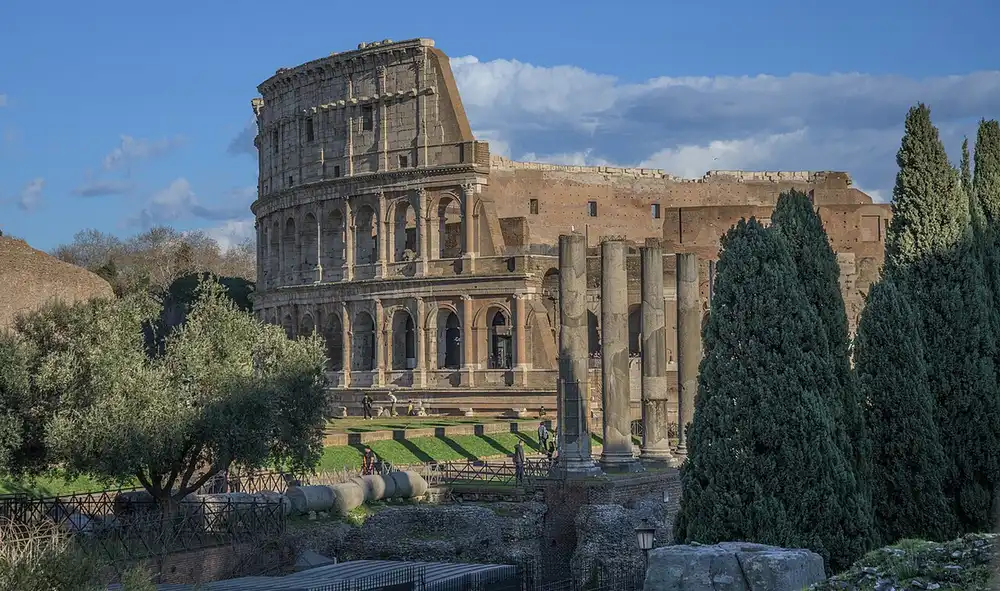
The Colosseum and the Roman Forum from the south
The Colosseum and the Roman Forum from the south. Photo: Wilfredor / Wikimedia Commons (CC0)
Day 3 itinerary card: Vatican Museums, Sistine Chapel, St. Peter's
Share the day.

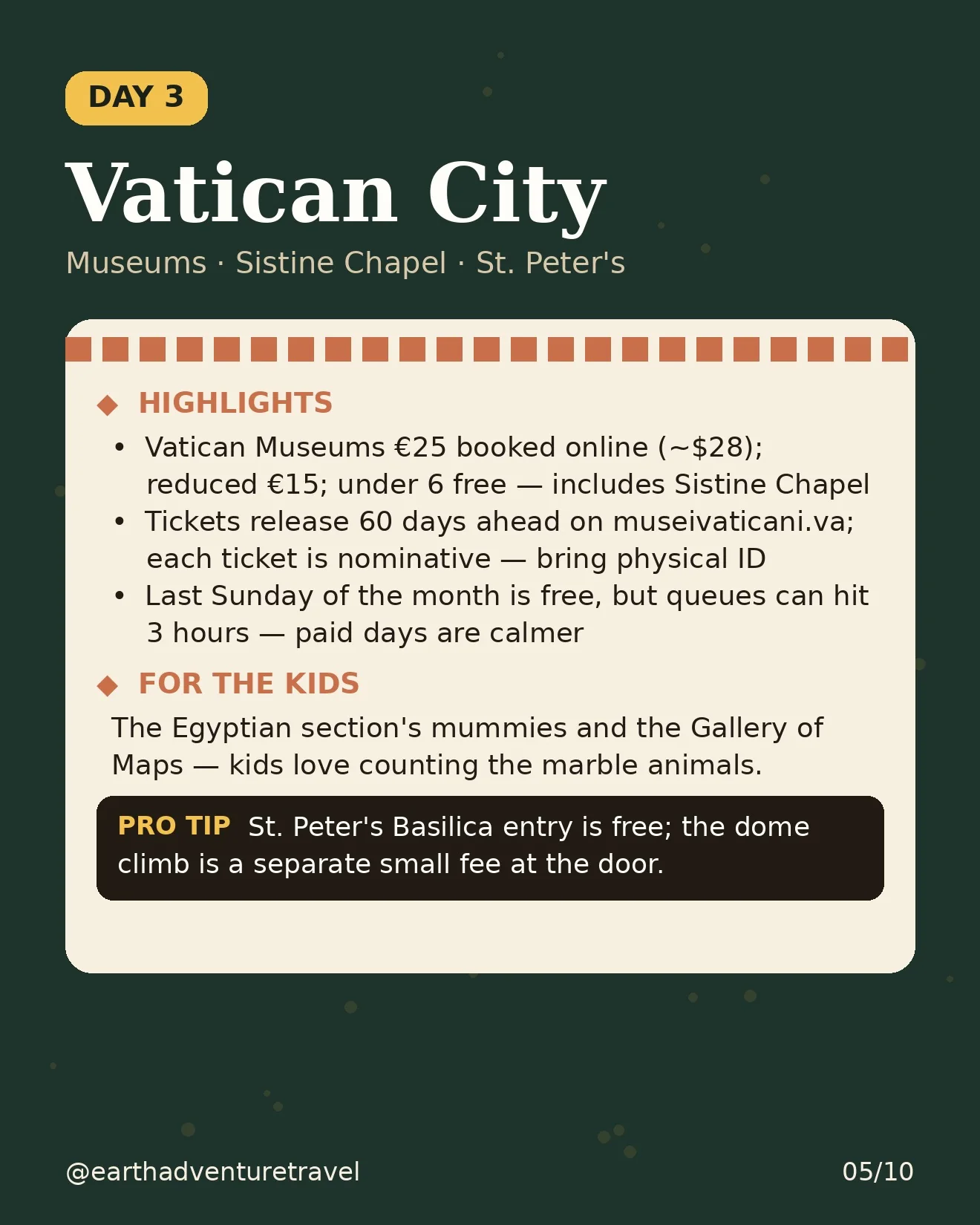
Book the earliest Museums slot (8 a.m.) — €20 + €5 online booking (~$28), reduced €10 (~$11) for ages 7–18, kids under 7 free. Tickets release 60 days ahead on museivaticani.va; bring physical ID for everyone. The one-way route runs about 7 km to the Sistine Chapel: the Egyptian section's mummies hook kids early, the Gallery of Maps invites a count-the-animals game, and the Raphael Rooms are the calm before the Sistine storm. Silence and no photos in the Chapel — prep the kids for five still minutes.
Exit via the Sistine Chapel's right-hand door into St. Peter's Basilica — entry is free, but shoulders and knees must be covered. Inside: the Pietà, Bernini's 95-foot baldachin, the grottoes. The dome climb is the day's decision: €10 (~$11) stairs / €15 (~$17) elevator at the kiosk (€17 (~$19)/€22 (~$25) online with audio guide) — 551 steps total, the last 320 a narrow leaning spiral even with the elevator. Fit kids 8+ love it; others should admire from the terrace.

Bathrooms are scarce mid-route — go before the Sistine Chapel. The Museums have elevators, but grandparents should plan bench breaks. Lunch after: Pizzarium near the Museums exit for pizza al taglio by weight. The last Sunday of the month is free, but queues can hit 3 hours — paid days are calmer.

The plan

  • 8 a.m. Vatican Museums (booked 60 days out); 3 hours at kid pace.
  • Midday: St. Peter's Basilica (free); dome climb — stairs €10/~$11 / elevator €15/~$17.
  • Evening: St. Peter's Square at dusk (free, crowd-free) or an early night.

Where to stay

  • Same Rome base — one last night; pack tonight for the morning train.
  • Hotel Alimandi Vaticano — family-run, across from the Museums entrance.
  • Starhotels Michelangelo — solid 4-star between the Vatican and Termini.
Day 3 → Day 4: Frecciarossa to Florence departs Roma Termini — arrive 20 minutes early.

Dress-code save: pack one light scarf and long pants per person — the Vatican turns away bare shoulders and short shorts.

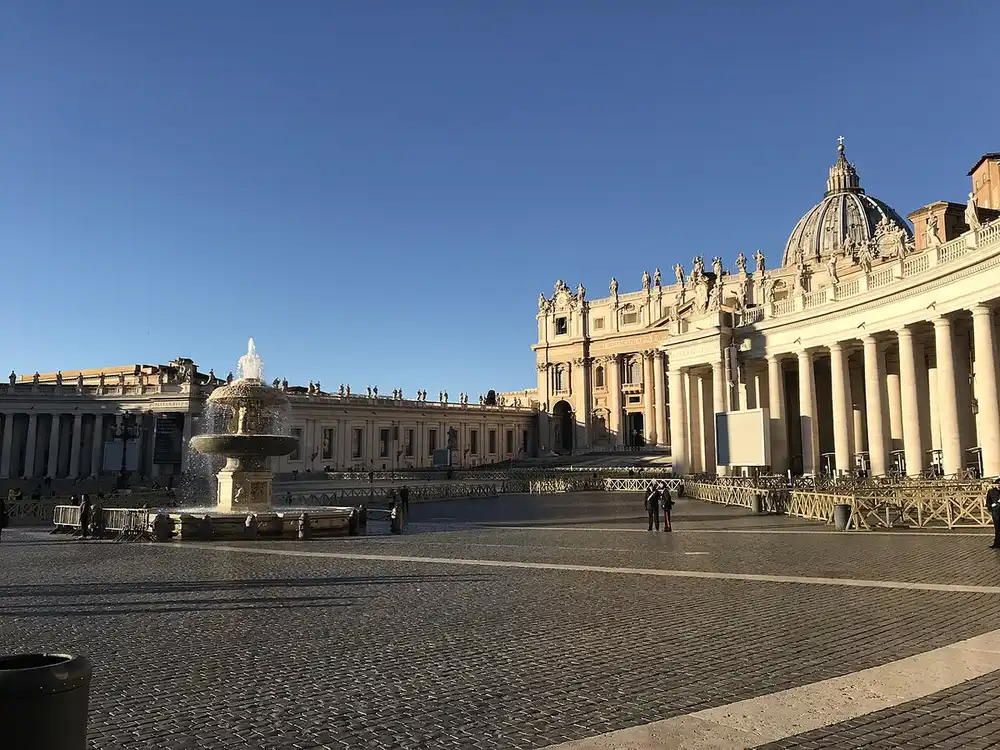
St. Peter's Square in early morning light
St. Peter's Square in early morning light. Photo: Monica Violante / Wikimedia Commons (CC BY-SA 4.0)
Day 4 itinerary card: Rome to Florence, Borghese, Frecciarossa
Share the day.

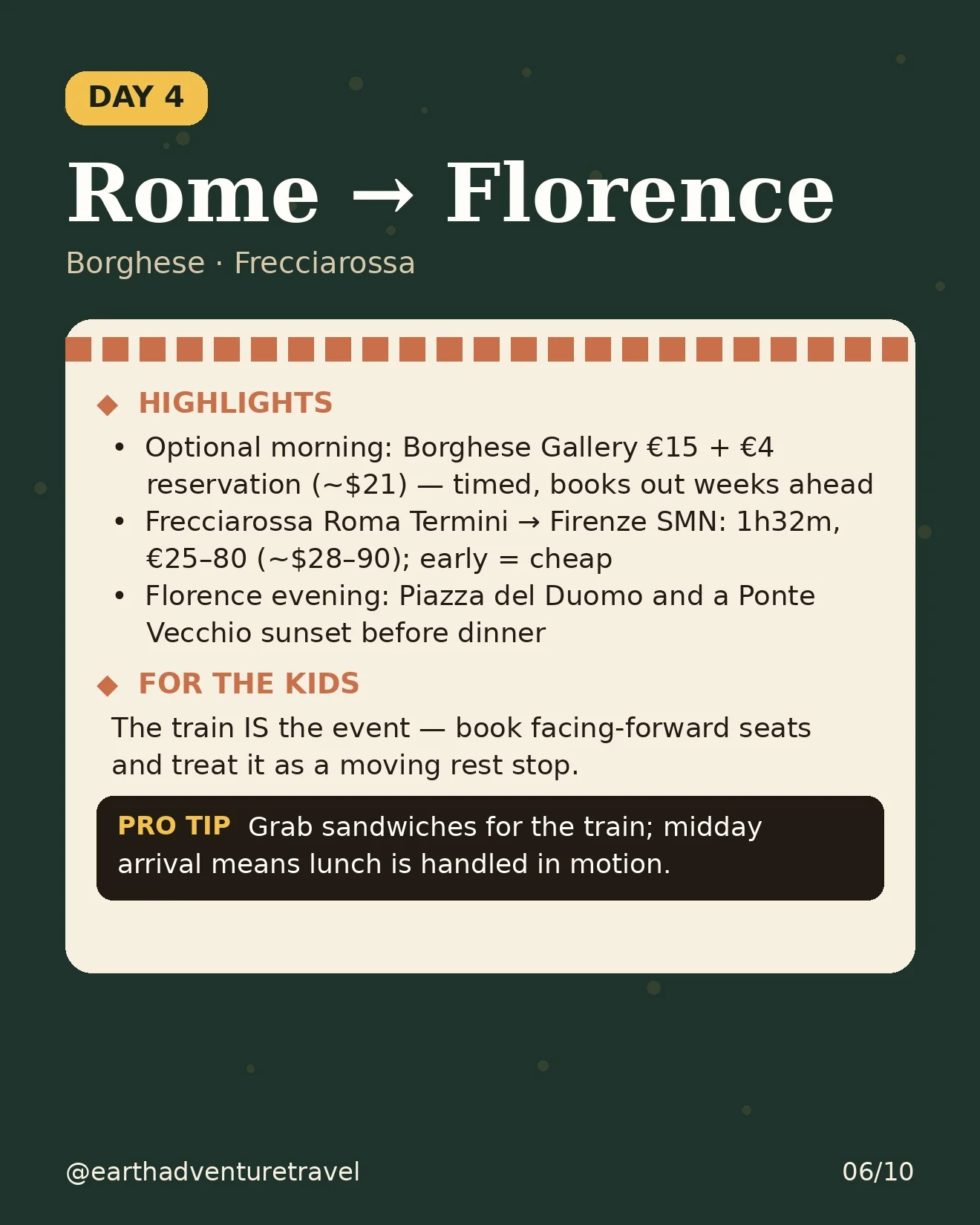
Optional slow morning: the Borghese Gallery (€18/~$20 all-in) is Rome's jewel-box museum — Bernini's Apollo and Daphne and Canova's Venus Victrix in twenty rooms. Visits are strict 2-hour timed slots (180 visitors each); peak-season tickets sell out 2–3 weeks ahead. Bags larger than a purse go in the mandatory cloakroom. Or skip it for a free morning in the Villa Borghese gardens with tired kids.

Midday Frecciarossa, Roma Termini → Firenze SMN: 1h32m, €25–80 (~$28–90) — book early on trenitalia.com. Book facing-forward seats and grab sandwiches at Termini — lunch is handled in motion as the Tuscan hills roll by.

Florence evening: drop bags near Santa Maria Novella (10-minute flat walk to the Duomo), then the Duomo in late light and Ponte Vecchio at sunset. Dinner in the Oltrarno: Trattoria 4 Leoni (book ahead) or Gusta Pizza. Never drive into the historic center — ZTL cameras fine €80 (~$90)+.

The plan

  • Morning (optional): Borghese 9 a.m. slot (€18/~$20) — or Villa Borghese gardens, free.
  • Midday: Frecciarossa to Firenze SMN (1h32m, €25–80/~$28–90); sandwiches for the train.
  • Evening: Duomo at golden light, Ponte Vecchio sunset, Oltrarno dinner.

Where to stay

  • Hotel Palazzo Guadagni (Piazza Santo Spirito) — family apartments with kitchens.
  • Hotel David — family-run and kid-welcoming, south of the center.
  • Ad Astra — Oltrarno B&B, garden terrace; calm for grandparents.
Day 4 → Day 5: Museum day tomorrow — the Accademia's first slot (8:15 a.m.) means the David with room to breathe.

Train-seat trick: pick exact seats on trenitalia.com — a facing-forward quad around a table.

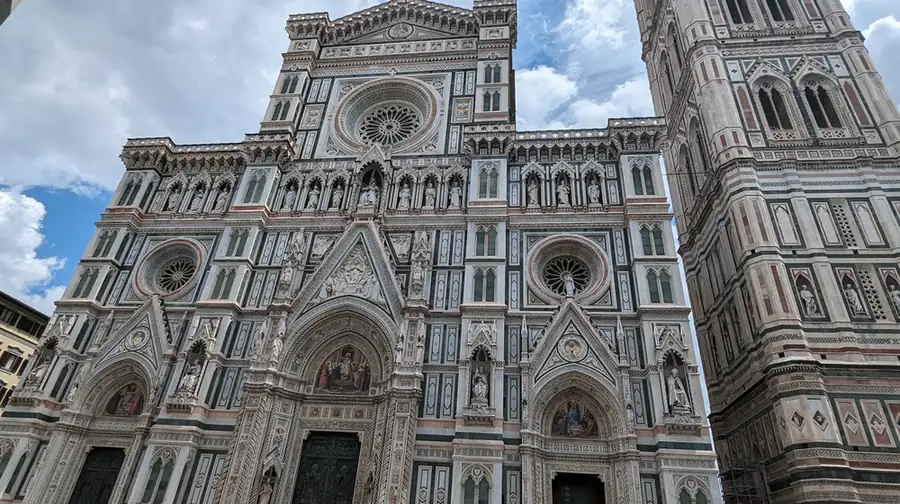
Florence's Duomo — Brunelleschi's dome over the marble facade
Florence's Duomo — Brunelleschi's dome over the marble facade. Photo: bobistraveling / Wikimedia Commons (CC BY 2.0)

Rome gives you the stones, Florence gives you the ceilings, and the Amalfi Coast gives you the light — and eight days is just enough to learn which one your family will dream about.

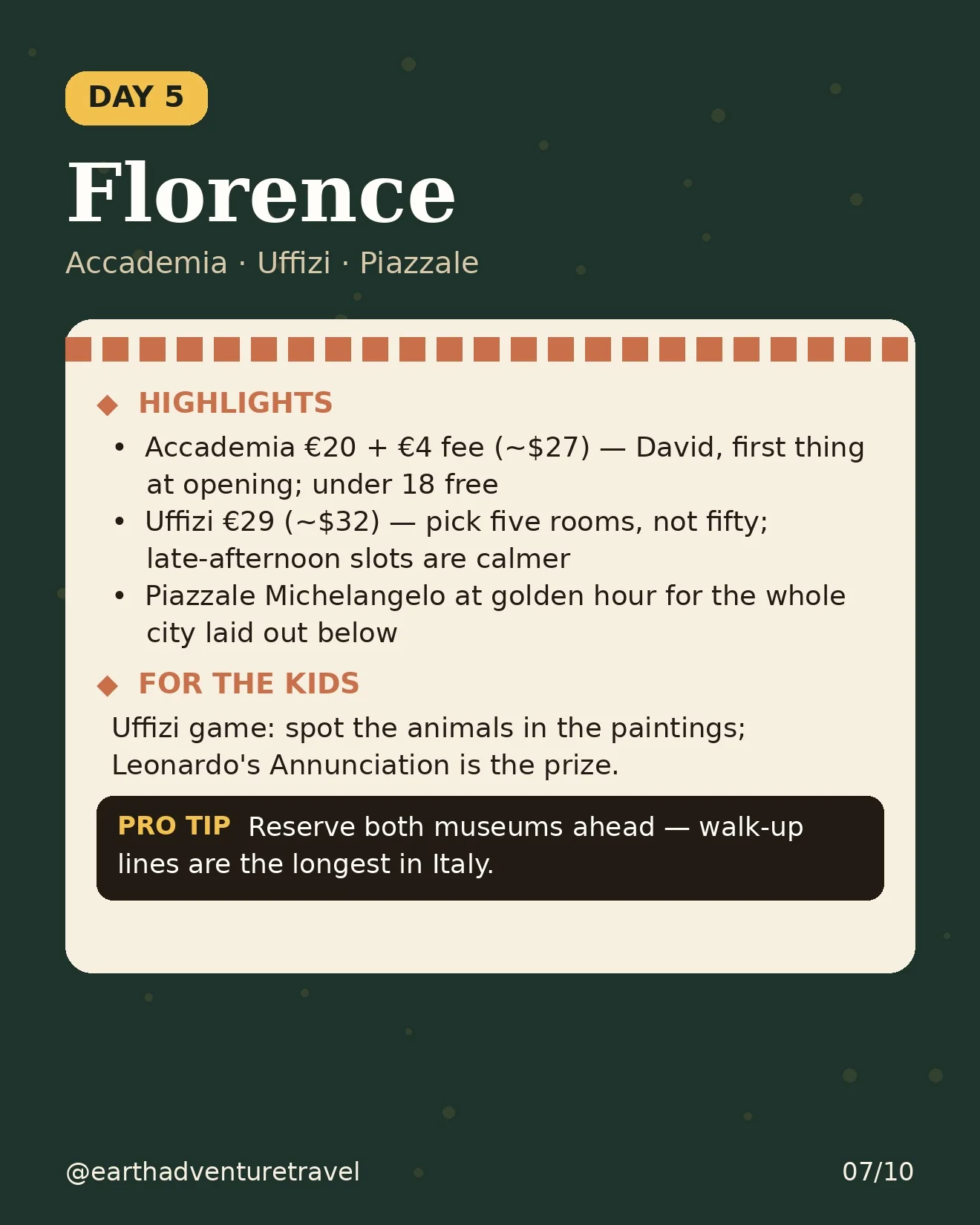
Day 5 itinerary card: Accademia, Uffizi, Piazzale Michelangelo
Share the day.

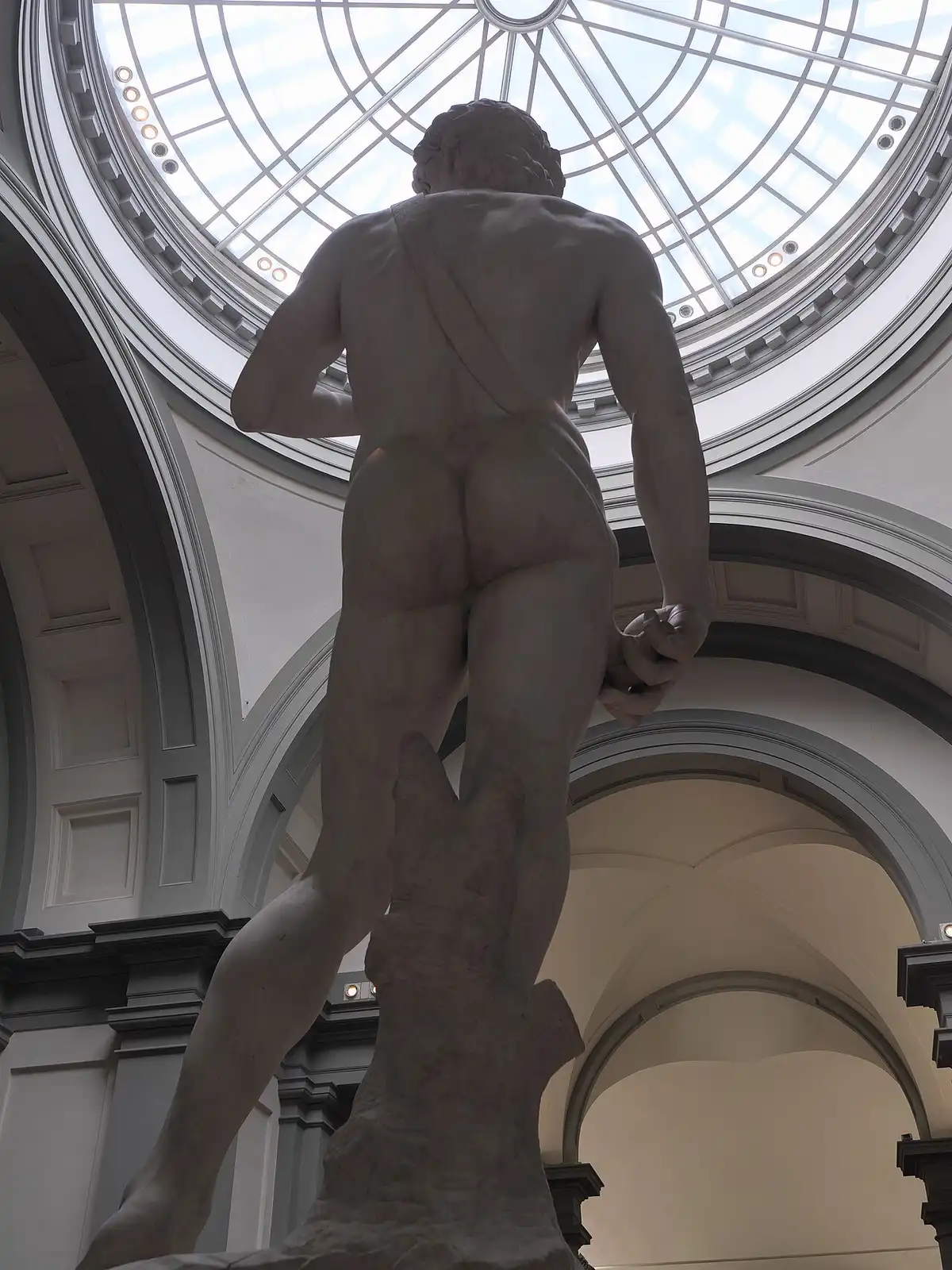
Be at the Accademia for the first slot (8:15 a.m.) — €16 walk-up / €20 online (~$22), under-18s free, EU 18–25 reduced. The museum is one long hall built around Michelangelo's David — 17 feet of marble in the sunlit tribuna. At opening you get him with thirty people instead of three hundred; the whole visit takes 60–90 minutes.

Rest, then the Uffizi in a late-afternoon slot — calmer than the morning crush. 2026 pricing is tiered: €25 at the door / €29 online (~$33), or the afternoon ticket from 4 p.m.: €16 (~$18) door / €20 (~$22) online — the best value in Florence, ~2.5 hours inside. Tickets are nominative (bring ID); closed Mondays, otherwise 8:15 a.m.–6:30 p.m. Don't try to see it all: pick five rooms — the Botticelli rooms, Leonardo's Annunciation (the kids' prize for the animal-spotting game), Michelangelo's Doni Tondo. The rooftop café puts you eye-level with Palazzo Vecchio's tower.

Golden hour belongs to the Piazzale Michelangelo — bus #12/#13 or the 20-minute climb from Piazza Poggi. Bring a second gelato. Dinner back in Santo Spirito square. Bad-weather pivot: the Museo Galileo (Galileo's actual telescopes) or a Palazzo Vecchio family tour.

The plan

  • 8:15 a.m. Accademia first slot (€20/~$22 online) — David, the Prisoners, 60–90 minutes.
  • Midday: rest; lunch at All'Antico Vinaio or the Mercato Centrale food hall.
  • Late afternoon: Uffizi (€29/~$32 online / €20/~$22 afternoon) — five rooms, not fifty; Piazzale at golden hour.

Where to stay

  • Same Florence base as Day 4 — no need to move.
  • Hotel Bernini Palace — central, quiet rooms, easy walk to both museums.
  • Plus Florence Hostel — private family rooms with a pool at half the price.
Day 5 → Day 6: Big travel day tomorrow — Frecciarossa Florence → Naples (~2h45m), then the Campania Express south. Pack tonight.

The Uffizi afternoon hack: the €16 (~$18) walk-up ticket after 4 p.m. means 2.5 hours, emptier rooms, dinner money saved.

Michelangelo's David in the Accademia's tribuna
Michelangelo's David in the Accademia's tribuna. Photo: Jörg Bittner Unna / Wikimedia Commons (CC BY 4.0)
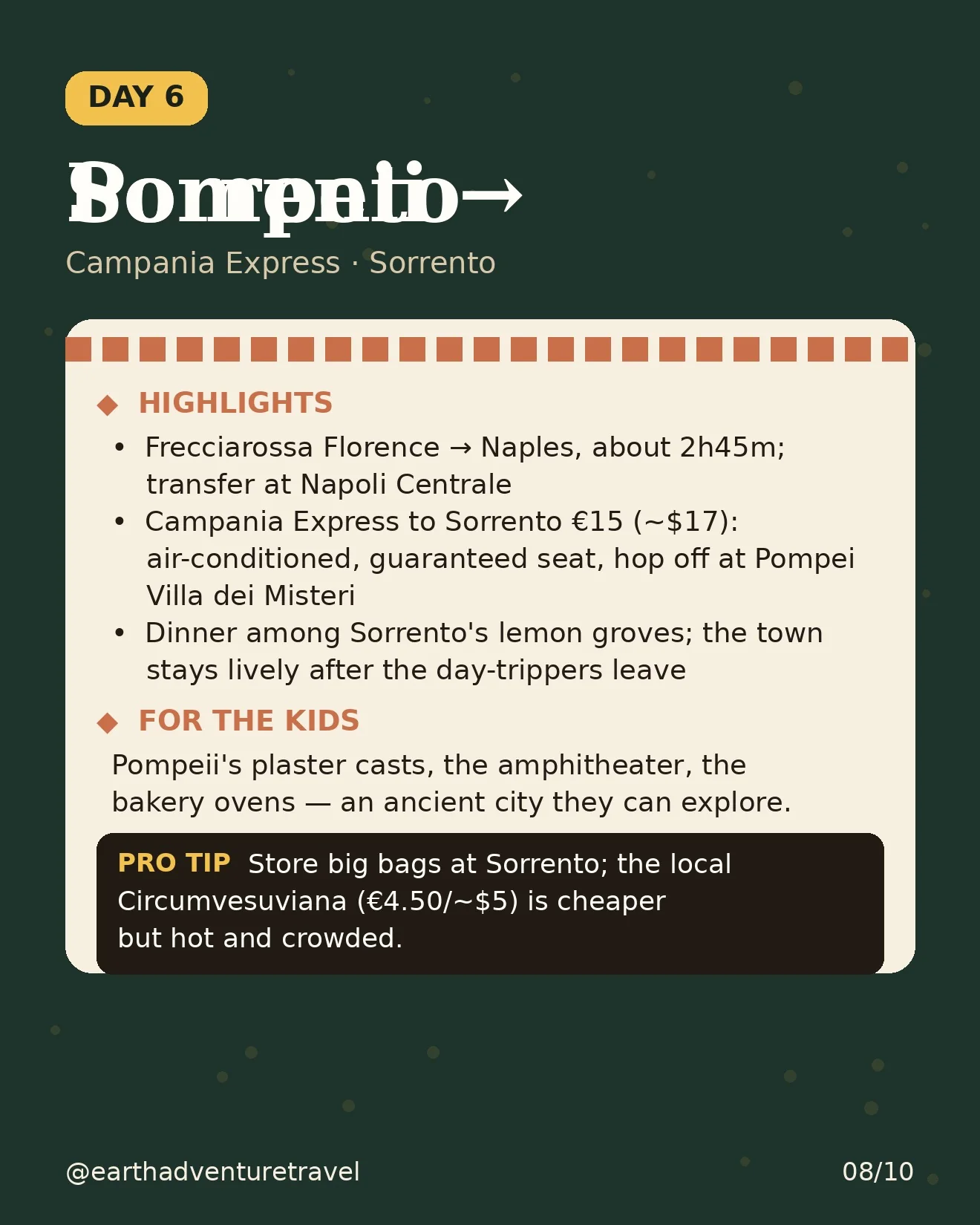
Day 6 itinerary card: Pompeii by Campania Express, sleep in Sorrento
Share the day.

Morning Frecciarossa Florence → Naples, about 2h45m — book early for the €25–80 (~$28–$90) fare band. At Napoli Centrale, follow signs downstairs to the Campania Express: €15 (~$17), air-conditioned, guaranteed seat, stopping at Pompei Scavi–Villa dei Misteri. The cheaper Circumvesuviana (~€4–5 (~$4–$6)) runs the same track but is hot and standing-room-only — the €15 (~$17) is money well spent.

Pompeii is a half-day, not a marathon. 2026 admission: €20 basic (~$22) / €25 Pompeii+ (~$28) with the suburban villas — the Plus is worth it for the Villa of the Mysteries frescoes. Under-18s free, EU 18–25 pay €2 (~$2). Hours April–October: 9 a.m.–7 p.m. (last entry 5:30 p.m.). The kid route: Porta Marina → Forum → amphitheater → bakery ovens → Garden of the Fugitives plaster casts. Two to three hours, then leave before the heat wins — 44 hectares, almost no shade. Bring 2 liters of water per person, hats, and a carrier.

Ride on to Sorrento — the town stays lively after the day-trippers leave. Dinner among the lemon groves at 'O Parrucchiano La Favorita (book ahead), or down at Marina Grande at Da Franco. Scope the Marina Piccola ferry dock tonight — 10 minutes downhill from Piazza Tasso.

The plan

  • Morning: Frecciarossa Florence → Napoli Centrale (~2h45m); Campania Express to Pompei Scavi (€15/~$17).
  • Midday: Pompeii 2–3 hours — Forum, amphitheater, bakery ovens, plaster casts.
  • Afternoon: on to Sorrento; check in, scope the Marina Piccola ferry dock; lemon-grove dinner.

Where to stay

  • Hotel Plaza Sorrento — family rooms, rooftop pool, minutes from station and ferry dock.
  • Hotel Villa Oriana Relais — lemon-grove setting, quieter, strong multigen pick.
  • Relais Villa Angiolina — small, calm, sea-view terraces; book the family suite early.
Day 6 → Day 7: Ferry day tomorrow — morning sailing out, evening sailing back.

Rain plan: swap Pompeii for Herculaneum — smaller, better roofed — or the Naples Archaeological Museum.

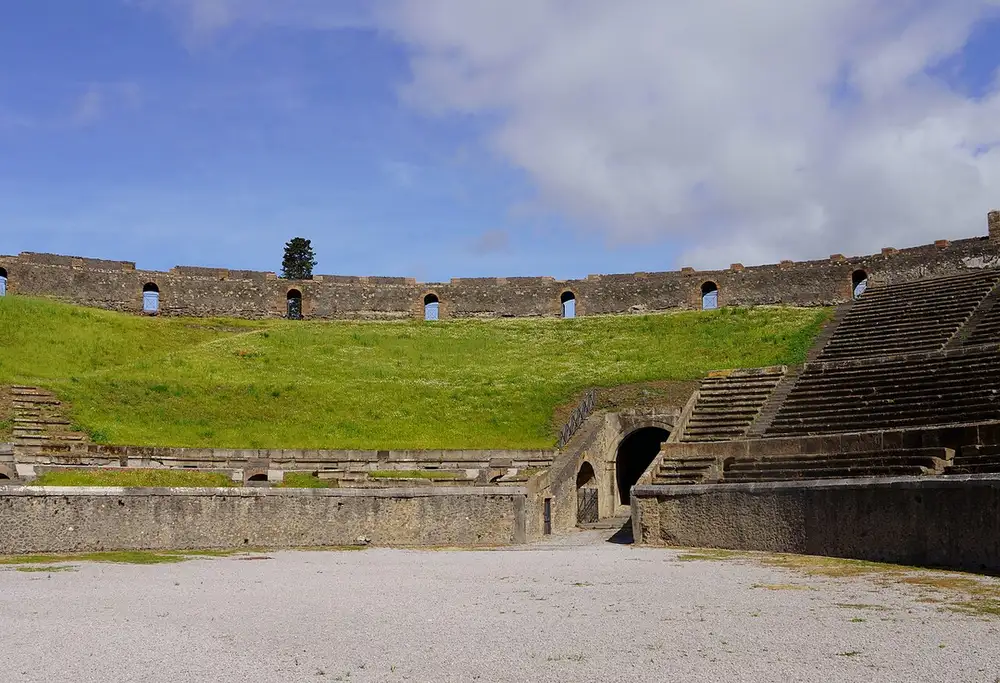
Inside Pompeii's ancient amphitheater
Inside Pompeii's amphitheater — the kids' favorite climb. Photo: Commonists / Wikimedia Commons (CC BY-SA 4.0)
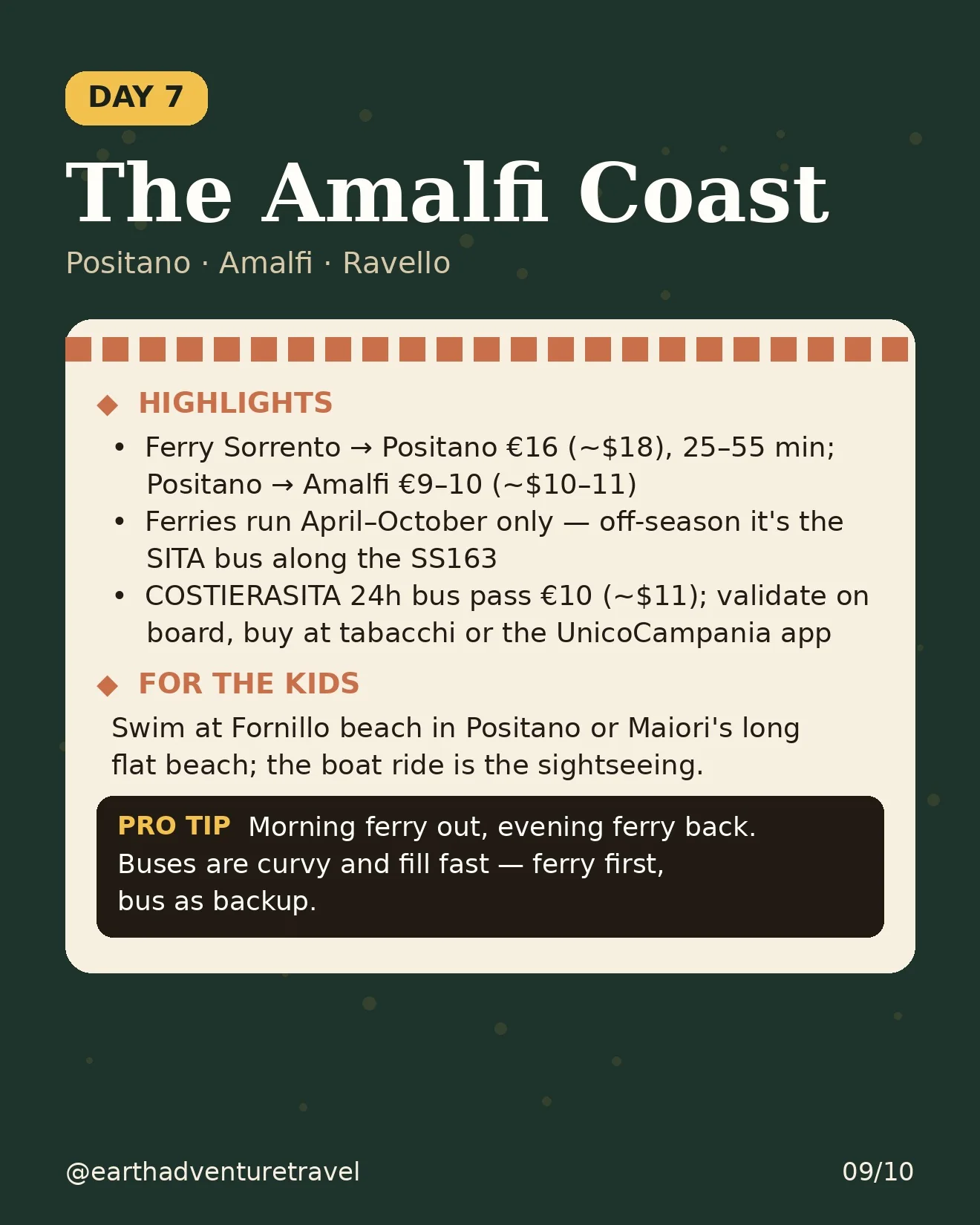
Day 7 itinerary card: the Amalfi Coast by ferry
Share the day.

Morning ferry out, evening ferry back — the whole strategy. Sorrento → Positano is €16 (~$18), 25–55 minutes, and the coast reveals itself from the water. Positano → Amalfi is another €9–10 (~$10–11). Ferries run April–October only — off-season, this day becomes the SITA bus along the SS163. Buy tickets at Marina Piccola or online the night before in season; morning sailings are calmest (sit mid-boat, facing forward).

Positano first: skip the main Spiaggia Grande and walk 10 minutes west to Fornillo beach — smaller, calmer, better for swimming. Budget an hour for the vertical lanes, then ride the shuttle bus back down (the steps are the day's workout). Then the ferry to Amalfi: the 9th-century Duomo (€3 (~$3) cloister), the paper museum's working press, and a sfogliatella at Pansa.

Ravello is the optional third stop — 25 minutes uphill by SITA bus or taxi. The Villa Cimbrone's Terrace of Infinity (€10 (~$11)) is the coast's most famous view, and the gardens give kids room to run. If legs are done, skip it guilt-free. Back in Sorrento for dinner — the evening passeggiata along Corso Italia is the trip's victory lap.

The plan

  • Morning: ferry Sorrento → Positano (€16/~$18); Fornillo beach swim, town wander.
  • Midday: ferry Positano → Amalfi (€9–10/~$10–11); Duomo, paper museum, Pasticceria Pansa.
  • Afternoon (optional): Ravello — Villa Cimbrone's Terrace of Infinity (€10/~$11); ferry back to Sorrento.

Where to stay

  • Same Sorrento base — pack tonight for the morning departure.
  • La Tonnarella — one splurge: private beach club in an old tonnara at Marina di Puolo.
  • Hotel Bristol Sorrento — big pool, sea views, easy checkout logistics.
Day 7 → Day 8: Departure tomorrow — Campania Express, Frecciarossa, Leonardo Express to FCO. Confirm train times tonight.

Bus backup: if seas cancel the ferries, the SITA bus runs the SS163 — buy the COSTIERASITA 24h pass (€10, ~$11) at a tabacchi or the UnicoCampania app and validate on board.

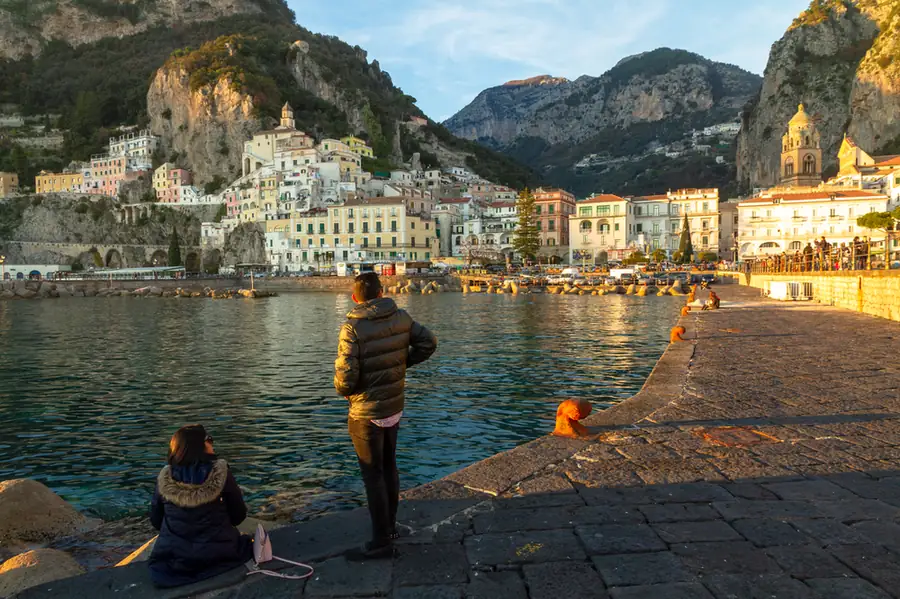
Amalfi's harbor and waterfront at golden hour
Amalfi's harbor and waterfront. Photo: Ugeorge / Wikimedia Commons (CC BY-SA 3.0)
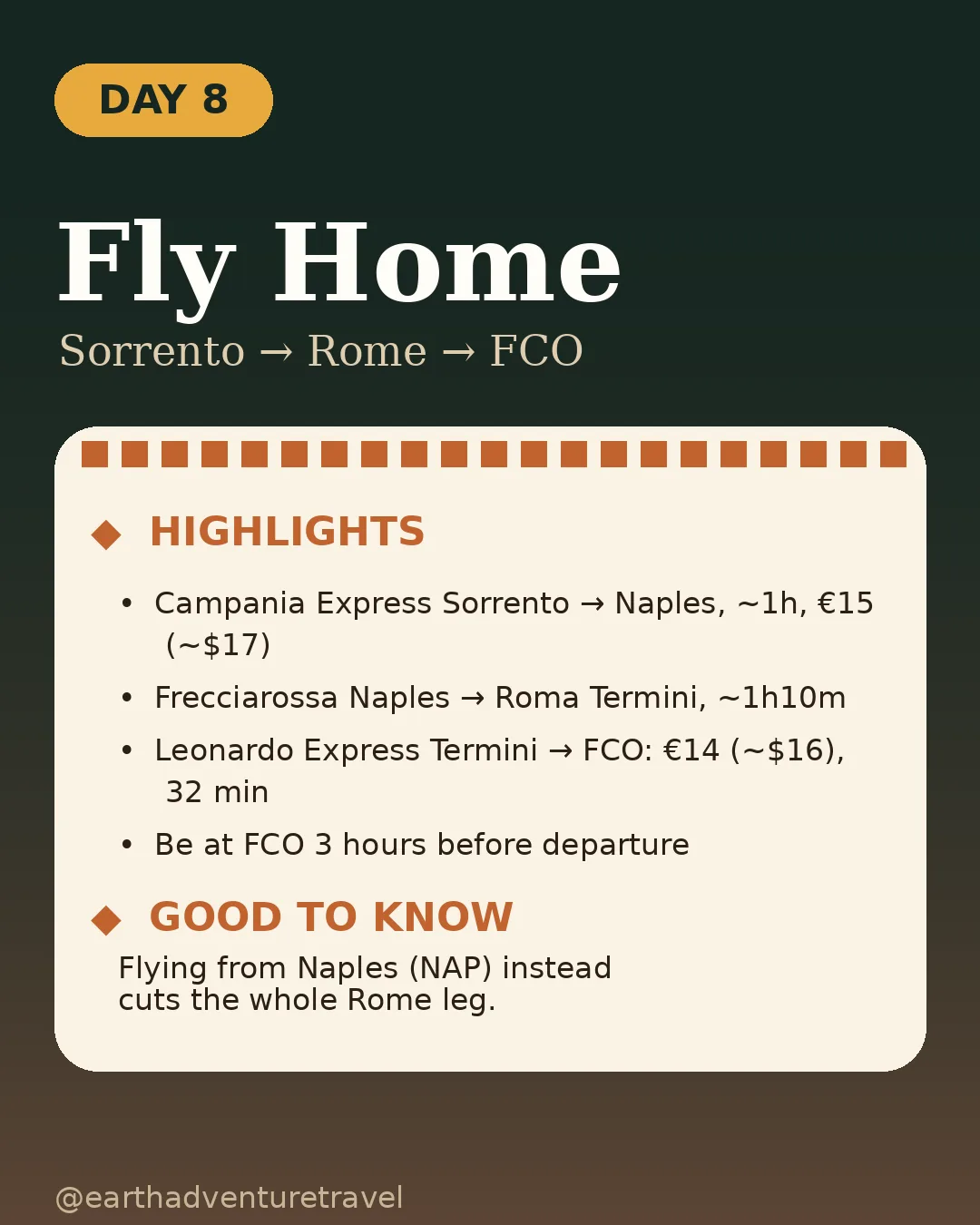
Day 8 itinerary card: fly home via Rome and FCO
Share the day.

Slow morning, sharp logistics. Check out, have one last sfogliatella on Piazza Tasso, and take the Campania Express back to Napoli Centrale (~1h, €15 (~$17)). Connect to the Frecciarossa to Roma Termini (~1h10m, €20–60 (~$22–$67) booked ahead), then the Leonardo Express to FCO (32 min, €14 (~$16)). Sorrento → FCO runs roughly 2h45m–3h15m plus connection buffers: be at Fiumicino 3 hours before a transatlantic departure.

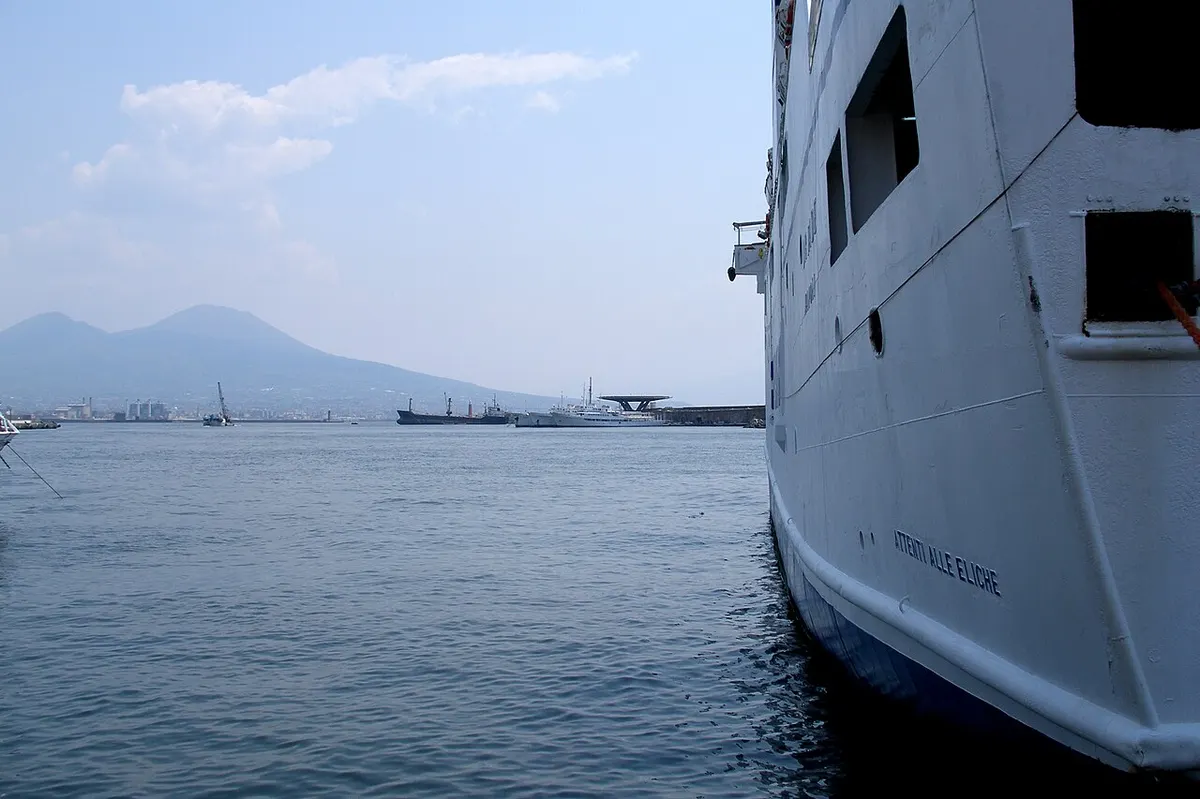
Flying home from Naples (NAP) is the alternative — often cheaper, and it cuts the whole Rome leg. With a late FCO flight, stash bags at Napoli Centrale and spend two hours at the Naples Archaeological Museum — or ride the Sorrento–Naples ferry one last time, Vesuvius across the bay.

Before you go: double-check the Frecciarossa platform at Napoli Centrale — it posts 10 minutes before departure and the station is a maze. Don't book the first connection that "just barely" works; one late train cascades. Take the earlier connection and have a calm coffee at Termini instead.

The plan

  • Morning: checkout, last Sorrento breakfast; Campania Express to Napoli Centrale (~1h, €15/~$17).
  • Midday: Frecciarossa Naples → Roma Termini (~1h10m); Leonardo Express → FCO (32 min, €14/~$16).
  • Buffer: FCO 3 hours before departure; Sorrento → FCO ≈ 3 hours + connections.

Where to stay

  • No hotel tonight — you're flying home.
  • If the flight is tomorrow: HelloSky Airport Hotel at FCO — walkable from the terminals.
  • If delayed in Naples: Hotel Piazza Bellini (historic center, family rooms) or the splurge Grand Hotel Vesuvio.
Day 8 → home: FCO tax-free shopping past security is genuinely good — the limoncello, the good olive oil, and the leather goods you talked yourself out of in Florence.

The earlier connection is always the right call on departure day. A missed Leonardo Express is a €14 (~$16) rebook; a missed flight is a ruined week.

The Bay of Naples and Mount Vesuvius from the departure ferry
The departure ferry with Vesuvius across the bay. Photo: Vyacheslav Argenberg / Wikimedia Commons (CC BY 4.0)
Italy route map: Rome (days 1–3), Florence (days 4–5), Naples area and Pompeii (day 6), Amalfi Coast (day 7), return leg (day 8)
Save the route.

The people behind the plans

Who is Earth Adventure Travel?

We build routes for real life — wrangling kids, spanning generations, or heading out solo — and check every detail against official sources so the plan holds up when you get there.

Learn About Us

Plan & pack

Rough budget · family of 4

$4,300 – $6,000

8 days / 7 nights · lodging, food, trains, attractions · international flights excluded · €1 ≈ $1.12 (October 5, 2026)

  • Lodging — $1,900–2,700: family rooms €220–330 (~$246–$370)/night across the three bases (Rome 3, Florence 2, Sorrento 3).
  • Food — $1,200–1,700: trattoria dinners, pizza-al-taglio lunches, market breakfasts, and a gelato budget with its own line item.
  • Trains & transit — $700–1,000: two Frecciarossa legs (~$28–90/adult each), Leonardo Express, Campania Express, Amalfi ferries.
  • Attractions — $400–600: Colosseum, Vatican, Uffizi, Accademia, Borghese, Pompeii — kids under 18 free at most state sites.
Booking deadlines, compared — miss these and you pay triple through resellers
WhatBook aheadWhere2026 price
Vatican Museums60 daysmuseivaticani.va€25 online (~$28)
Colosseum + Forum + Palatine30 days, 9 a.m. Rome timecoopculture.it€20 (~$22), 24h
Uffizi2–3 weekstickets.uffizi.it€29 (~$32) online / €20 (~$22) afternoon
Accademia (David)2–3 weeksofficial booking site€20 online (~$22)
Borghese Gallery2–3 weeks (180/slot)galleriaborghese.cultura.gov.it€18 (~$20)
PompeiiA few days (rarely sells out)pompeiisites.org€20 (~$22) / €25 (~$28) Plus
Frecciarossa trainsAs early as possibletrenitalia.com€25–80 (~$28–$90)/leg

Pack for the trip

  • Broken-in walking shoes — 12,000–18,000 steps a day on Rome's sampietrini and Pompeii's basalt.
  • Baby carrier, not a stroller — Pompeii, the Vatican's 7 km route, and Positano's steps defeat wheels.
  • Shoulders-and-knees cover-up — the Vatican and every church enforce the dress code, no exceptions.
  • 2L refillable water bottles — Pompeii has almost no shade or fountains; Rome's nasone fountains refill free.
  • Swim gear + reef-safe sunscreen — Fornillo beach in Positano is the trip's best swim.
  • Light layers + packable rain shell — shoulder seasons swing 20°F between morning museums and evening piazzas.
  • Small daypack — museum days, train days, and the ferry all run on one bag.
  • Motion-sickness bands — the Amalfi ferries and the SS163 bus are both curvy.
  • Portable charger — maps, train tickets, and timed-entry QR codes drain phones by mid-afternoon.
  • Cash in small bills — tabacchi bus passes, small trattorias, and market stalls.
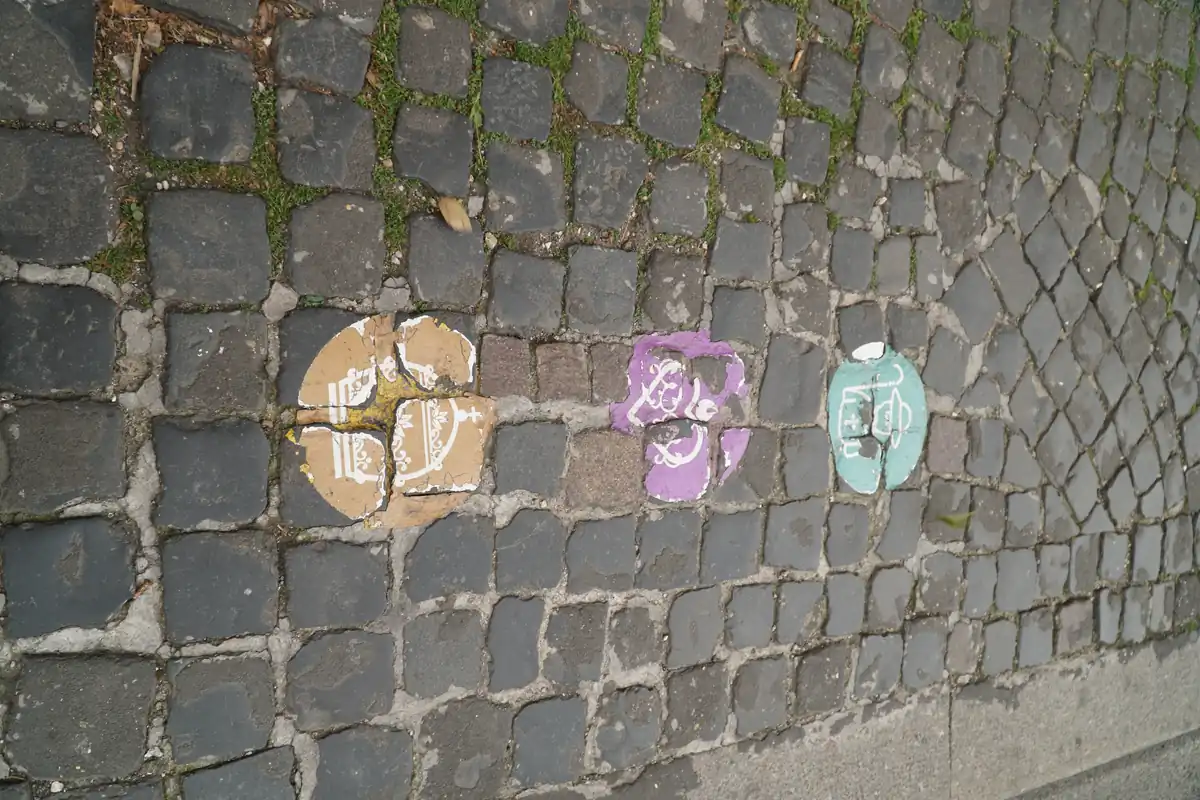
Roman sampietrini cobblestones up close
Broken-in shoes. Rome's sampietrini cobblestones — 15,000+ steps a day on uneven stone. Photo: Deb Nystrom / Wikimedia Commons (CC BY 2.0)
Positano Bay as seen from the ferry
Swim gear + motion bands. The coast as you'll see it — from the ferry deck. Photo: Spenvann / Wikimedia Commons (CC BY-SA 4.0)
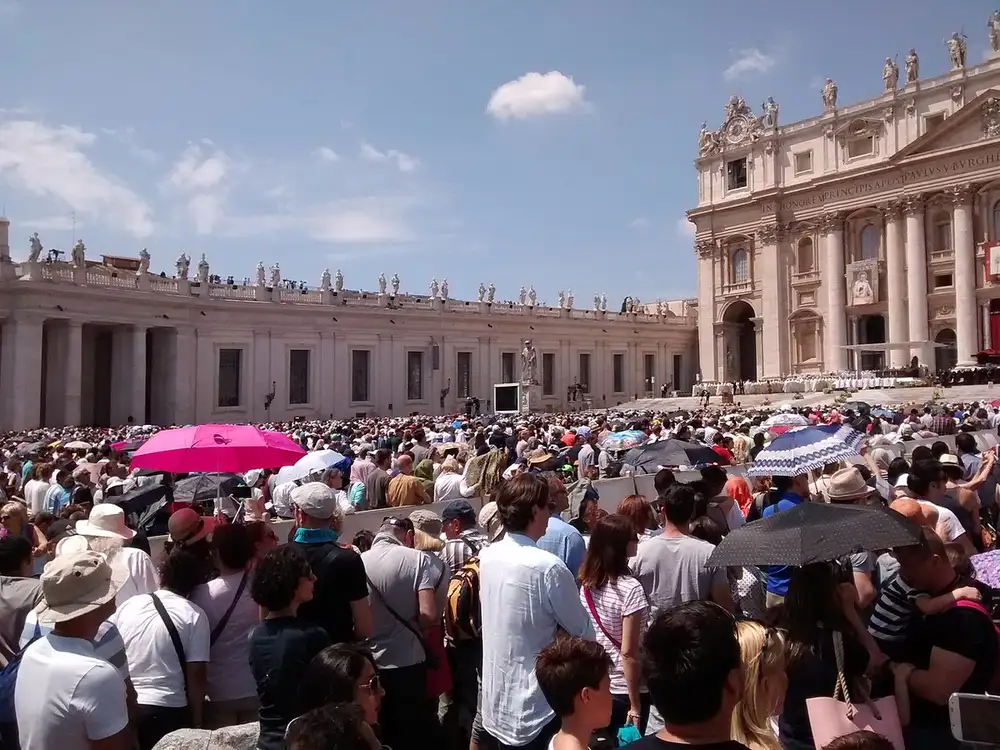
St. Peter's Square at midday with crowds
Cover-up + timed slot. St. Peter's Square at midday — the crowds are real; the 8 a.m. slot is the antidote. Photo: Mx. Granger / Wikimedia Commons (CC0)

Eat like a local

Italy rewards the hungry generalist. Breakfast like a local at a bar — cappuccino and cornetto standing up, €2 (~$2). Lunch is pizza al taglio, supplì, or a market sandwich. Dinner: one long trattoria meal per city — cacio e pepe in Rome, bistecca-adjacent ribollita in Florence, gnocchi alla sorrentina in Sorrento. Kids' menus are rare; instead order an extra primi — restaurants are unfailingly accommodating, and no one on this route requires an adventurous order.

Day trips & swaps

Got a ninth day? Herculaneum pairs with Pompeii day for the full eruption story, or ride the Circumvesuviana to Naples for pizza at L'Antica Pizzeria da Michele and the Archaeological Museum. Rainy day in Rome? Explora Children's Museum near Piazza del Popolo. Skip the Borghese and the Villa Borghese gardens plus rowboats cost nothing. Flying home from Naples instead of FCO cuts the entire Day 8 train chain.

Planning notes

When is the best time to take this Italy trip?

Travel between April and early October, with the sweet spots in May–June and September–early October. You get mild walking weather, all ferries running, and thinner crowds than July. The Amalfi Coast ferries run April–October only — outside those months you lose the boat days entirely.

Avoid August: it is peak heat, peak crowds, and peak prices, and many Romans leave the city. Late October still works for Rome and Florence, but the coast quiets down fast.

Is this Italy itinerary good for kids? What ages?

It is built for kids roughly 6 and up, and for multigenerational crews. Days are paced around one big sight plus breathing room, with kid hooks baked in: gladiator day at the Colosseum, mummies and map-counting at the Vatican, the train as an event, plaster casts and bakeries at Pompeii, and a swim day on the coast.

Bring a baby carrier rather than a stroller — Pompeii's basalt streets, the Vatican's 7 km route, and Positano's steps defeat wheels. Teens get the dome climb, the ferry decks, and Ravello's views.

How far ahead do we need to book tickets for Italy?

Vatican Museums: 60 days ahead on museivaticani.va. Colosseum: exactly 30 days ahead at 9 a.m. Rome time on coopculture.it. Those two are the hard deadlines — miss them and you pay triple through resellers or miss out.

Uffizi, Accademia, and Borghese: 2–3 weeks ahead in season (Borghese admits only 180 visitors per 2-hour slot). Frecciarossa trains: book early on trenitalia.com — the cheapest €25–80 (~$28–$90) fares go first. Pompeii rarely sells out; buy a few days ahead.

Do we need a car for this Italy itinerary?

No — and you should not rent one for this route. Everything runs on Frecciarossa high-speed trains, the Campania Express, the Circumvesuviana, and Amalfi Coast ferries. The trains are faster than driving and the ferries are the sightseeing.

Rome and Florence both have camera-enforced ZTL limited-traffic zones where a single wrong turn costs €80 (~$90) or more. If you add a countryside leg later, pick the car up outside the historic centers.

How much does 8 days in Italy cost for a family of 4?

Roughly $4,300–$6,000 for 8 days and 7 nights, excluding international flights. Family rooms run €220–330 (~$246–$370)/night across the three bases; food €130–200 (~$146–$224)/day for four; two Frecciarossa legs plus ferries and local trains €175–250 (~$196–$280)/adult; attractions €100–150 (~$112–$168)/adult for the week.

Kids under 18 enter free at the Colosseum, Uffizi, Accademia, and Pompeii (under 7 at the Vatican Museums) — the single biggest budget lever. Converted at €1 ≈ $1.12 (October 5, 2026).

Is Pompeii too much for kids?

Not if you treat it like a half-day, not a marathon. Do 2–3 hours: enter at Porta Marina, walk the Forum, see the plaster casts at the Garden of the Fugitives, climb the amphitheater steps, and find the bakery ovens — then leave before the heat wins.

Bring 2 liters of water per person, hats, and a carrier; the 44-hectare site has almost no shade and uneven basalt streets that defeat strollers. The Pompeii+ ticket (€25 (~$28)) adds the Villa of the Mysteries frescoes.

Ferry or bus on the Amalfi Coast with kids?

Ferry first, bus as backup. The Sorrento–Positano ferry (€16 (~$18), 25–55 min) is the sightseeing — the coast reveals itself from the water, and kids experience it as a boat ride, not a transfer. Morning ferry out, evening ferry back.

The SS163 bus is spectacular but curvy, crowded, and fills fast; it is the fallback when seas cancel ferries (they run April–October only). If anyone gets motion sick, sit mid-boat facing forward on the calmest morning sailing.

What if it rains during the trip?

Every base has a strong indoor pivot. Rome: Palazzo Massimo's mosaics or the Explora Children's Museum near Piazza del Popolo. Florence: the Museo Galileo (Galileo's actual telescopes) or a Palazzo Vecchio family tour.

Pompeii in rain: swap to Herculaneum, which is more compact and better roofed — or the Naples Archaeological Museum, where Pompeii's best frescoes and mosaics actually live. The Amalfi day becomes a Sorrento old-town morning.

Can grandparents do this trip?

Yes — it was designed multigen-friendly. Trains have reserved seats and elevators at every major station; the Colosseum has an elevator to the upper tier; St. Peter's dome has an elevator option that skips the first 231 steps; the Uffizi and Vatican Museums have elevators throughout.

The hard days are Pompeii (uneven ground, no shade — go at opening, leave by noon) and Positano's steps (ferry in, taxi up). The Day 4 free morning and the slow Day 8 start are built-in recovery.

What do picky eaters eat in Italy for 8 days?

Italy is the easiest country in Europe for picky eaters. Pizza al taglio, plain margherita, pasta al pomodoro or burro, and gelato appear within a five-minute walk almost everywhere on this route.

Roman trapizzini, Florentine schiacciata sandwiches, and Sorrento's gnocchi alla sorrentina are all kid-safe wins. Supermarkets cover breakfasts and train snacks; no restaurant on this itinerary requires an adventurous order.

Before you lock the trip

Sources & official links

Prices converted at €1 ≈ $1.12 (October 5, 2026). Confirm fares, hours, and booking windows on the official sites before you travel — Italian pricing changes most often in January.

The trip index

Choose the landscape. Then choose the pace.

Every itinerary gives you a realistic route, daily rhythm, planning notes, and the details that make a family trip work.

Use the filters above to see the routes that match.

No exact match—yet.

Clear a filter to see the closest routes already in the library.