A 5-Day Iceland Winter Trip for Northern Lights & Two
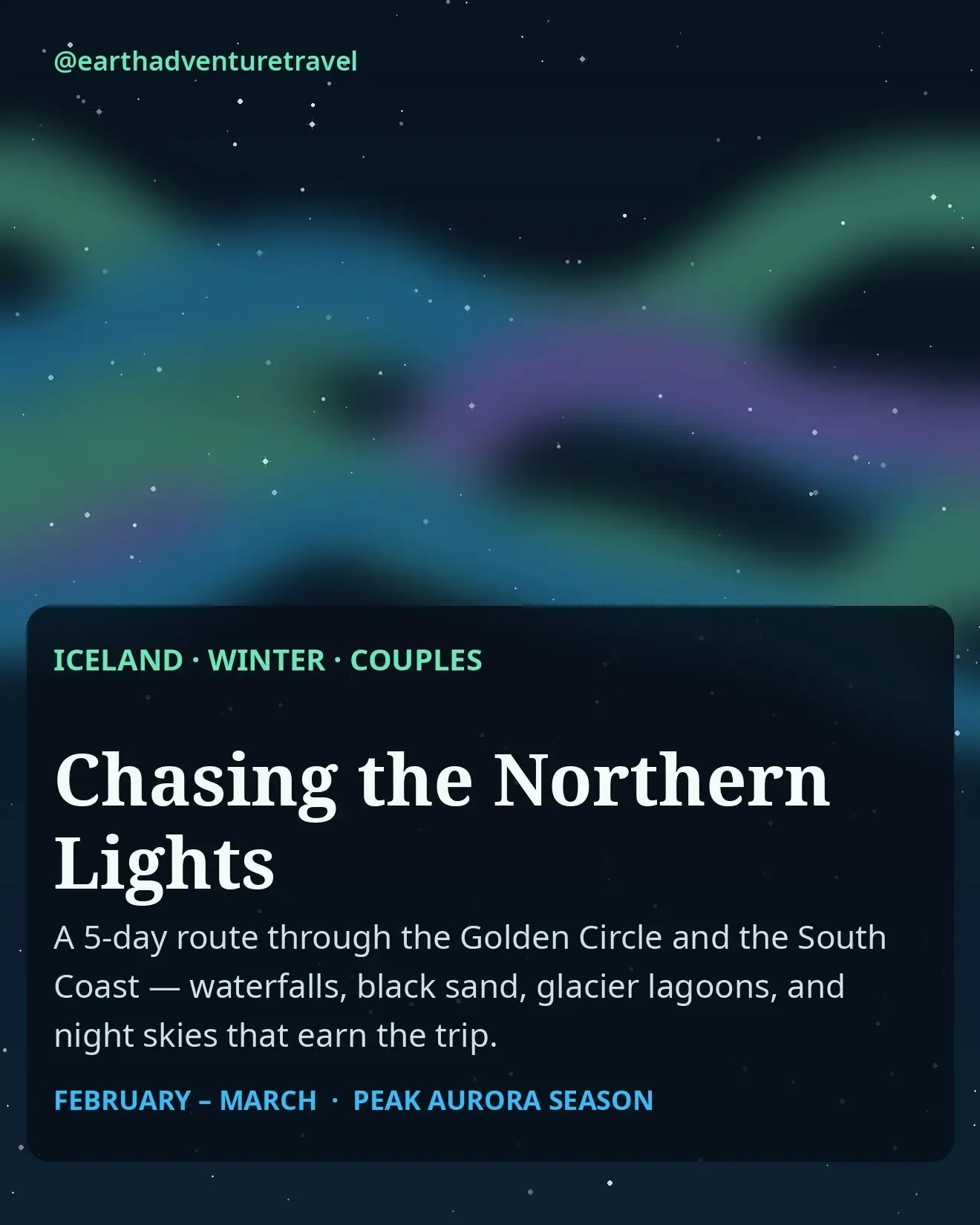
Five February days built around the sky after dark: aurora hunting from dark-sky bases, the Golden Circle's geysers and falls, walk-behind waterfalls on the South Coast, black beaches, a glacier lagoon — and a geothermal soak at the end of every single day.
5 days / 4 nightsFeb–Mar best window2 travelers$3.8K–$5.2K for two
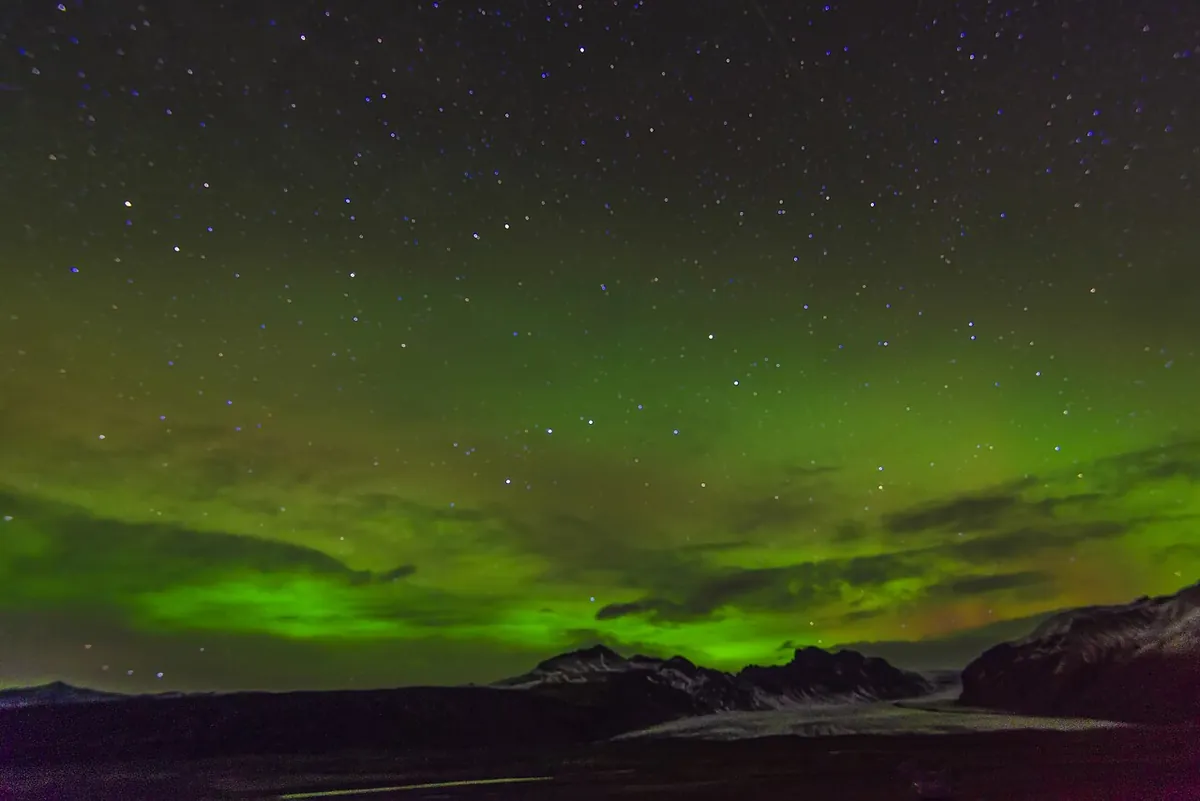
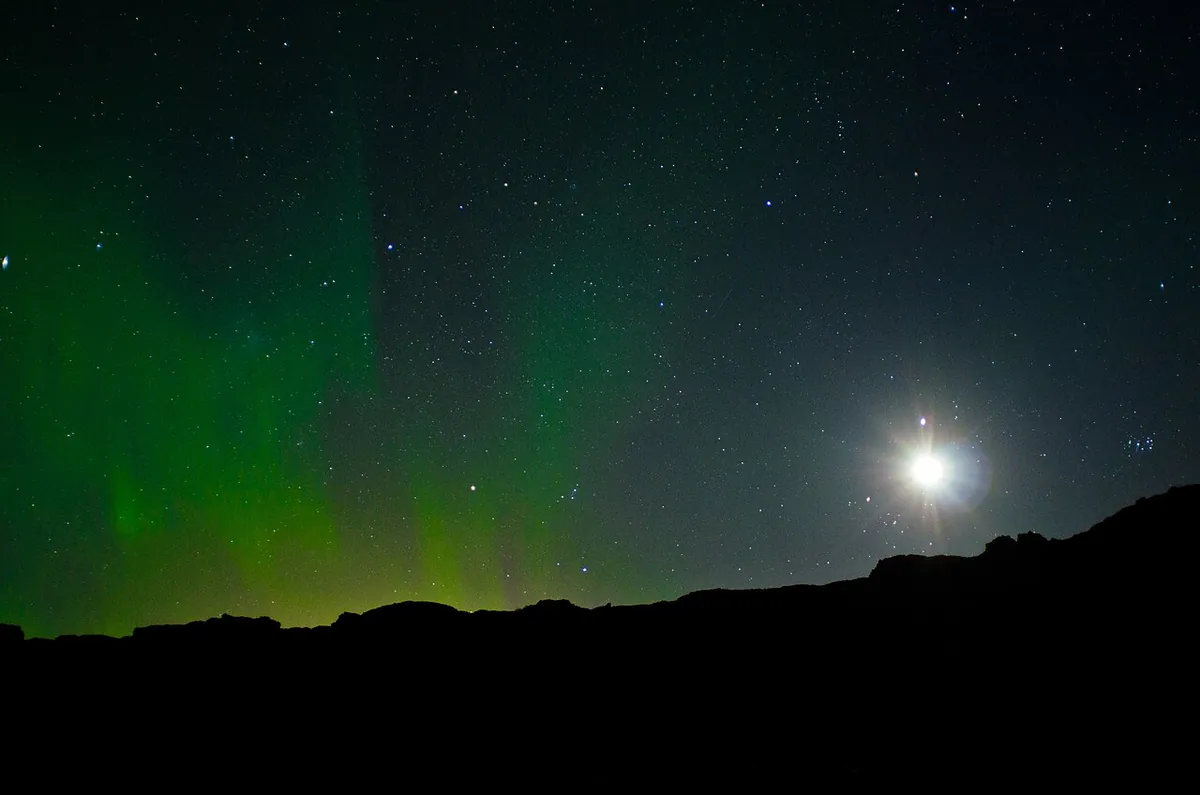
The trip, at a glance — save it, then read the plan below.The reason for the season — aurora over Iceland. Photo: Francisco Diez, CC BY 2.0, via Wikimedia Commons.
On this page
The trip in 60 seconds
Rough budget · 2 adults
Planning ranges, not quotes. Iceland prices move with the season — winter is kinder than summer, but book lagoons and ice cave tours early. Converted from ISK at about 122 per $1 (October 2026).
$3.8K–$5.2K
Five days / four nights · flights excluded
Lodging · 4 nights
$900–$1,500
Rental 4x4 + fuel
$700–$1,100
Food & drink
$800–$1,200
Lagoons, tours & parking
$500–$800
Buffer · souvenirs, snacks
$200–$400
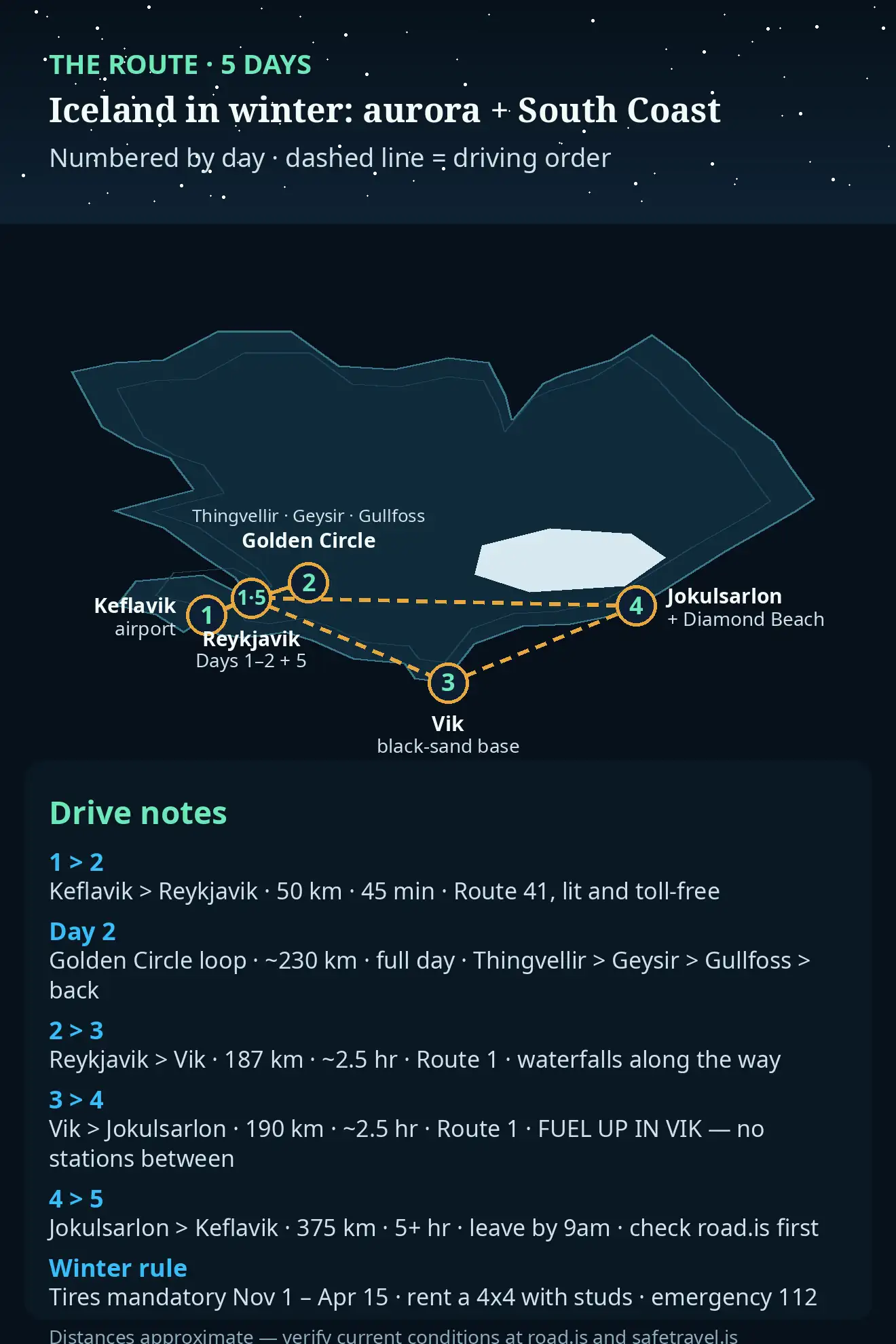
Saveable route recap · Reykjavik to the glacier lagoon and back
Day-by-day summary
The idea
Winter is when Iceland stops performing and starts glowing.
Summer Iceland is a postcard — crowded, bright at midnight, beautiful and a little exhausting. Winter Iceland is a secret the island keeps for the people willing to show up in the dark. The waterfalls half-freeze into blue sculptures. The beaches go black-on-white. The lagoons steam harder against the cold air. And after 9 p.m., the whole country becomes a theater with no seats and no tickets — just you two, a thermos, and a sky that might catch fire.
This is the After Dark take on the classic five-day loop: every overnight is chosen for dark skies, every day earns its keep in daylight, and every evening ends in hot water. It is built for two people, one rental 4x4, and a willingness to look up.
Fly into Keflavik, loop the Golden Circle and the South Coast, and finish back in Reykjavik. Drive in daylight, hunt the aurora after 9 p.m., and soak every evening. Each day below opens with the full plan.
01Keflavik arrival · Blue Lagoon · Reykjavik
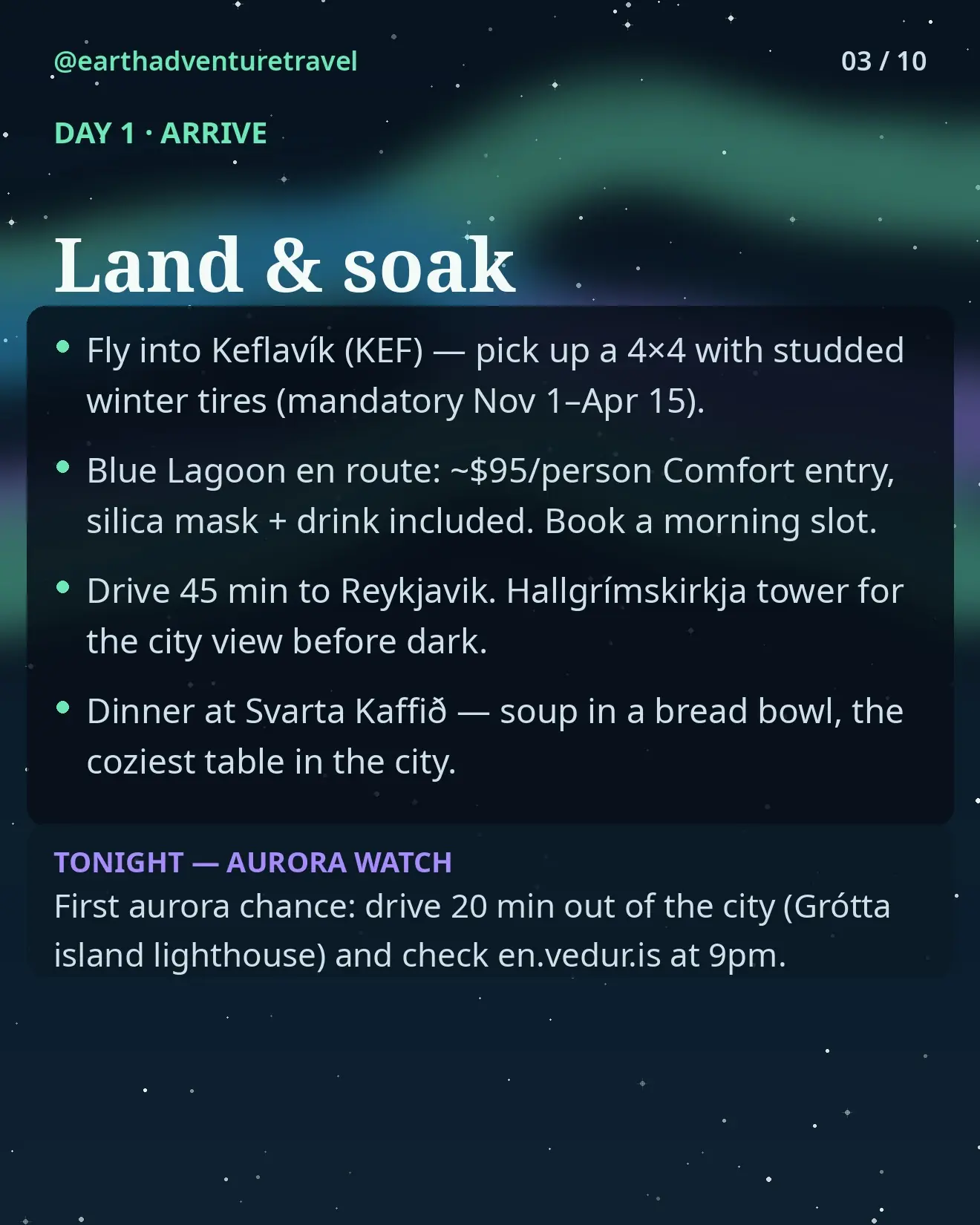
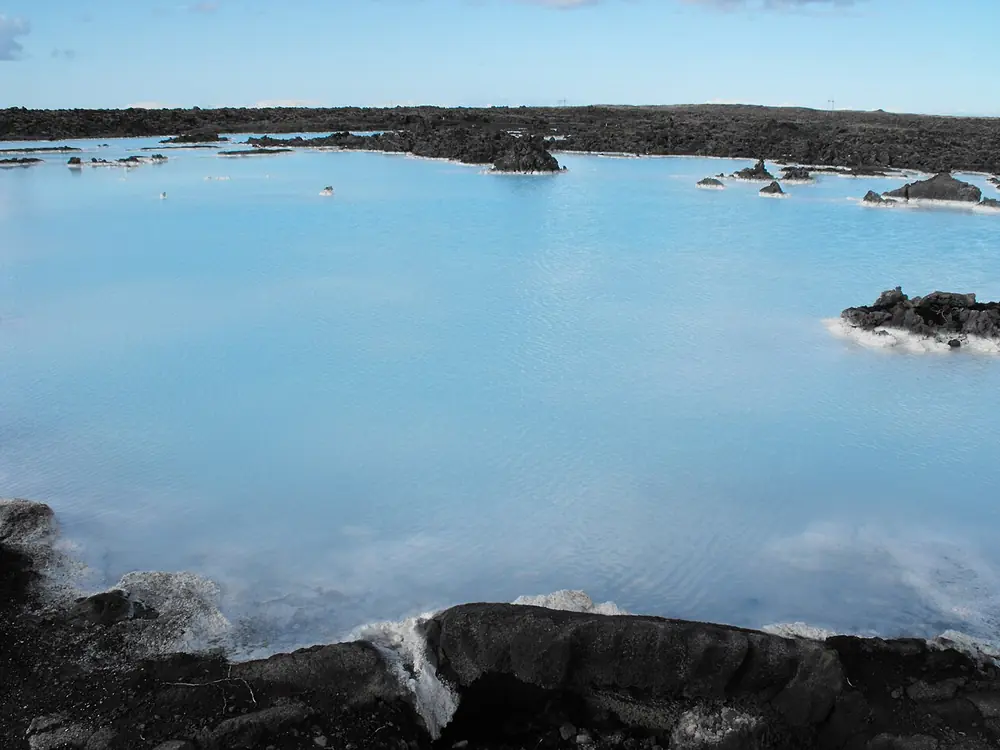
Day 1 starts the moment you land: the Blue Lagoon sits 20 minutes from Keflavik airport, directly on the road to Reykjavik, and there is no better jet-lag cure than milky-blue 38–40°C water under a winter sky. Book the Comfort entry (~$95/person) for a midday timed slot — it includes a silica mud mask, towel, and a first drink at the swim-up bar. Shower naked with soap before entering: it is mandatory at every Icelandic pool, and attendants do check.
The Blue Lagoon — 20 minutes from the airport, on the way to the city. Photo: diego_cue, CC BY-SA 3.0, via Wikimedia Commons.
Afternoon: Reykjavik on foot
The drive into the city takes about 45 minutes. Check in, nap if you must, then walk it off: Hallgrimskirkja church (ride the tower lift for the city-and-mountains panorama), the Sun Voyager sculpture on the waterfront path, and the glass-honeycomb Harpa concert hall. Warm up with a hot dog at Baejarins Beztu Pylsur by the harbor — the stand has been there since 1937, and yes, it lives up to the hype.
Blue Lagoon: reserve a timed slot weeks ahead — midday beats jet lag
Hallgrimskirkja tower: the best orientation view in the city
Pick up the 4x4 at the airport — winter tires mandatory Nov 1–Apr 15
Evening: dinner, then look up
Dinner in the old harbor — seafood at a harbor-side restaurant or soup served in a bread bowl at Svarta Kaffid. Then the trip's first ritual: around 9–10 p.m., check the aurora forecast at en.vedur.is. If the KP index reads 3+ and the cloud map shows a break, drive 10 minutes to the Grótta Island Lighthouse on Seltjarnarnes — dark skies, ocean foreground, and on a good night, the whole sky moving. Bring a thermos of hot chocolate and give it at least 45 minutes.
Where to stay
Two nights in Reykjavik to start — no repacking. The Canopy by Hilton Reykjavik City Centre (from ~$200/night in winter) sits on Laugavegur with a great breakfast; the Fosshotel Barón (from ~$140/night) has harbor views and an easy walk to the old town. Both are 10 minutes from Grótta for aurora runs.
Bad-weather plan
Storm socked in? Perlan's Wonders of Iceland has an indoor ice cave and a planetarium aurora film — the consolation prize that barely feels like one. FlyOver Iceland near the harbor is the other rainy-day classic.
Tonight's sky
Aurora hunting starts tonight. Check en.vedur.is around 9–10 p.m.: you want KP 3 or higher and a gap in the cloud cover. Dark, clear, patient — in that order.
Drive: KEF → Blue Lagoon 20 km · Blue Lagoon → Reykjavik ~40 km · Blue Lagoon Comfort ~$95/person · Emergency 112
Soak-first rule: Do the Blue Lagoon on arrival day, not departure day. You land stiff and grey; you leave the lagoon loose and pink. It sets the tone for the whole trip — and the midday light on the blue water photographs better anyway.
02Thingvellir · Geysir · Gullfoss · Secret Lagoon
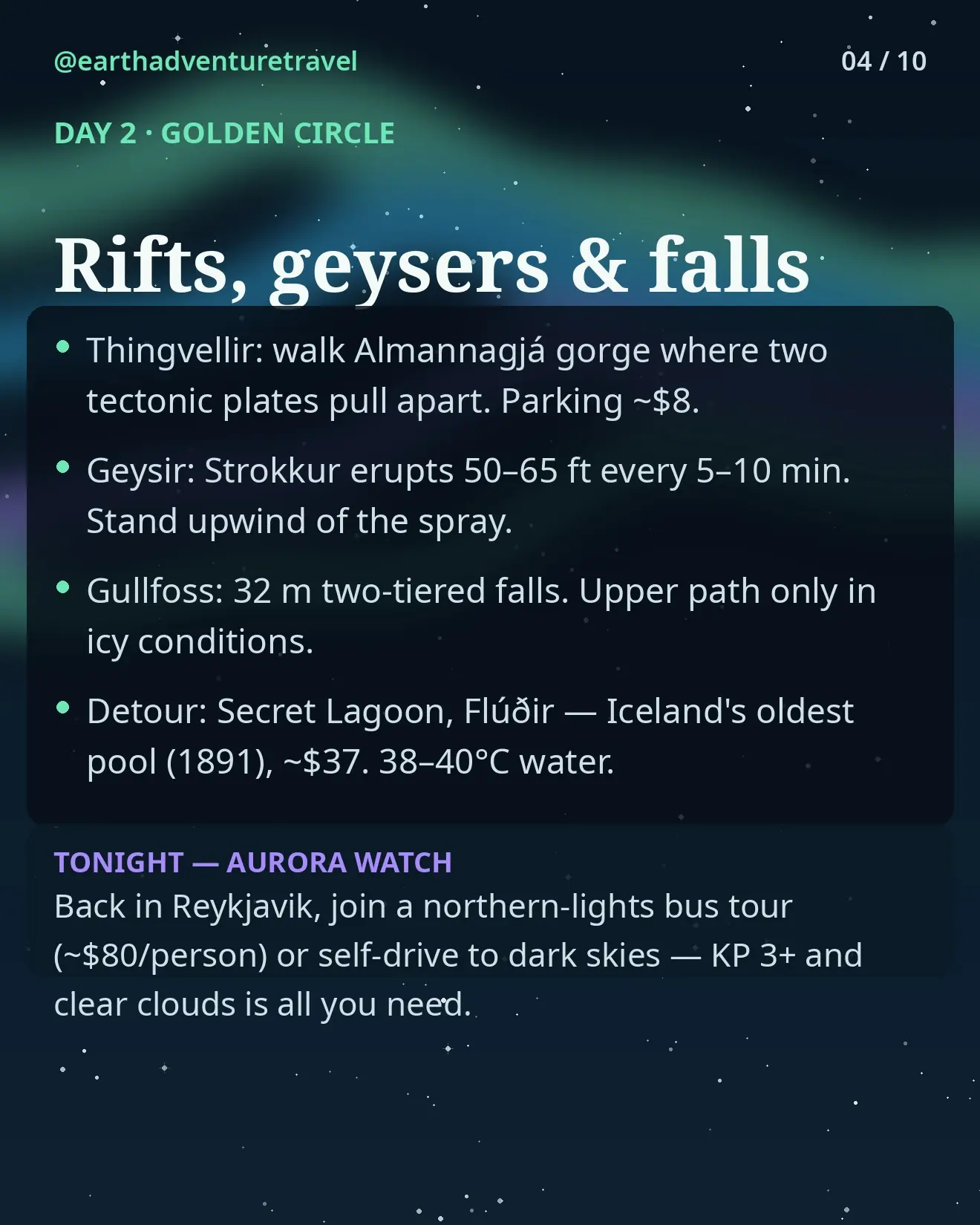
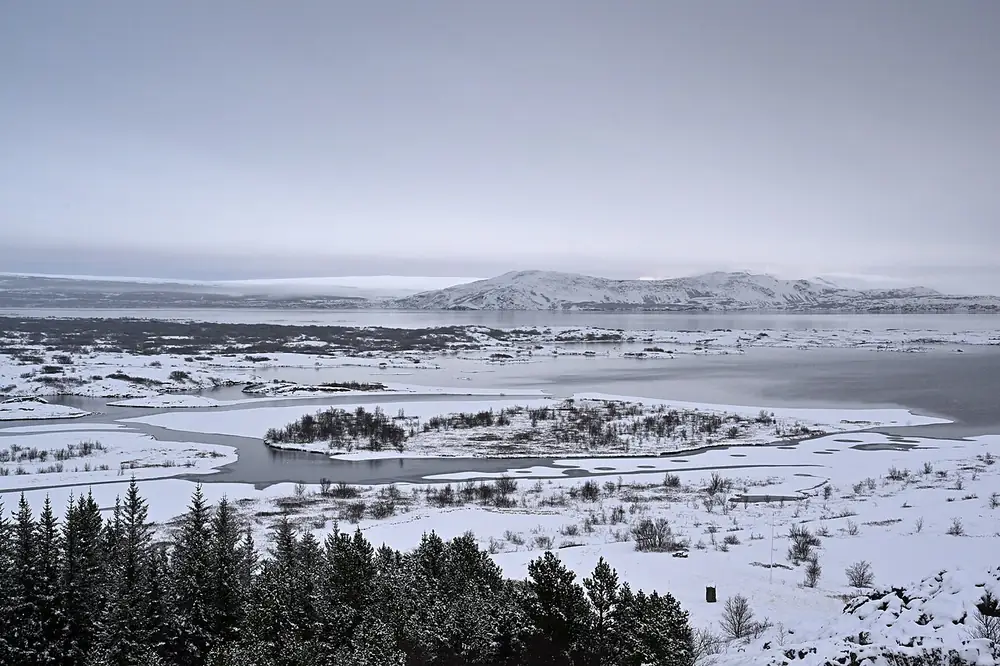
Day 2 is the classic loop — about 230 km round trip from Reykjavik, and the most-travelled winter road in Iceland. Leave by 9 a.m. to use every hour of the short daylight. First stop: Thingvellir National Park (parking 1,000 ISK, ~$8), where you walk the Almannagjá gorge between the North American and Eurasian tectonic plates — the continents drift about 2 cm further apart every year, and you can stand in the crack.
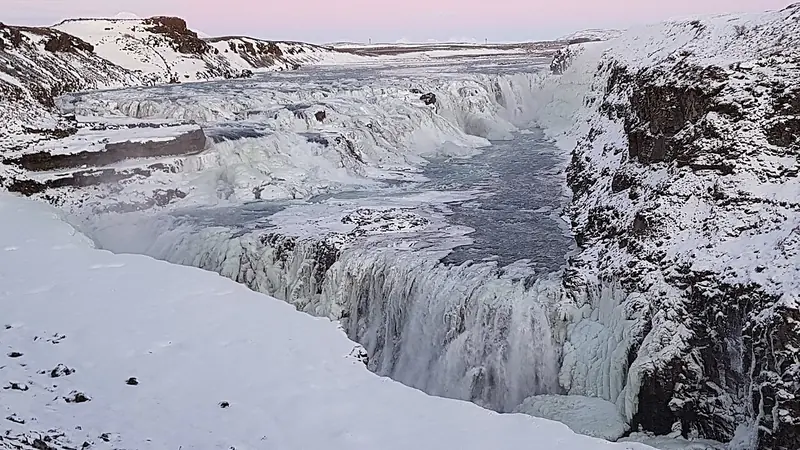
Gullfoss in winter — the two-tiered giant runs all year. Photo: Arcthylor, CC BY 4.0, via Wikimedia Commons.
Midday: geysers and the giant falls
At Geysir, the original Great Geysir is mostly retired — but Strokkur erupts every 5–10 minutes, throwing boiling water 15–20 meters skyward. Stand upwind. Then Gullfoss, the two-tiered giant dropping 32 meters into a canyon that steams with ice mist in winter. The upper viewpoint is the dramatic one; the lower path puts you close enough to feel it in your chest. Lunch at the Gullfoss café — the lamb soup is the move.
Thingvellir: walk between continents; allow 90 minutes
Strokkur: erupts every 5–10 min — camera ready, stand upwind
Gullfoss: 32 m, two tiers; the winter ice formations are the show
Afternoon: the Secret Lagoon
On the return leg, detour to Flúðir for the Secret Lagoon — 4,500 ISK (~$37), open 10 a.m.–7 p.m. in winter. It is Iceland's oldest swimming pool (1891), a steamy 38–40°C rectangle with a little geyser erupting beside it, and a fraction of the Blue Lagoon's crowds. This is the locals' lagoon, and after a cold day at the falls, it feels like a reward you earned.
Where to stay
Back in Reykjavik at the same hotel — the loop returns you by dinner. Eat on Laugavegur tonight; try Smiðjan Brugghús (brewpub, great burgers) or go classic Icelandic at a downtown bistro. Early night if you're tired: tomorrow starts the South Coast.
Bad-weather plan
High winds on the loop? Flip Day 2 and Day 3 — the waterfalls are actually better in moody weather, and the Golden Circle's viewpoints suffer most in a whiteout. Check road.is before you leave the hotel; if it says don't drive, don't.
Tonight's sky
Same drill: en.vedur.is at 9–10 p.m. The Golden Circle's countryside is darker than the city — if the forecast looked promising at lunch, consider an evening drive 20 minutes out of town instead of Grótta.
Drive: ~230 km loop · Thingvellir parking 1,000 ISK · Strokkur erupts every 5–10 min · Secret Lagoon 4,500 ISK (~$37), winter hours 10 AM–7 PM
Daylight rule: In February you get 8–10 hours of light — spend it outside. Waterfalls, gorges, and viewpoints eat daylight; lagoons and dinners don't. Front-load every outdoor stop and let the soak be the sunset.
03Seljalandsfoss · Gljúfrabúi · Skógafoss · Vík
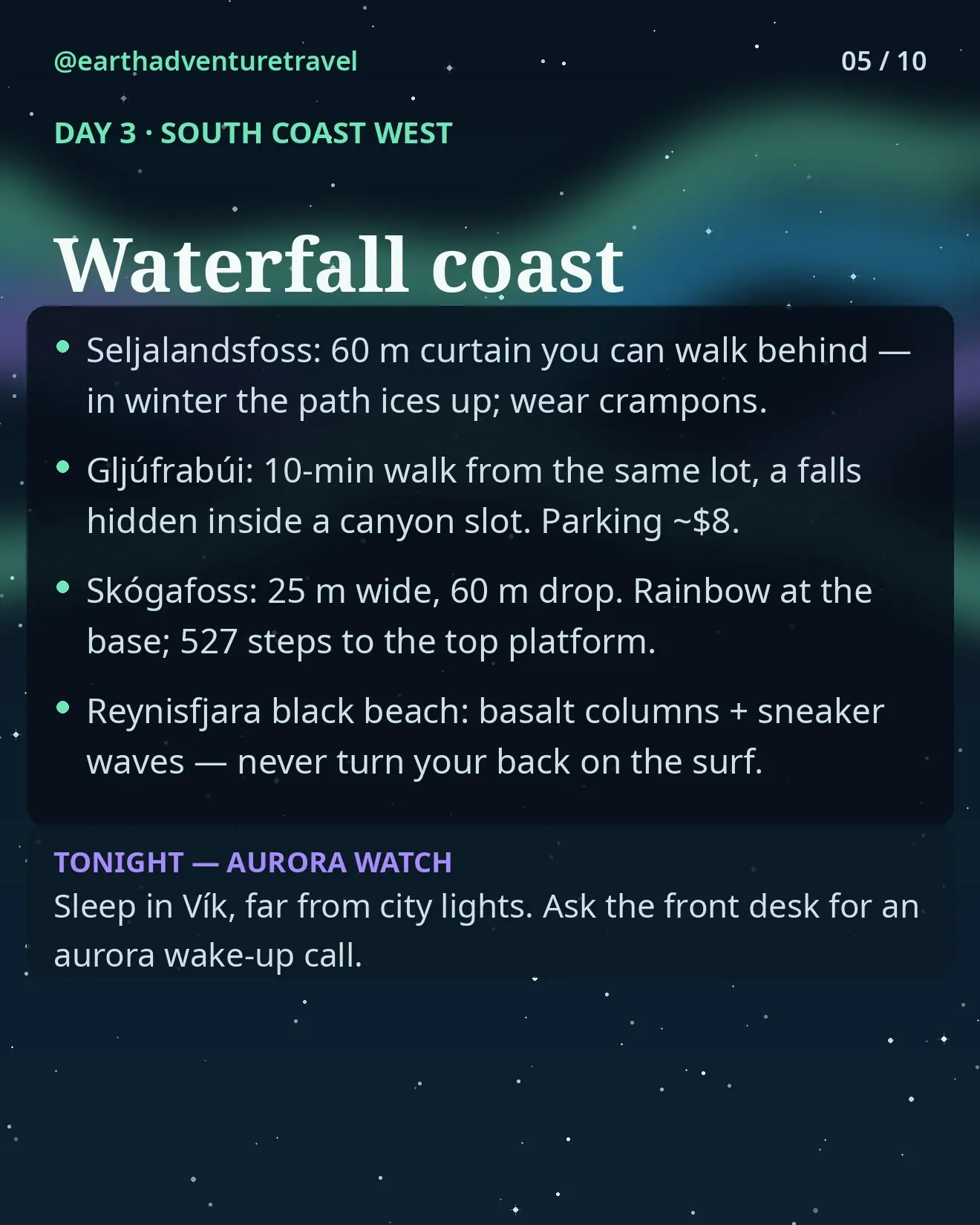
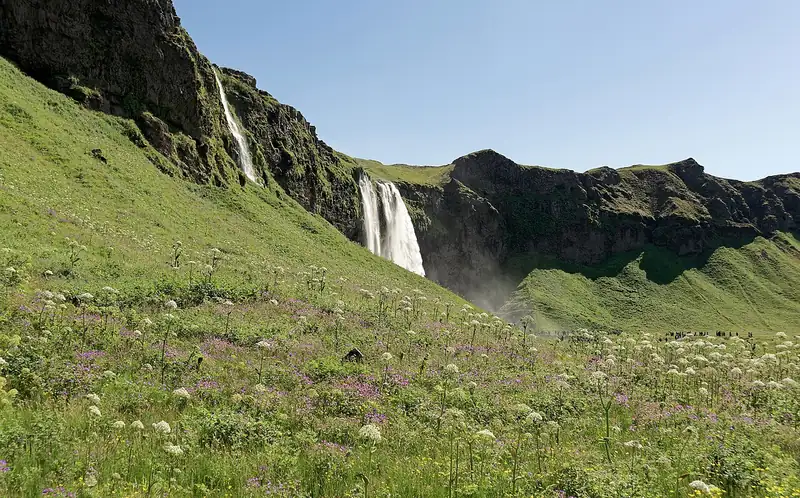
Day 3 heads east down the South Coast — the greatest waterfall density per kilometer anywhere in Iceland, and in winter half of them wear blue ice. Check out of Reykjavik, check road.is, and point the 4x4 toward Vík, 187 km away. First stop: Seljalandsfoss, the 60-meter ribbon you can walk behind — in winter the path ices over, so wear the grips and take it slow; the view through the falling water is worth every careful step. Parking runs about 1,000 ISK.
Seljalandsfoss — the walk-behind waterfall, at its most dramatic in winter. Photo: Jakub Hałun, CC BY 4.0, via Wikimedia Commons.
Midday: the hidden one and the giant
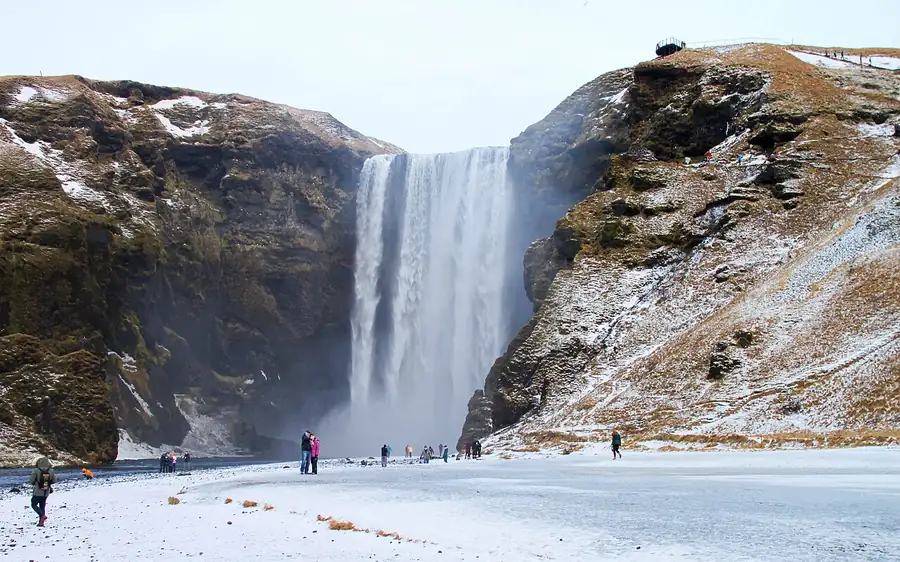
Ten minutes on foot from Seljalandsfoss, half-hidden in a canyon crack, is Gljúfrabúi — wade the short stream (waterproof boots earn their keep) and step inside a moss-walled chamber with a waterfall for a ceiling. Then Skógafoss: 25 meters wide, 60 meters of thunder, and 527 steps to the top viewpoint. The staircase is the workout; the view down the coastline is the payoff. On sunny winter days the spray throws double rainbows.
Seljalandsfoss: 60 m, walk behind — ice grips essential in winter
Gljúfrabúi: 10-min walk; the canyon hides the falls until you're inside
Skógafoss: 25 m wide, 60 m drop; 527 steps to the top
Evening: Vík
Roll into Vík by late afternoon — Iceland's southernmost village, population ~750, with a church on the hill that doubles as the volcano evacuation point (the Katla volcano sleeps under the Mýrdalsjökull glacier behind town). Dinner at a village restaurant, then step outside: Vík's skies are properly dark, and the aurora often performs right over the church hill.
Where to stay
Hotel Kría or Hotel Katla in Vík (from ~$180–$220/night in winter) — both are aurora-wake-up territory with big dark-sky views from the rooms. Book dinner early; village kitchens close sooner than city ones.
Bad-weather plan
If the wind howls, the Skógar Museum (folk and transport museums, turf houses) fills an hour well, and the waterfalls are better in dramatic weather — just keep a firm grip on the car doors. Seriously: Icelandic wind has removed doors before.
Tonight's sky
Vík is one of the darkest bases on this route — check en.vedur.is at 9 p.m., then walk to the church hill. No city glow, no driving required. This is the night the trip is secretly built around.
Drive: Reykjavik → Vík 187 km · Seljalandsfoss parking ~1,000 ISK · Skógafoss: 527 steps to the top · Vík: Iceland's southernmost village
Door rule: In South Coast wind, open car doors with two hands and park facing into the wind. It sounds dramatic until you watch a gust take a door off its hinges — rental companies charge for that.
The aurora is not a show you buy a ticket for. It is a gift the sky hands you for showing up after dark.
04Reynisfjara · Katla ice cave · Jökulsárlón
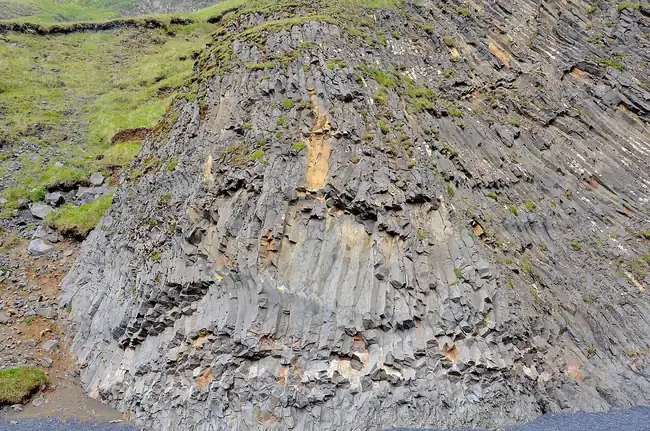
Day 4 is the farthest east you go — and the most otherworldly. Start at Reynisfjara, the black sand beach 10 minutes from Vík: hexagonal basalt columns like organ pipes, the Reynisdrangar sea stacks rising from the surf, and sand so black the ice chunks on it look like scattered diamonds. Then the safety briefing that matters: sneaker waves surge far up this beach without warning. Never turn your back on the surf, keep well back from the waterline, and stay off the low rocks. The photos are just as good from a respectful distance.
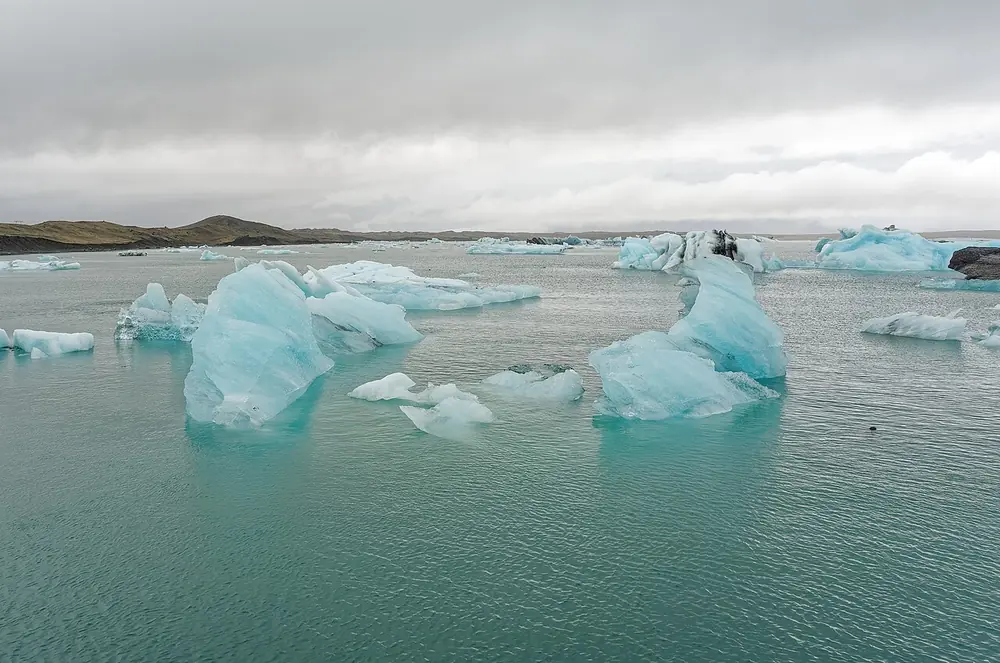
Jökulsárlón — thousand-year-old ice, calved and drifting. Photo: Jakub Hałun, CC BY 4.0, via Wikimedia Commons.
Midday: inside the glacier
Natural blue ice caves exist only in winter, and the Katla ice cave tour leaves from Vík — about $180/person for 3 hours with a super-jeep ride across the glacier outwash plain, helmets and crampons included. Inside: sapphire-blue ice, ash stripes from old eruptions, light filtering through frozen time. Book ahead — tours run only when conditions are safe, and small groups fill fast.
Reynisfjara: sneaker waves — never turn your back on the surf
Katla ice cave: ~$180/person, 3 hours, book ahead
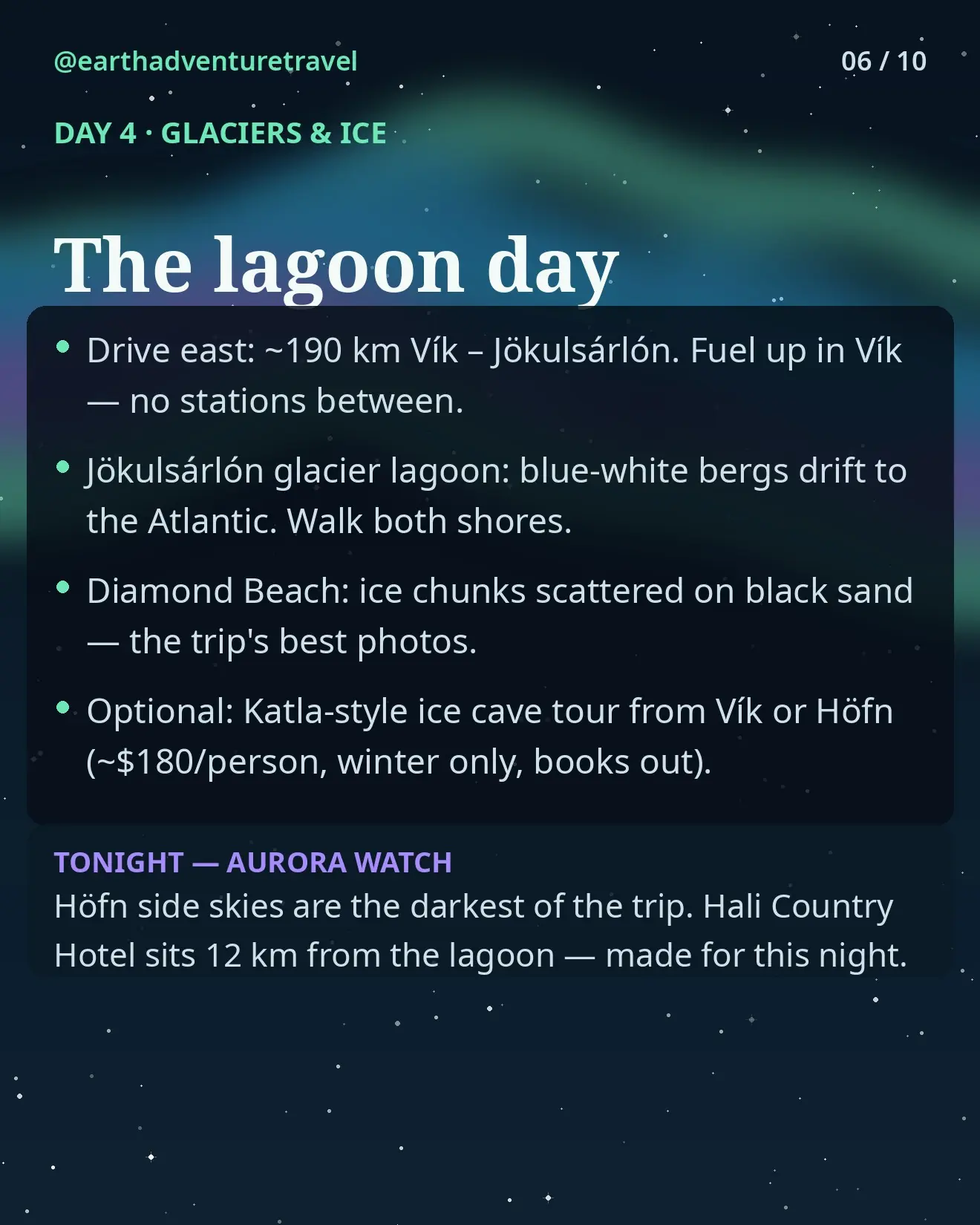
Fuel up in Vík: no gas stations between Vík and the lagoon
Afternoon: the glacier lagoon
Drive east — 190 km from Vík to Jökulsárlón — and arrive at the glacier lagoon in the low golden light. Thousand-year-old ice calves off Breiðamerkurjökull and drifts out to sea; across the road, Diamond Beach strands the bergs on black sand. Walk the shoreline hand in hand and watch the light go blue. This is the farthest point of the loop — everything from here is the long, beautiful way back.
Where to stay
Base near the lagoon for the darkest skies of the trip. The Fosshotel Glacier Lagoon at Hnappavellir (from ~$238/night) offers aurora wake-up calls — they ring your room when the sky lights up. The Hali Country Hotel, 12 km from the lagoon, is the quieter, cheaper alternative with the same black sky overhead.
Bad-weather plan
If the ice cave tour cancels for safety, the lagoon and Diamond Beach still deliver — and the Hofn lobster restaurants 75 km east make a worthy consolation dinner. Never argue with a cancelled glacier tour; the glacier always wins the argument.
Tonight's sky
The darkest night of the trip. Set the en.vedur.is alarm, request the wake-up call, and sleep in your thermals if you must — nobody ever regretted being woken for the aurora over the lagoon.
Drive: Vík → Jökulsárlón 190 km · Katla ice cave ~$180/person (3h) · Fuel up in Vík — no stations to the lagoon · Aurora wake-up calls at Fosshotel Glacier Lagoon
Ice-cave rule: Never enter an ice cave without a guide — conditions change daily and collapses happen. The guided Katla tour is the experience; the unguided shortcut is the headline you don't want to be.
05Diamond Beach · South Coast · Sky Lagoon
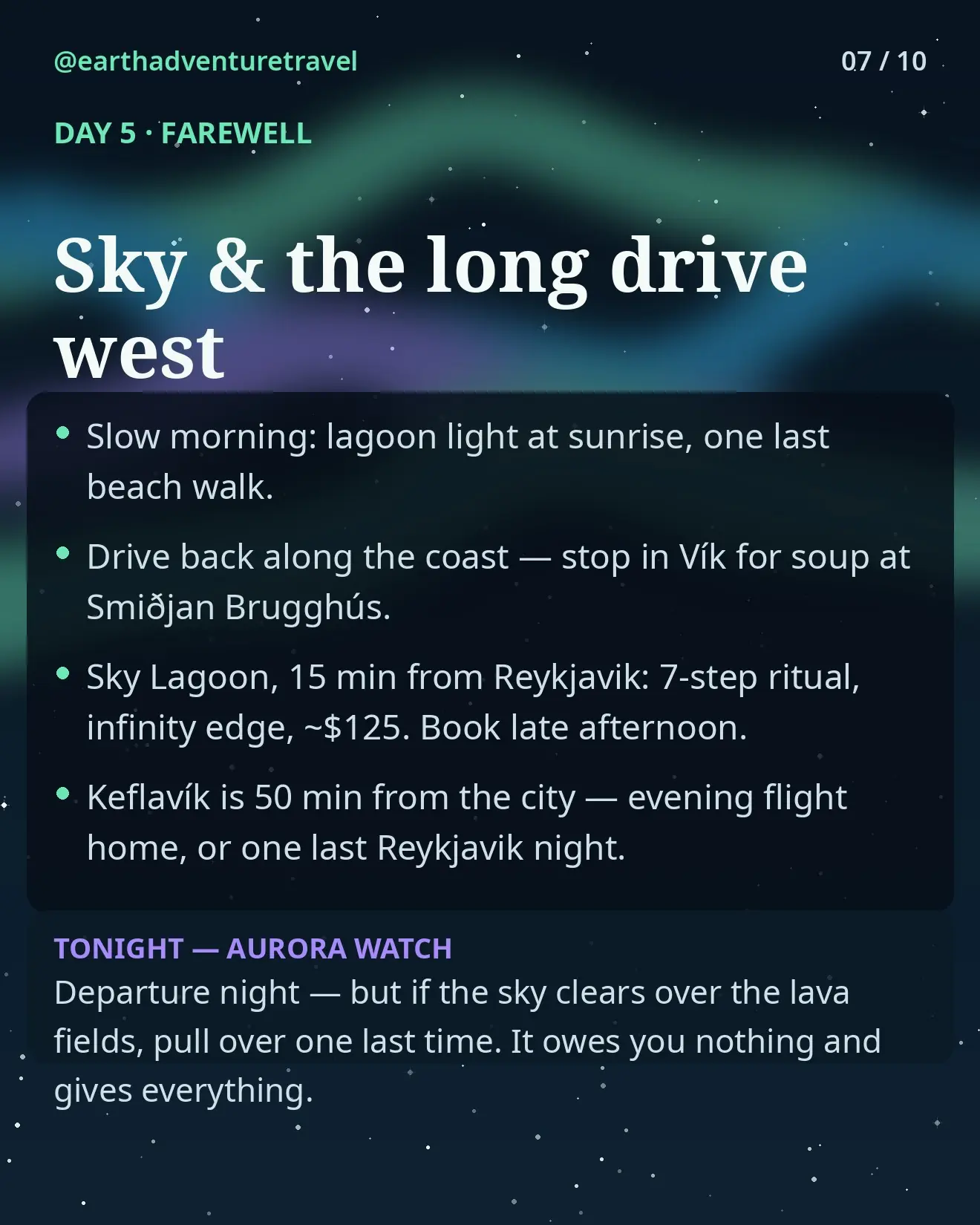
Day 5 starts before sunrise at Diamond Beach — the icebergs stranded overnight on the black sand glow blue and gold in the first light, and you'll likely have the whole shoreline to yourselves. Then the long drive west begins: 380 km back to Reykjavik, retracing the South Coast with fresh eyes. Stop where the light tells you to — the waterfalls face the morning sun on the return, and Seljalandsfoss at 10 a.m. is a different waterfall than the one you saw at 3 p.m.
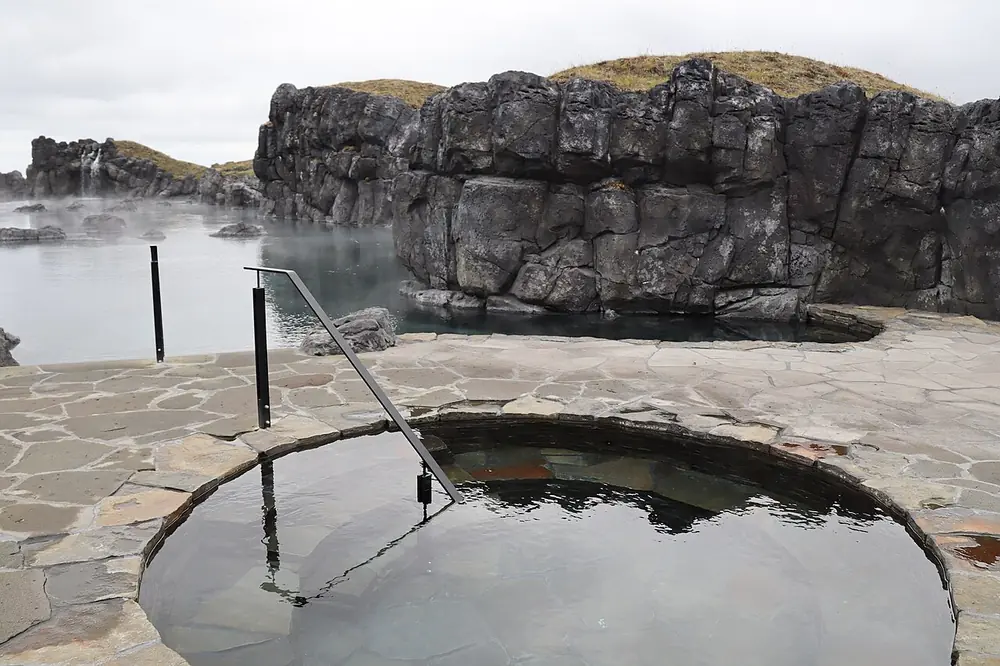
Sky Lagoon's cold plunge — the bracing half of the seven-step Skjól ritual. Photo: CC BY-SA 4.0, via Wikimedia Commons.
Afternoon: the farewell soak
Time the return to reach Sky Lagoon (10 minutes from downtown Reykjavik) by late afternoon. The Saman entry (~$125/person) includes the seven-step Skjól ritual: lagoon, cold plunge, sauna, cold mist, body scrub, steam, shower — a slow, shared wind-down that feels designed for the last day of a trip. The infinity edge faces the ocean; in winter the steam hangs over the water and the sun sets straight ahead.
Diamond Beach at dawn: go before the tour buses — worth the early alarm
Sky Lagoon Saman: ~$125/person, includes the 7-step Skjól ritual
Return the 4x4 with a full tank — fill up before Keflavik
Evening: one last look up
Farewell dinner back in the city — book somewhere you couldn't get into on Day 1. Then the closing ritual: one final check of en.vedur.is, one final drive to Grótta if the sky cooperates. Five nights, five chances. Whatever the sky did or didn't do, you end the trip the way you started it: two people, hot thermos, looking up.
Where to stay
Last night back at your Reykjavik base — the Canopy by Hilton or Fosshotel Barón. If you're flying out early tomorrow, the Aurora Hotel at Keflavik airport removes the dawn-drive stress. Either way: pack tonight, aurora-hunt first, sleep second.
Bad-weather plan
Storm on the return leg? Build in the buffer: leave the lagoon by 9 a.m. and skip the waterfall re-stops. The Sky Lagoon slot is the one reservation that matters today — everything else flexes around it.
Tonight's sky
Last chance saloon. en.vedur.is one more time, Grótta one more time. The trip doesn't need the aurora to have been worth it — but it would be a fine way to say goodnight.
Drive: Jökulsárlón → Reykjavik ~380 km · Sky Lagoon Saman ~$125/person (7-step ritual) · Leave the lagoon by 9 AM in bad weather
Farewell rule: Book the Sky Lagoon for the afternoon, not the morning — you want the return drive done and the rental return sorted before you sink into 38°C water. Nothing ruins a ritual like watching the clock.
Why this guide exists
Who is Earth Adventure Travel?
We're a small team that maps the trips we'd take ourselves — day by day, with the prices, the parking fees, and the "check this before you go" links included. We don't run tours; we publish the plan we'd hand a friend. If this route earns a place in your camera roll, that's the whole business model.
Book the lagoons early. Pack for wind, not just cold.
These are planning ranges, not quotes. Winter prices are kinder than summer's, but lagoon slots and ice cave tours sell out — book the timed entries first, then the hotels. Hours and prices should be checked again before departure.
Which lagoon, when
Lagoon
Price
The deal
Book ahead?
Blue Lagoon
~$95/person (Comfort)
The icon — milky-blue water, silica mask, swim-up bar. Do it on arrival day.
The quiet one — Iceland's oldest pool (1891), 38–40°C, tiny geyser next door. Golden Circle day.
Usually walk-in
Prices converted from ISK at ~122 per $1 (October 2026). All three require the naked-with-soap shower first — it's the law of the lagoon.
What earns space
Insulated, windproof parka — rated to -20°C; wind is the real enemy, not the thermometer
Merino wool base layers — top and bottom; cotton kills in Icelandic wind
Waterproof hiking boots + ice grips — waterfall paths ice over by afternoon
Swimsuit — yes, in winter; you'll live in lagoons
Tripod — aurora photos need 10–25 second exposures; handheld won't cut it
Power bank — cold drains phone batteries fast; keep it in an inside pocket
Wool hat, insulated gloves, buff — the waterfall-mist-and-wind trio
Sunglasses — low winter sun on snow and ice is blinding
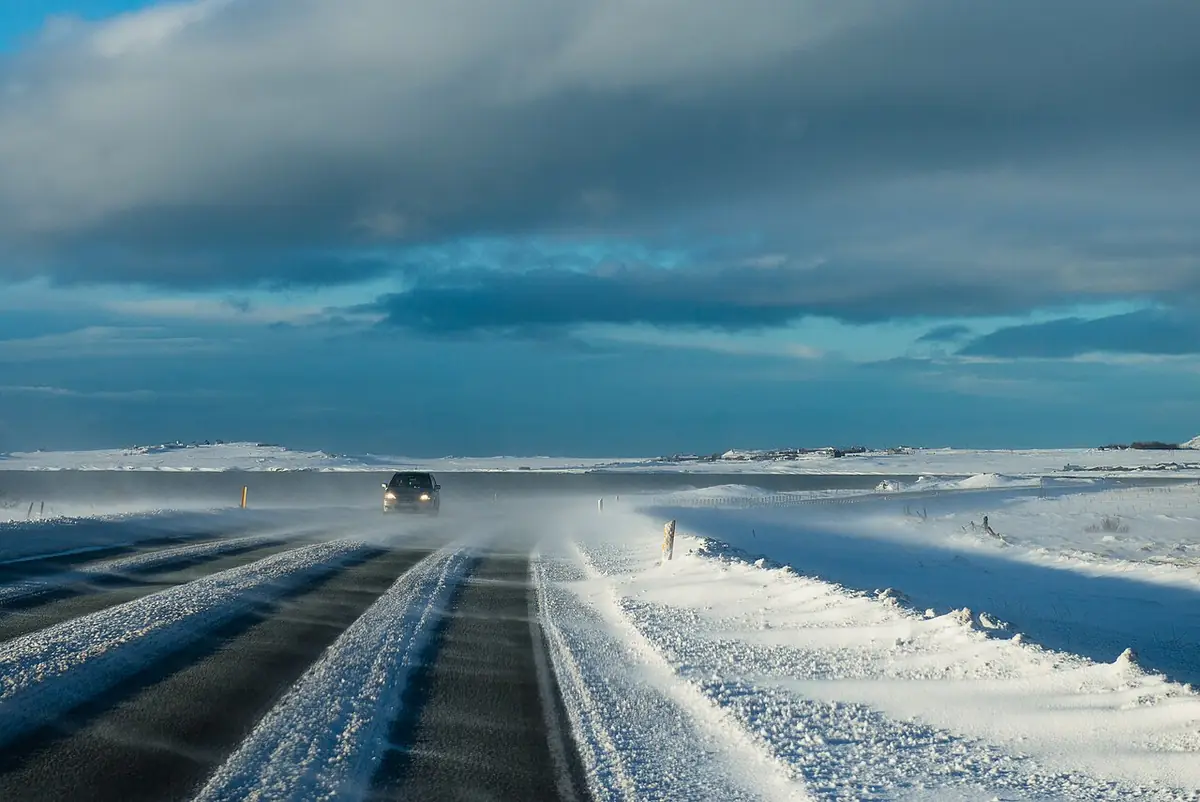
Pack for Reynisfjara wind — the basalt columns are beautiful and the gusts are serious. Photo: CC BY-SA 4.0, via Wikimedia Commons.Winter roads demand respect — check road.is every morning before driving. Photo: CC BY 2.0, via Wikimedia Commons.
Read the sky
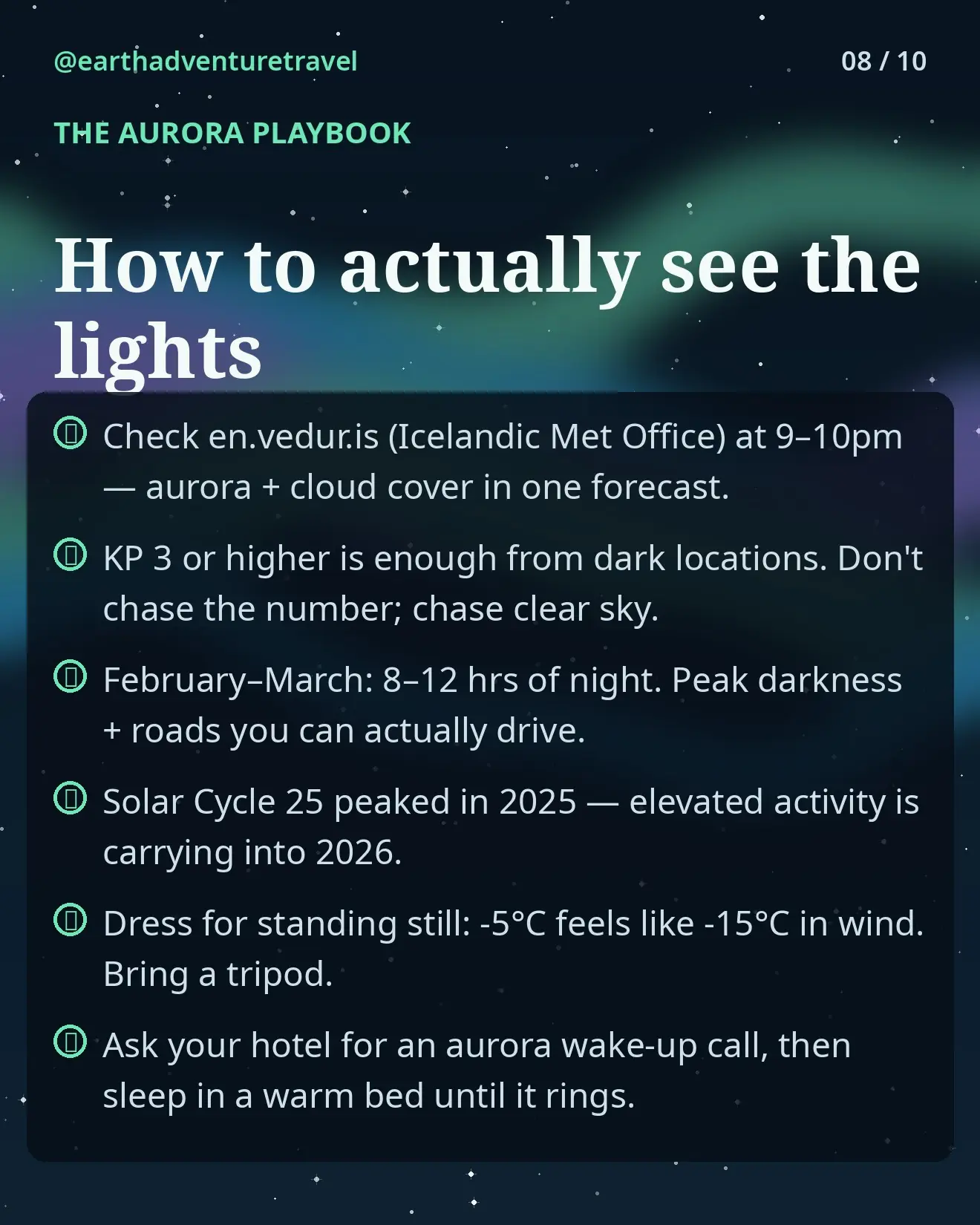
The aurora needs two things: solar activity and clear skies. en.vedur.is (the Icelandic Met Office) publishes both — an aurora forecast and a cloud-cover map. Check around 9–10 p.m. each night: KP 3+ with a cloud gap means drive 15 minutes out of town and look up. Solar Cycle 25 peaked in 2025, so activity stays elevated into 2026 — the odds are on your side.
Drive like winter means it
road.is every morning, safetravel.is for your travel plan, 112 for emergencies. Winter tires are mandatory November 1–April 15 (minimum 3mm tread; studded advised). Do your driving in daylight, keep the tank above half on the South Coast, and if the road signs say closed — they're closed.
Saveable aurora guide · how to read the forecast and where to standSaveable packing graphic · what earns space in a winter bag for twoAurora watch — dark sky, hot thermos, patience. This is the whole trip in one frame. Photo: CC BY-SA 4.0, via Wikimedia Commons.Thingvellir in February — walking between two continents, frost on the lava fields. Photo: CC BY 4.0, via Wikimedia Commons.Skogafoss in winter — 60 meters of thunder with ice for a frame. Photo: CC BY 2.0, via Wikimedia Commons.
Quick answers
Planning notes
When is the best time to see the northern lights in Iceland?
Aurora season runs September through April, with November to March the peak. February and March are the sweet spot for couples: still-dark nights for aurora hunting plus 8–12 hours of daylight for sightseeing. Solar Cycle 25 peaked in 2025, so activity stays elevated into 2026.
How likely are we to actually see the aurora in five days?
Never guaranteed — you need solar activity plus clear skies. But five February nights give you five rolls of the dice, and a KP index of 3 or higher is visible from dark sites outside town. Check en.vedur.is around 9–10 p.m. each night and be ready to drive 15 minutes out of the city.
Is driving in Iceland in winter safe for two people?
Yes, with respect for the conditions. Rent a 4x4, check road.is every morning, register your plans at safetravel.is, and do your driving in daylight. Route 1 is well maintained, and the Golden Circle and South Coast are the most-travelled winter roads in the country.
Do we need a 4x4, or will a regular car do?
Book the 4x4. Winter tires are mandatory from November 1 to April 15 with at least 3mm of tread, and studded tires are advised. A 4x4 gives you clearance and stability on snowy stretches of the South Coast, and most rental companies bundle winter tires in the cold months.
Blue Lagoon vs Sky Lagoon — which should we pick?
Blue Lagoon (Comfort entry ~$95/person) is the icon — milky-blue water, silica masks, book well ahead. Sky Lagoon (Saman ~$125/person) is the connoisseur pick near Reykjavik with its seven-step Skjól ritual. Do one big lagoon and add the Secret Lagoon (~$37) on the Golden Circle for the quiet local contrast.
What is the etiquette at Icelandic hot springs?
Shower naked with soap before entering — it is mandatory, not optional, and attendants do check. Rinse thoroughly, tie up long hair, and keep voices low. Iceland added its pool culture to UNESCO's Intangible Heritage list in December 2025, so treat every lagoon like the cultural treasure it is.
How cold does Iceland get in winter, really?
Milder than the latitude suggests: Reykjavik winters hover around 0–4°C (32–39°F) thanks to the Gulf Stream. Wind is the real factor — a calm -2°C day feels pleasant, a windy one bites. Pack a windproof shell, merino base layers, and a buff; you will be comfortable.
How much daylight will we have?
In February, Reykjavik gets roughly 8–10 hours (sunrise near 9:20 a.m., sunset near 6 p.m. mid-month). By March it stretches to 10.5–12 hours. Plan waterfall stops for the bright middle of the day and keep aurora hunting for after 9 p.m.
Is Reynisfjara black beach dangerous?
It can be. Sneaker waves surge far up the beach without warning, so never turn your back on the surf, keep well back from the waterline, and stay off the rocks near the waves. Admire the basalt columns and sea stacks from a respectful distance — the photos are just as good.
What does a five-day Iceland winter trip cost for two?
Budget roughly $3,800–$5,200 for two adults, excluding flights: $900–$1,500 for four nights of lodging, $700–$1,100 for a 4x4 rental plus fuel, $800–$1,200 for food, and $500–$800 for lagoons, tours, and parking. Converted from ISK at about 122 per $1 (October 2026).
Can we visit the glacier lagoon and an ice cave in winter?
Yes — winter is the season for both. Jökulsárlón glacier lagoon is spectacular year-round, and natural blue ice caves (like Katla, from Vík, ~$180/person for a 3-hour tour) only exist in winter. Book ice cave tours ahead; they run only when conditions are safe.
What if the aurora never shows?
Then you still had five days of waterfalls, black beaches, glacier lagoons, and geothermal soaks — that is the point of this route. Every day is built to win on its own. And many couples report the trip that "failed" on aurora became the trip they talk about most.
Last look
Check the sky. Check the road. Book the soak.
Aurora forecasten.vedur.is · check 9–10 p.m. · KP 3+ from dark sites
Road conditionsroad.is every morning · safetravel.is for your plan
Winter tiresMandatory Nov 1–Apr 15 · 3mm tread minimum
Blue LagoonTimed entry ~$95/person · reserve weeks ahead
Emergency112 · works even without cell signal
Golden Circle passProposed for May 2027 — not in effect; no fee now
Details checked October 5, 2026. Conditions and prices can change — recheck the official links before departure. Photo credits: see assets/photo-credits.json.
The trip index
Choose the landscape. Then choose the pace.
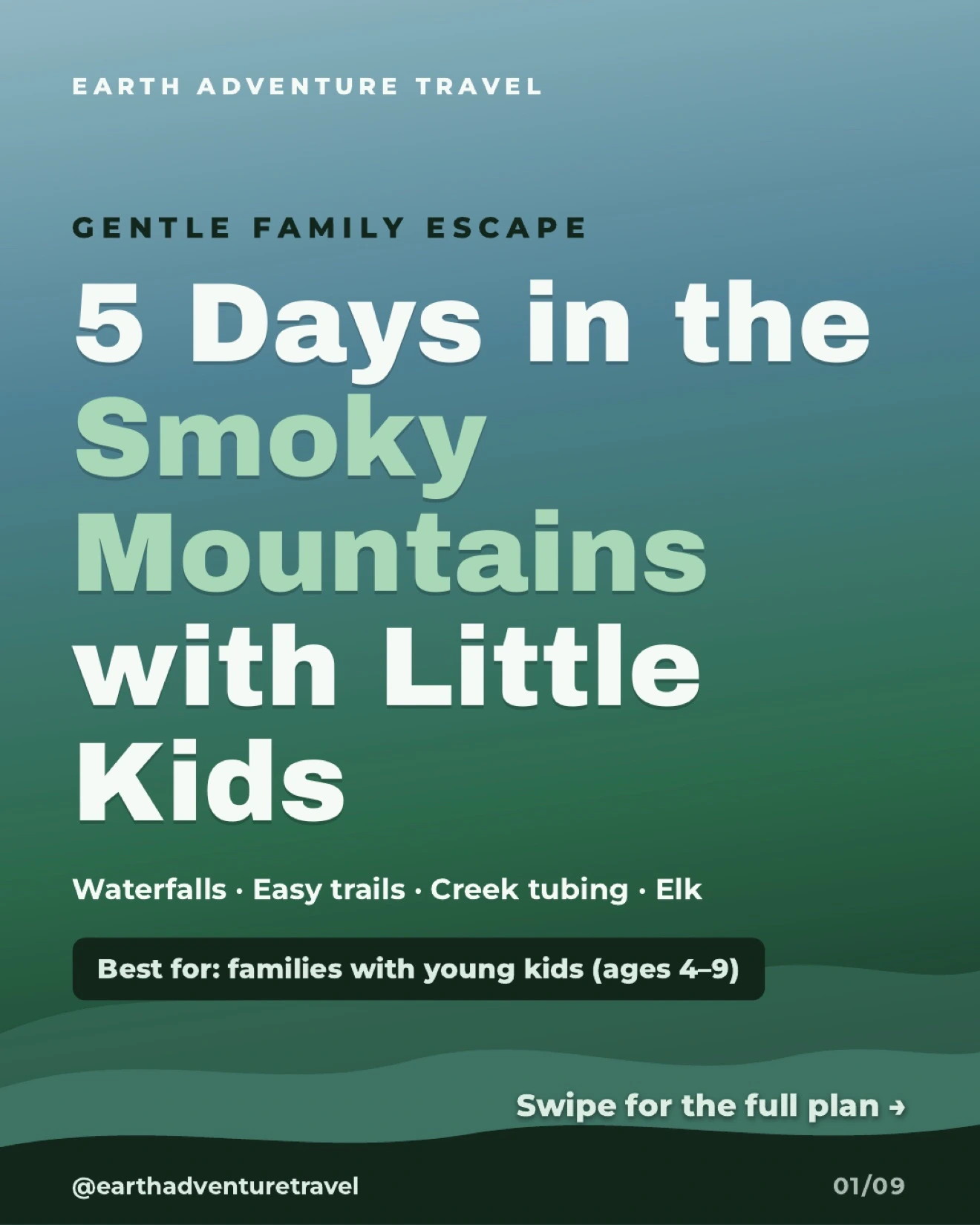
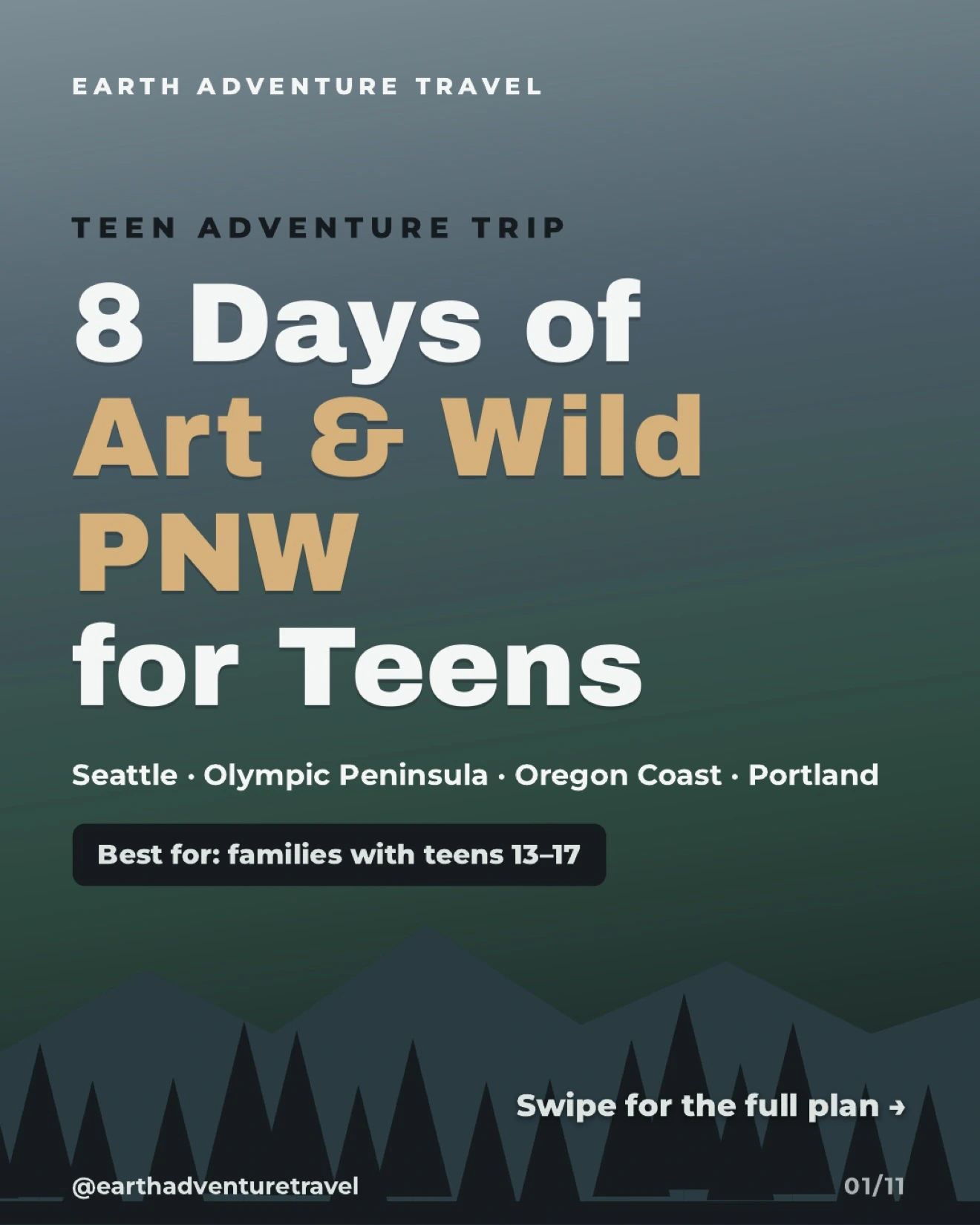
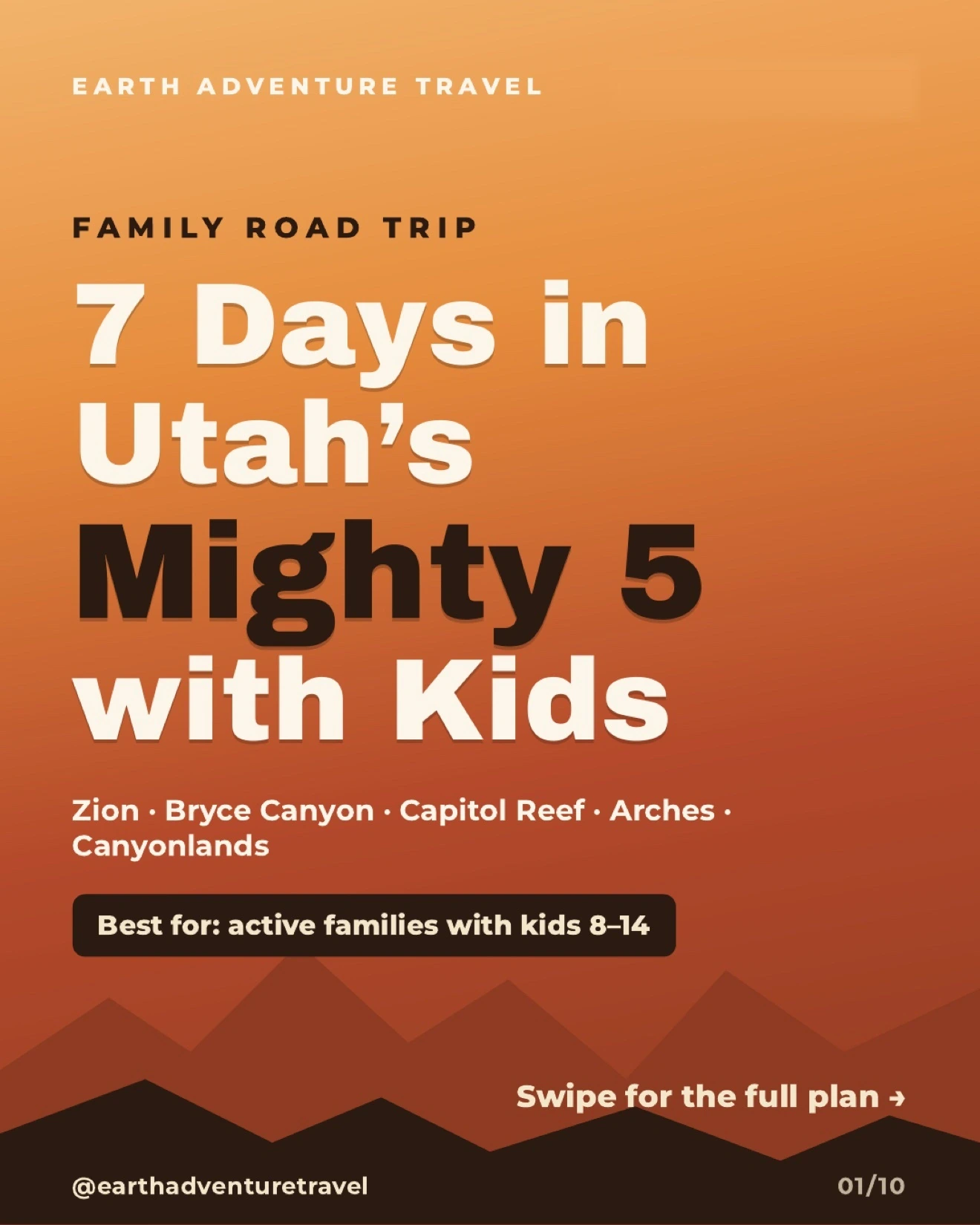
Every itinerary gives you a realistic route, daily rhythm, planning notes, and the details that make a family trip work.
↑
Use the filters above to see the routes that match.
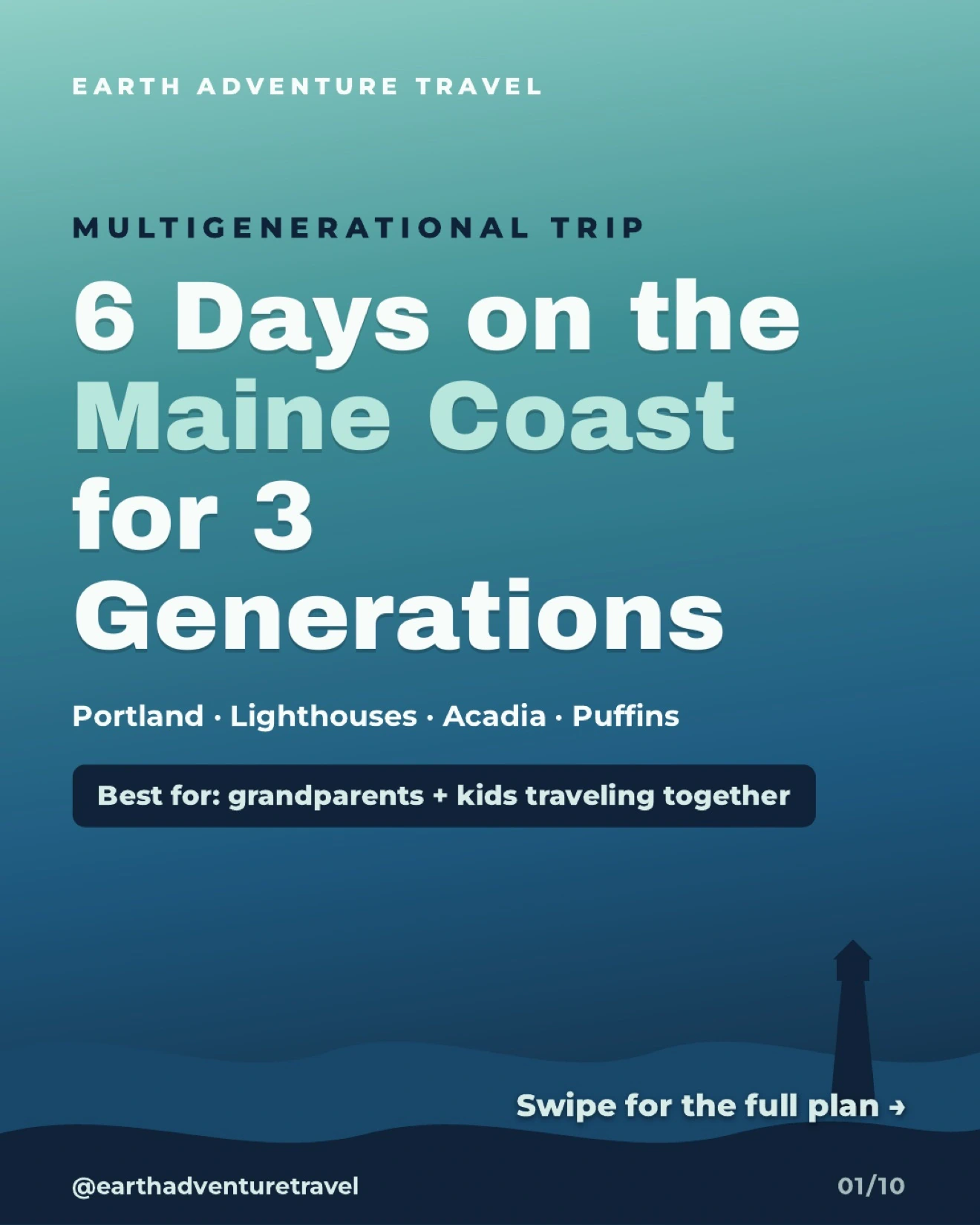
Featured route · New York
Niagara Falls to the Finger Lakes
Big-water drama first, then gorge walks, glassmaking, and lake-country calm—a five-day route designed for grandparents, parents, and kids traveling together.